
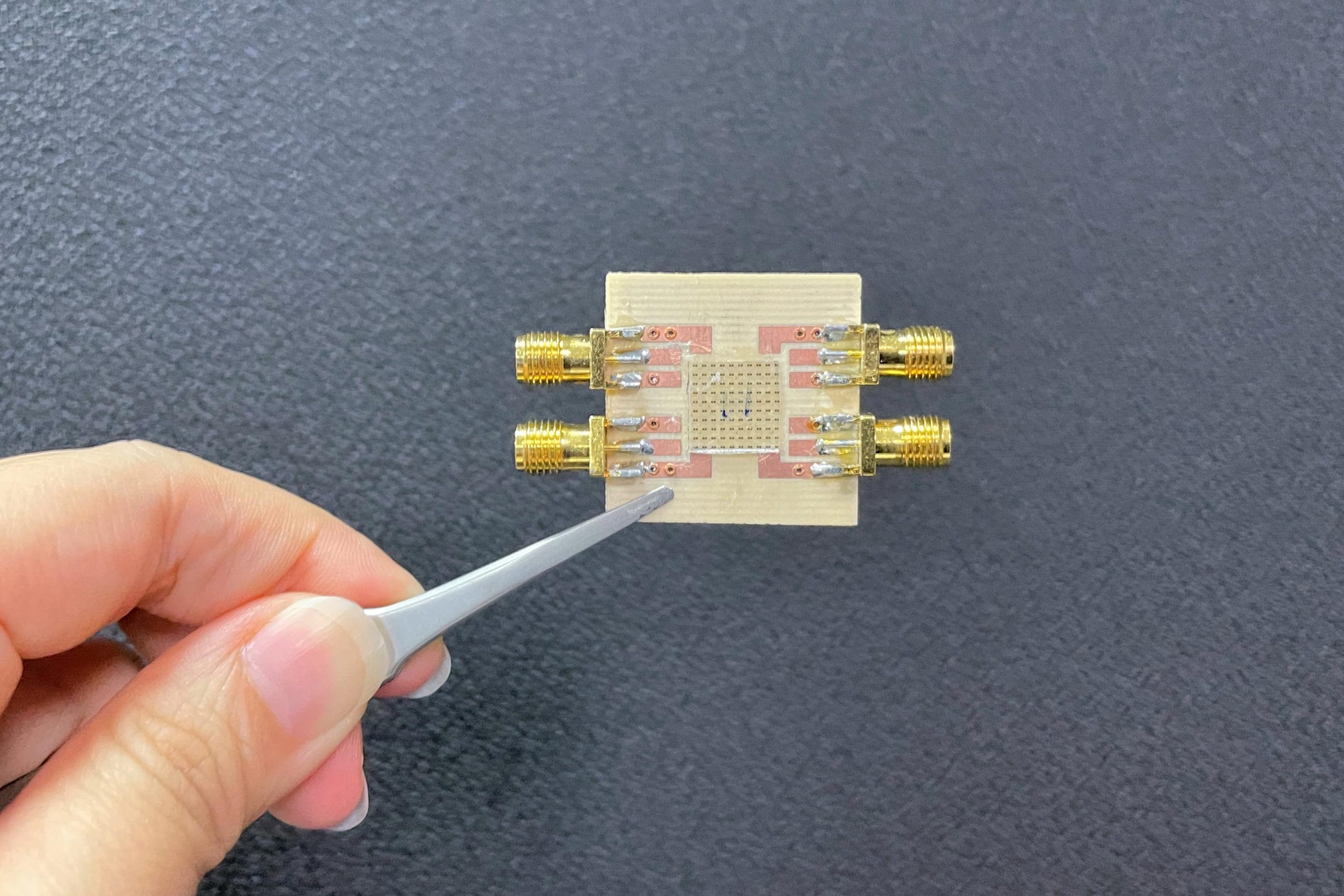
Researchers have devised a method, using spin-torque oscillators, to harness wireless signals and convert them into energy to power small electronics.
With the rise of the digital age, the amount of WiFi sources to transmit information wirelessly between devices has grown exponentially. This results in the widespread use of the 2.4GHz radio frequency that WiFi uses, with excess signals available to be tapped for alternative uses.
To harness this under-utilized source of energy, a research team from the National University of Singapore (NUS) and Japan’s Tohoku University (TU) has developed a technology that uses tiny smart devices known as spin-torque oscillators (STOs) to harvest and convert wireless radio frequencies into energy to power small electronics. In their study, the researchers had successfully harvested energy using WiFi-band signals to power a light-emitting diode (LED) wirelessly, and without using any battery.
“We are surrounded by WiFi signals, but when we are not using them to access the Internet, they are inactive, and this is a huge waste. Our latest result is a step towards turning readily-available 2.4GHz radio waves into a green source of energy, hence reducing the need for batteries to power electronics that we use regularly. In this way, small electric gadgets and sensors can be powered wirelessly by using radio frequency waves as part of the Internet of Things. With the advent of smart homes and cities, our work could give rise to energy-efficient applications in communication, computing, and neuromorphic systems,” said Professor Yang Hyunsoo from the NUS Department of Electrical and Computer Engineering, who spearheaded the project.
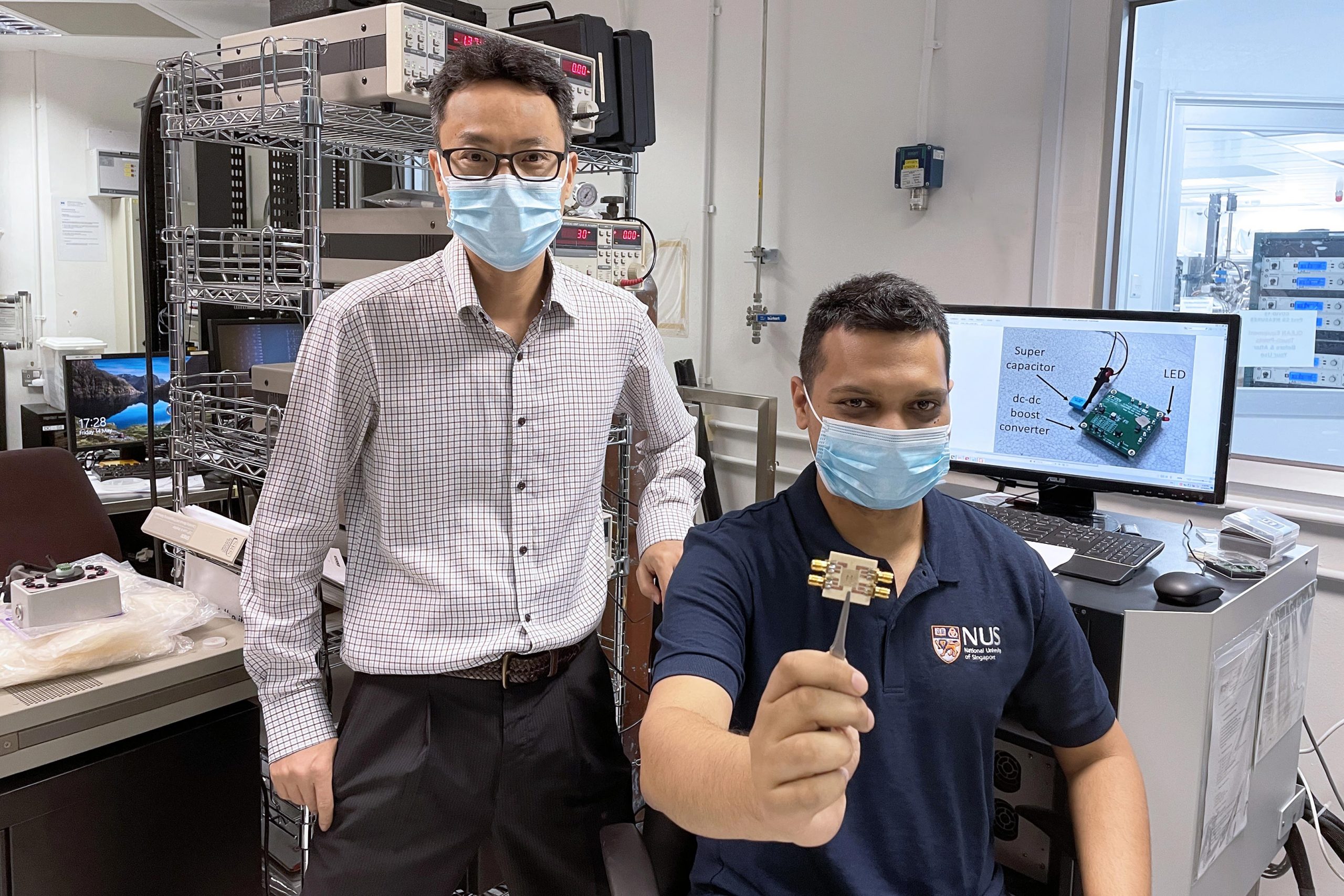
The research was carried out in collaboration with the research team of Professor Guo Yong Xin, who is also from the NUS Department of Electrical and Computer Engineering, as well as Professor Shunsuke Fukami and his team from TU. The results were published in Nature Communications on May 18, 2021.
Converting WiFi Signals Into Usable Energy
Spin-torque oscillators are a class of emerging devices that generate microwaves, and have applications in wireless communication systems. However, the application of STOs is hindered due to a low output power and broad linewidth.
While mutual synchronization of multiple STOs is a way to overcome this problem, current schemes, such as short-range magnetic coupling between multiple STOs, have spatial restrictions. On the other hand, long-range electrical synchronization using vortex oscillators is limited in frequency responses of only a few hundred MHz. It also requires dedicated current sources for the individual STOs, which can complicate the overall on-chip implementation.
To overcome the spatial and low frequency limitations, the research team came up with an array in which eight STOs are connected in series. Using this array, the 2.4 GHz electromagnetic radio waves that WiFi uses was converted into a direct voltage signal, which was then transmitted to a capacitor to light up a 1.6-volt LED. When the capacitor was charged for five seconds, it was able to light up the same LED for one minute after the wireless power was switched off.
In their study, the researchers also highlighted the importance of electrical topology for designing on-chip STO systems, and compared the series design with the parallel one. They found that the parallel configuration is more useful for wireless transmission due to better time-domain stability, spectral noise behavior, and control over impedance mismatch. On the other hand, series connections have an advantage for energy harvesting due to the additive effect of the diode-voltage from STOs.
Commenting on the significance of their results, Dr. Raghav Sharma, the first author of the paper, shared, “Aside from coming up with an STO array for wireless transmission and energy harvesting, our work also demonstrated control over the synchronizing state of coupled STOs using injection locking from an external radio-frequency source. These results are important for prospective applications of synchronized STOs, such as fast-speed neuromorphic computing.”
Next Steps
To enhance the energy harvesting ability of their technology, the researchers are looking to increase the number of STOs in the array they had designed. In addition, they are planning to test their energy harvesters for wirelessly charging other useful electronic devices and sensors.
The research team also hopes to work with industry partners to explore the development of on-chip STOs for self-sustained smart systems, which can open up possibilities for wireless charging and wireless signal detection systems.
Reference: “Electrically connected spin-torque oscillators array for 2.4 GHz WiFi band transmission and energy harvesting” by Raghav Sharma, Rahul Mishra, Tung Ngo, Yong-Xin Guo, Shunsuke Fukami, Hideo Sato, Hideo Ohno and Hyunsoo Yang, 18 May 2021, Nature Communications.
DOI: 10.1038/s41467-021-23181-1
Never miss a breakthrough: Join the SciTechDaily newsletter.
Follow us on Google and Google News.
1 Comment
Are there any electromechanical similarities between spin-torque oscillators and DNA?