
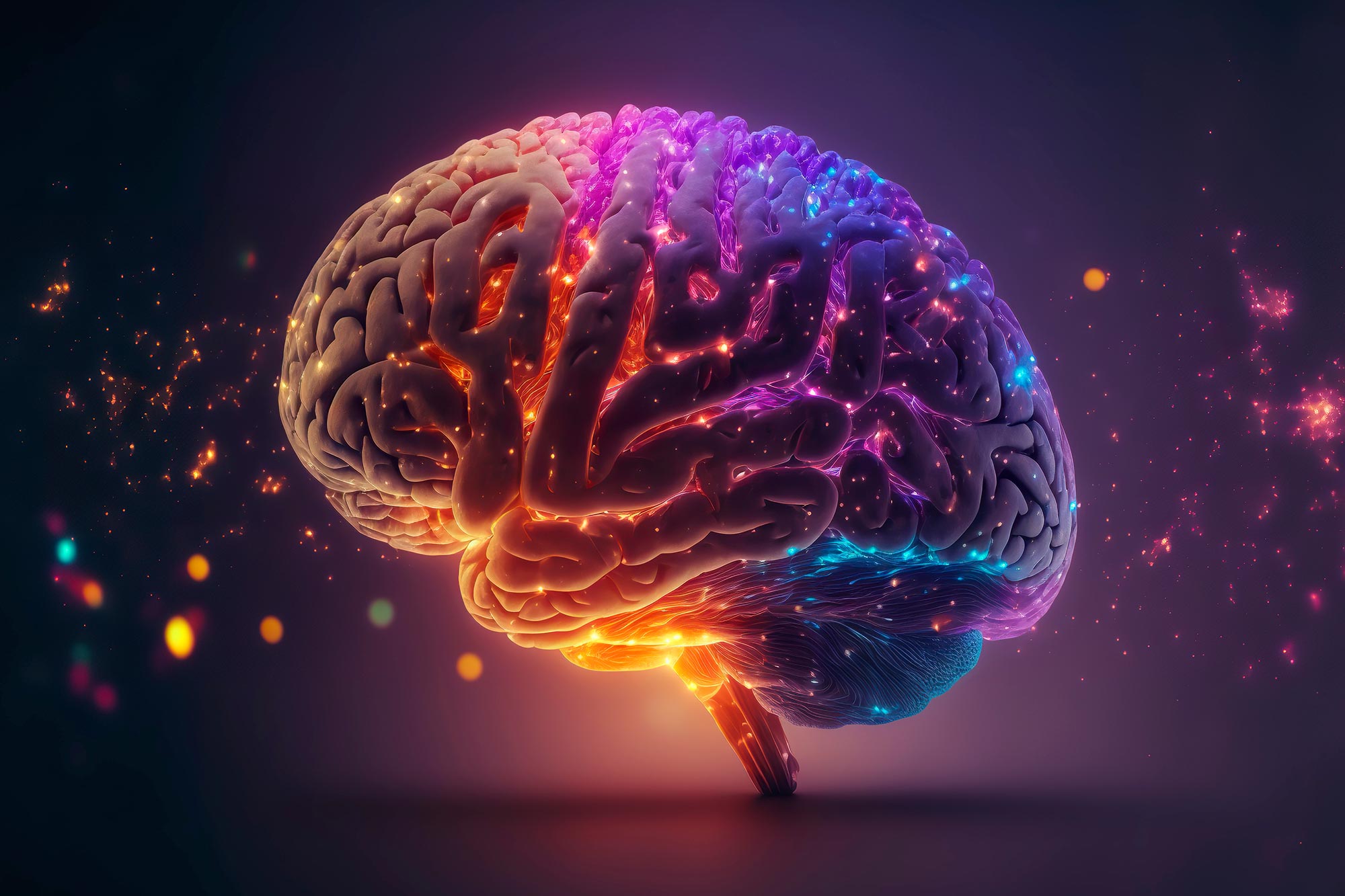
What makes us human? According to neurobiologists, it is our neocortex. This outer layer of the brain is rich in neurons and lets us do abstract thinking, create art, and speak complex languages. An international team led by Dr. Mareike Albert at the Center for Regenerative Therapies Dresden (CRTD) of TUD Dresden University of Technology has identified a new factor that might have contributed to neocortex expansion in humans. The results were published in the EMBO Journal.
The neocortex is the characteristic folded outer layer of the brain that resembles a walnut. It is responsible for higher cognitive functions such as abstract thinking, art, and language. “The neocortex is the most recently evolved part of the brain,” says Dr. Mareike Albert, research group leader at the CRTD. “All mammals have a neocortex, but it varies in size and complexity. Human and primate neocortices have folds while, for example, mice have a completely smooth neocortex, without any creases.”
The folds characteristic of the human brain increase the surface area of the neocortex. The human neocortex has a greater number of neurons that support complex cognitive functions.
The molecular mechanisms driving neocortex evolution are still largely unknown. “Which genes are responsible for inter-species differences in neocortex size? What factors have contributed to brain expansion in humans? Answering these questions is crucial to understanding human brain development and potentially addressing mental health disorders,” explains Dr. Albert.
The Power of Brain Organoids
To search for factors influencing brain expansion, the Albert group compared the developing brains of mice and humans. “Stem cells in mice don’t divide as much and don’t produce as many neurons compared to primates. Humans, on the other hand, have a large number of stem cells in the developing brain. This highly expanded pool of stem cells underlies the increase in the number of neurons and brain size,” explains Dr. Albert.
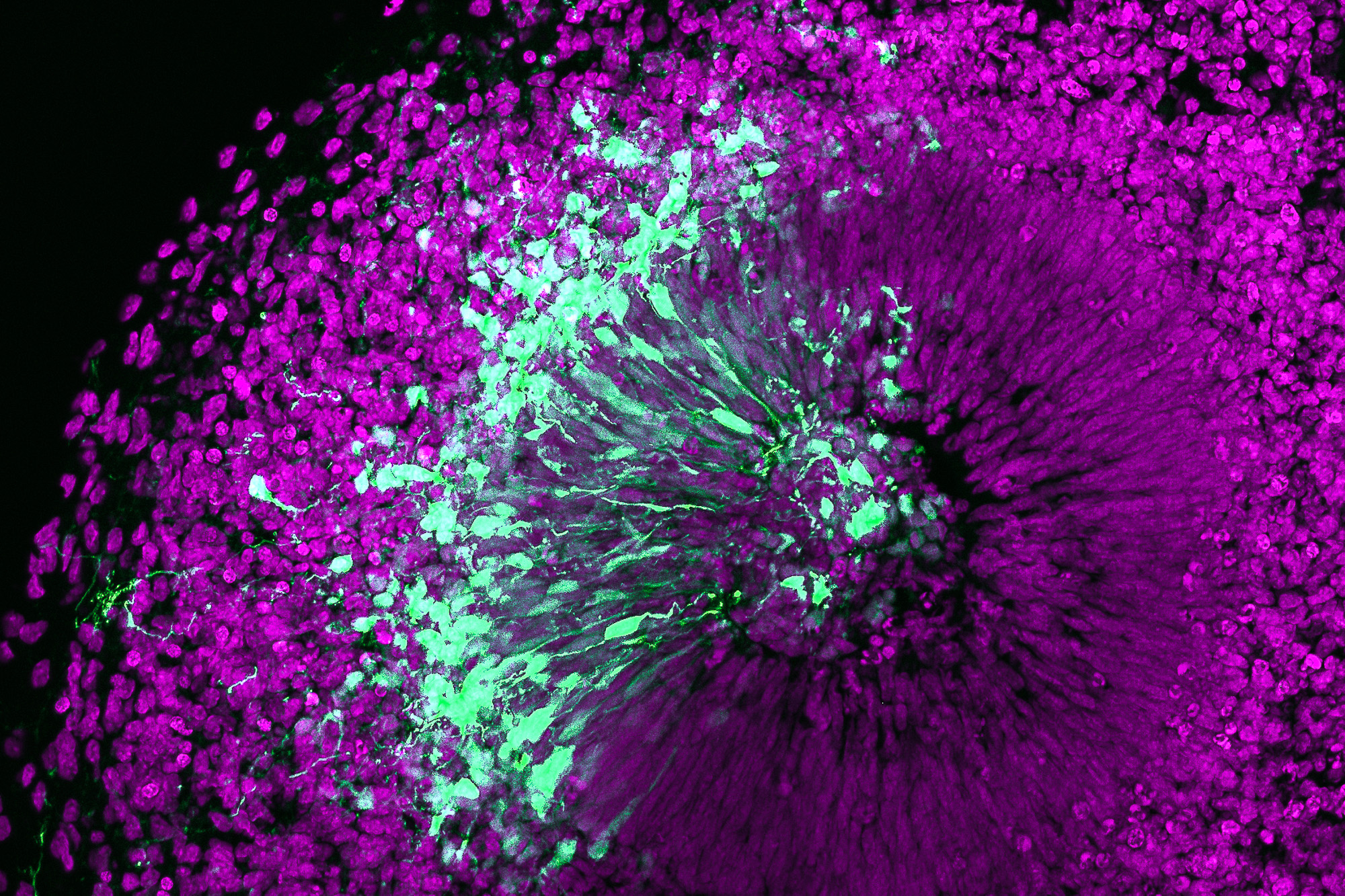
The team found a factor that is present in humans but not in mice. Using 3D cell culture technology, the group tested if the newly identified factor could influence the expansion of the neocortex. “Thanks to the research awarded with the Nobel prize in 2012, it is possible to turn any cell into a stem cell. Such a stem cell can then be transformed into a three-dimensional tissue that resembles an organ, e.g., a brain. Human stem cells make it possible to study development and diseases directly in human tissues,” explains Dr. Albert.
These 3D brain cultures, or brain organoids, may not resemble brains to an untrained eye, but they mimic the cellular complexity of developing brains. “Most of the cell types of the developing brain are present. They interact, signal, and are similarly arranged as in an actual human brain,” says Dr. Albert.
Using 3D brain organoids, the group was able to show that a growth factor, known as epiregulin, indeed promotes the division and expansion of stem cells in the developing brain.
All About the Amount
“Knowing that epiregulin drives expansion of human neocortical stem cells, we looked back at the gene that codes for epiregulin and tried to trace it through the evolutionary tree,” says study lead author Paula Cubillos, a doctoral candidate at the CRTD. The gene is not unique to humans, but also present in other primates and even in mice. “Epiregulin is not produced in the developing mouse brain, however, because the gene is permanently shut off and not being used. We were intrigued to understand whether there are any differences in how epiregulin works in humans and other primates,” explains Paula Cubillos.
The researchers turned again to the 3D culture technology. Using gorilla stem cells, the researchers generated gorilla brain organoids. “Gorillas are endangered species. We know very little about their brain development. Organoids made from stem cells offer a way to study their brain development without interacting with the species at all,” says Dr. Albert.
Comparing the effect of epiregulin in human and gorilla brain organoids, the team found that adding epiregulin to gorilla brain organoids can further promote the expansion of stem cells. However, adding even more epiregulin to human brain organoids did not have the same effect. This might be because the human neocortex has already expanded to a very large extent.
“Unlike previously identified factors, epiregulin as such seems not to be unique to humans. Instead, the amount of the growth factor seems to be the crucial regulator for the inter-species differences,” concludes Dr. Albert.
This study not only advances our understanding of human uniqueness but also highlights the importance of new technologies that offer ethical and non-invasive complements to animal research.
Reference: “The growth factor EPIREGULIN promotes basal progenitor cell proliferation in the developing neocortex” by Paula Cubillos, Nora Ditzer, Annika Kolodziejczyk, Gustav Schwenk, Janine Hoffmann, Theresa M Schütze, Razvan P Derihaci, Cahit Birdir, Johannes EM Köllner, Andreas Petzold, Mihail Sarov, Ulrich Martin, Katherine R Long, Pauline Wimberger and Mareike Albert, 21 March 2024, The EMBO Journal.
DOI: 10.1038/s44318-024-00068-7
The study was performed in collaboration with King’s College London, the Medical Faculty Carl Gustav Carus of TU Dresden, the Max Planck Institute of Molecular Cell Biology and Genetics, and Hannover Medical School.
Never miss a breakthrough: Join the SciTechDaily newsletter.
Follow us on Google and Google News.