
Close Menu
    Facebook X (Twitter) Instagram
    SciTechDaily
    • Biology
    • Chemistry
    • Earth
    • Health
    • Physics
    • Science
    • Space
    • Technology
    Facebook X (Twitter) Pinterest YouTube RSS
    SciTechDaily
    Home»Space»Euclid’s Final Earthly Sighting: Dark Universe Explorer Prepares for Launch
    Space

    Euclid’s Final Earthly Sighting: Dark Universe Explorer Prepares for Launch

    By European Space Agency (ESA)June 29, 20231 Comment2 Mins Read
    Facebook Twitter Pinterest Telegram LinkedIn WhatsApp Email Reddit
    Share
    Facebook Twitter LinkedIn Pinterest Telegram Email Reddit
    Last Glimpse of Euclid on Earth
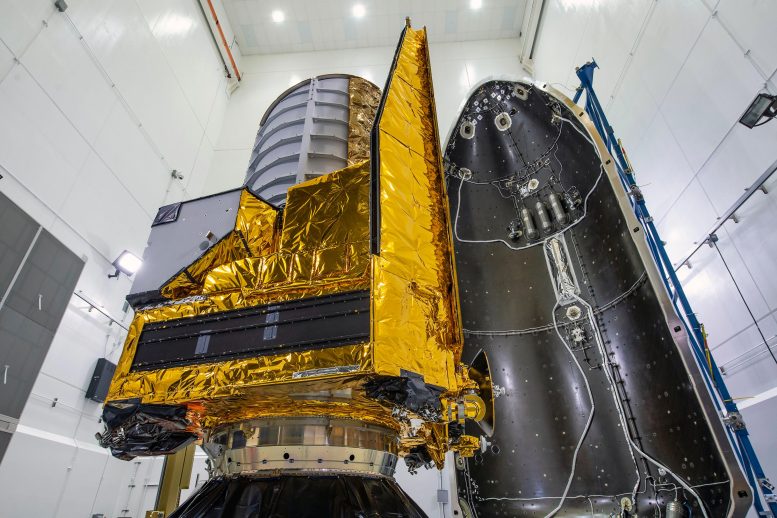
    On June 27, the final sighting of ESA’s Euclid space telescope was captured as it was ensconced by a SpaceX Falcon 9 fairing, signifying that the rocket’s nose was fitted over the spacecraft. Preparing for its scheduled launch on July 1, 2023, from Cape Canaveral, Florida, Euclid will be shielded by the Falcon 9 fairing to prevent degradation from Earth’s atmosphere. Credit: SpaceX

    ESA’s Euclid space telescope, encased in a SpaceX Falcon 9 fairing for protection, is set for launch on July 1, 2023, from Cape Canaveral, Florida. The mission aims to illuminate the mysteries of dark matter and dark energy by creating a precise 3D map of the Universe.

    On June 27, this last glimpse of the European Space Agency’s Euclid space telescope was caught right before it was encapsulated by a SpaceX Falcon 9 fairing, meaning that the nose of the rocket was installed over the spacecraft.

    Euclid is 4.7-m (15.4 feet) tall and 3.7-m (12.1 feet) in diameter, fitting nicely in the Falcon 9 fairing with a height of 13.1-m (43.0 feet) and a width of 5.2-m (17.0 feet).

    The Euclid satellite is getting ready for the target launch date of July 1, 2023, from Cape Canaveral in Florida, USA.  The Falcon 9 fairing will keep Euclid safe and clean during the last days before lift-off and it will protect the spacecraft against Earth’s atmosphere during launch. Euclid’s telescope and instruments are extremely sensitive and must be kept very clean. To protect them from degradation during launch a special request was made for a brand-new fairing.

    ESA’s Euclid mission is designed to explore the dark Universe and uncover the great cosmic mystery of dark matter and dark energy. The space telescope will create the largest, most accurate 3D map of the Universe across space and time by observing billions of galaxies out to 10 billion light-years, across more than a third of the sky. This wealth of new data will chart how matter is distributed across immense distances and how the Universe has expanded, revealing more about the role of gravity and the nature of dark energy and dark matter.

    Never miss a breakthrough: Join the SciTechDaily newsletter.
    Follow us on Google and Google News.

    Euclid Mission European Space Agency SpaceX
    Share. Facebook Twitter Pinterest LinkedIn Email Reddit

    Related Articles

    Unveiling Cosmic Mysteries: Euclid Launches on Epic Voyage To Map the Universe’s Dark Side

    Euclid “Dark Universe” Space Telescope Lifts Off on Quest To Unravel Deepest Cosmic Mysteries

    How To Watch the Euclid “Dark Universe Explorer” Launch Live

    NASA, ESA Assign Astronauts to Space Station Mission on SpaceX Crew Dragon

    SpaceX Dragon Fire

    Astronauts Chosen for NASA SpaceX Crew-3 Mission to Space Station

    Alpha Mission: First ESA Astronaut to Ride a Dragon to Space

    Visualizing Dark Matter With the Biggest Astronomy Collaboration Ever

    Module for ESA’s Euclid ‘Dark Universe’ Mission in Development

    1 Comment

    1. Albert on June 29, 2023 4:25 pm

      Given Dark Energy and Dark Matter don’t exist, this is a COLOSSAL waste of money.

      Reply
    Leave A Reply Cancel Reply

    • Facebook
    • Twitter
    • Pinterest
    • YouTube

    Don't Miss a Discovery

    Subscribe for the Latest in Science & Tech!

    Trending News

    This Experimental Drug Repaired the Gut and Reversed Severe Fatty Liver Disease

    Physicists Just Turned a Black Hole Energy Theory Into Reality

    Stanford Scientists Solve a 252-Million-Year-Old Mass Extinction Mystery

    The Ancient Survival Mechanism Making Weight Loss So Difficult

    Just 3,000 Steps a Day May Help Protect the Brain From Alzheimer’s

    “Weird Clams” Reveal a New Invasion Along the U.S. Northeast Coast

    Archaeologists Decapitated Tutankhamun and Glued His Body Back Together

    New Black Hole Theory Solves a 50-Year-Old Problem

    Follow SciTechDaily
    • Facebook
    • Twitter
    • YouTube
    • Pinterest
    • Newsletter
    • RSS
    SciTech News
    • Biology News
    • Chemistry News
    • Earth News
    • Health News
    • Physics News
    • Science News
    • Space News
    • Technology News
    Recent Posts
    • The Oldest Known Right-Handed Animal May Have Lived 550 Million Years Ago
    • MIT’s Tiny Flying Robot Just Learned To Move Like a Real Insect
    • Why Are Bees Struggling To Survive This Summer?
    • Antarctic Meltwater Is Making Glaciers Slide Faster Toward the Ocean
    • Ancient Dog Skulls Rewrite the Story of Canine Evolution
    Copyright © 1998 - 2026 SciTechDaily. All Rights Reserved.
    • Science News
    • About
    • Contact
    • Editorial Board
    • Privacy Policy
    • Terms of Use

    Type above and press Enter to search. Press Esc to cancel.