
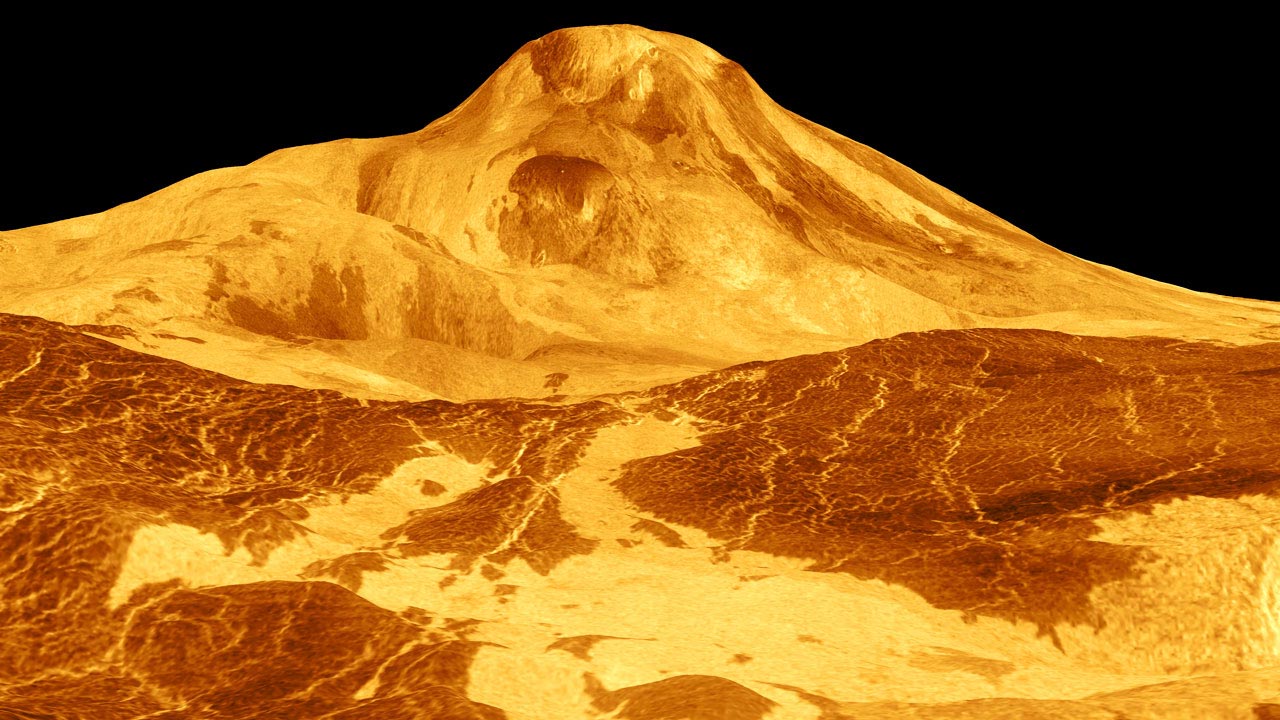
Venus’ phosphine likely signals volcanic eruptions—not alien life.
Traces of the gas phosphine point to volcanic activity on Venus, according to new research from Cornell University.
Last autumn, scientists revealed that phosphine was found in trace amounts in the planet’s upper atmosphere. That discovery promised the slim possibility that phosphine serves as a biological signature for the hot, toxic planet.
Now Cornell scientists say the chemical fingerprint supports a different and important scientific find: a geological signature, showing evidence of explosive volcanoes on the mysterious planet.
“The phosphine is not telling us about the biology of Venus,” said Jonathan Lunine, professor of physical sciences and chair of the astronomy department at Cornell. “It’s telling us about the geology. Science is pointing to a planet that has active explosive volcanism today or in the very recent past.”
A New Study Points to Volcanic Origins
Lunine and Ngoc Truong, a doctoral candidate in geology, authored the study, “Volcanically Extruded Phosphides as an Abiotic Source of Venusian Phosphine,” published today (July 12, 2021) in the Proceedings of the National Academy of Sciences.
Truong and Lunine argue that volcanism is the means for phosphine to get into Venus’ upper atmosphere, after examining observations from the ground-based, submillimeter-wavelength James Clerk Maxwell Telescope atop Mauna Kea in Hawaii, and the Atacama Large Millimeter/submillimeter Array (ALMA) in northern Chile.
If Venus has phosphide — a form of phosphorous present in the planet’s deep mantle — and, if it is brought to the surface in an explosive, volcanic way and then injected into the atmosphere, those phosphides react with the Venusian atmosphere’s sulfuric acid to form phosphine, Truong said.
Magellan Radar and the Explosive Clues
Lunine said their phosphine model “suggests explosive volcanism occurring,” while “radar images from the Magellan spacecraft in the 1990s show some geologic features could support this.”
In 1978, on NASA’s Pioneer Venus orbiter mission, scientists uncovered variations of sulfur dioxide in Venus’ upper atmosphere, hinting at the prospect of explosive volcanism, Truong said, similar to the scale of Earth’s Krakatoa volcanic eruption in Indonesia in 1883.
But, Truong said, “confirming explosive volcanism on Venus through the gas phosphine was totally unexpected.”
Reference: “Volcanically extruded phosphides as an abiotic source of Venusian phosphine” by N. Truong and J. I. Lunine, 12 July 2021, Proceedings of the National Academy of Sciences.
DOI: 10.1073/pnas.2021689118
Funding for the research was provided by the NASA Goddard Space Flight Center in Greenbelt, Maryland.
Never miss a breakthrough: Join the SciTechDaily newsletter.
Follow us on Google and Google News.
4 Comments
The crust,forms lithosphere includes upper layer of mantle which is soft due to heat.Below ths layer hòt fluid mantle is present abòve the central part core the planet consist of hard soĺid iron alloy core.Corè can endure temperature and pressure with great strength having no effect.
Pressure is created by the crust(or lithosphere) due to its mass on the mantle.Between these lithosphere and mantle one thin fluid layer come to exìstance known as asthenosphere.The work of asthenosphere is to exchange fòrces between hot mantle and massive lithosphere in a balanced null static state.
Thus when volcanic ativiries are present in planet Venus,physical studies of them suggest that simillar geophysical proporties are present in between both Earth and Venus.
The crust,forms lithosphere includes upper layer of mantle which is soft due to heat.Below ths layer hòt fluid mantle is present abòve the central part core the planet consist of hard soĺid iron alloy core.Corè can endure temperature and pressure with great strength having no effect.
Pressure is created by the crust(or lithosphere) due to its mass on the mantle.Between these lithosphere and mantle one thin fluid layer come to exìstance known as asthenosphere.The work of asthenosphere is to exchange fòrces between hot mantle and massive lithosphere in a balanced null static state.
Thus when volcanic ativiries are present in planet Venus,physical studies of them suggest that simillar geophysical proporties are present in between both Earth and Venus.
These facts are confirming from some observational calculatiòns from the studies of columns in the crust of Venus by volcanos in active form at different time intervals.
The crust,forms lithosphere includes upper layer of mantle which is soft due to heat.Below ths layer hòt fluid mantle is present abòve the central part core the planet consist of hard soĺid iron alloy core.Corè can endure temperature and pressure with great strength having no effect.
Pressure is created by the crust(or lithosphere) due to its mass on the mantle.Between these lithosphere and mantle one thin fluid layer come to exìstance known as asthenosphere.The work of asthenosphere is to exchange fòrces between hot mantle and massive lithosphere in a balanced null static state.
Thus when volcanic ativiries are present in planet Venus,physical studies of them suggest that simillar geophysical proporties are present in between both Earth and Venus.
These facts are confirming from some observational calculatiòns from the studies of columns in the crust of Venus by volcanos in active form at different time intervals.As they change in a balanced way and are regular without any fluction in physical behaviour predicts simillarities in geophysics direction.
The crust,forms lithosphere includes upper layer of mantle which is soft due to heat.Below ths layer hòt fluid mantle is present abòve the central part core the planet consist of hard soĺid iron alloy core.Corè can endure temperature and pressure with great strength having no effect.
Pressure is created by the crust(or lithosphere) due to its mass on the mantle.Between these lithosphere and mantle one thin fluid layer come to exìstance known as asthenosphere.The work of asthenosphere is to exchange fòrces between hot mantle and massive lithosphere in a balanced null static state.
Thus when volcanic ativiries are present in planet Venus,physical studies of them suggest that simillar geophysical proporties are present in between both Earth and Venus.
These facts are confirming from some observational calculatiòns from the studies of columns in the crust of Venus by volcanos in active form at different time intervals.As they change in a balanced way and are regular without any fluction in physical behaviour predicts simillarities in geophysics direction.
The difference in chemistry arise due difference in proportion of different molecules(oŕ matter)present.Again geology of planet venus is different according to formation of crust in time scale;beside difference occure due to planet’s geologic activities as now seen.Physical state of different matter with different chemistry now can make venus different than earth comparable on a unique basic platm or axis.