
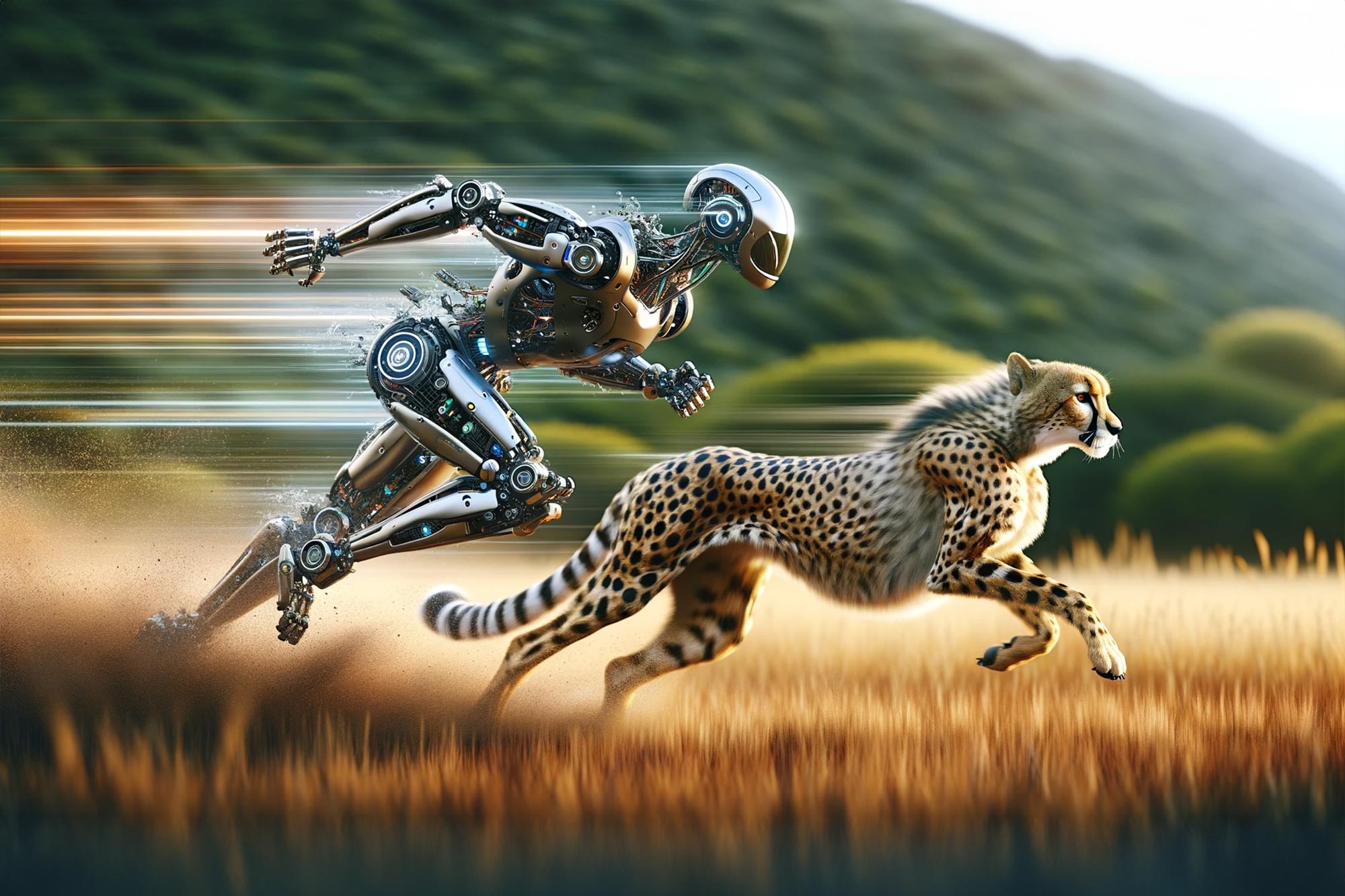
Despite superior individual components, robots lag behind animals in overall performance, suggesting a future focus on better system integration and control in robotics.
Robotics engineers have worked for decades and invested many millions of research dollars in attempts to create a robot that can walk or run as well as an animal. And yet, it remains the case that many animals are capable of feats that would be impossible for robots that exist today.
“A wildebeest can migrate for thousands of kilometers over rough terrain, a mountain goat can climb up a literal cliff, finding footholds that don’t even seem to be there, and cockroaches can lose a leg and not slow down,” says Dr. Max Donelan, Professor in Simon Fraser University’s Department of Biomedical Physiology and Kinesiology. “We have no robots capable of anything like this endurance, agility, and robustness.”
Comparing Robots to Animals
To understand why, and quantify how, robots lag behind animals, an interdisciplinary team of scientists and engineers from leading research universities completed a detailed study of various aspects of running robots, comparing them with their equivalents in animals, for a paper published in Science Robotics. The paper finds that, by the metrics engineers use, biological components performed surprisingly poorly compared to fabricated parts. Where animals excel, though, is in their integration and control of those components.
Alongside Donelan, the team comprised Drs. Sam Burden, Associate Professor in the Department of Electrical & Computer Engineering at the University of Washington; Tom Libby, Senior Research Engineer, SRI International; Kaushik Jayaram, Assistant Professor in the Paul M Rady Department of Mechanical Engineering at the University of Colorado Boulder; and Simon Sponberg, Dunn Family Associate Professor of Physics and Biological Sciences at the Georgia Institute of Technology.
The researchers each studied one of five different “subsystems” that combine to create a running robot – Power, Frame, Actuation, Sensing, and Control – and compared them with their biological equivalents. Previously, it was commonly accepted that animals’ outperformance of robots must be due to the superiority of biological components.
“The way things turned out is that, with only minor exceptions, the engineering subsystems outperform the biological equivalents – and sometimes radically outperformed them,” says Libby. “But also what’s very, very clear is that, if you compare animals to robots at the whole system level, in terms of movement, animals are amazing. And robots have yet to catch up.”
Insights Into Robotics Progress
More optimistically for the field of robotics, the researchers noted that, if you compare the relatively short time that robotics has had to develop its technology with the countless generations of animals that have evolved over many millions of years, the progress has actually been remarkably quick.
“It will move faster, because evolution is undirected,” says Burden. “Whereas we can very much correct how we design robots and learn something in one robot and download it into every other robot, biology doesn’t have that option. So there are ways that we can move much more quickly when we engineer robots than we can through evolution – but evolution has a massive head start.”
More than simply an engineering challenge, effective running robots offer countless potential uses. Whether solving ‘last mile’ delivery challenges in a world designed for humans that is often difficult to navigate for wheeled robots, carrying out searches in dangerous environments or handling hazardous materials, there are many potential applications for the technology.
Future Directions in Robotics
The researchers hope that this study will help direct future development in robot technology, with an emphasis not on building a better piece of hardware, but in understanding how to better integrate and control existing hardware. Donelan concludes, “As engineering learns integration principles from biology, running robots will become as efficient, agile, and robust as their biological counterparts.”
Reference: “Why animals can outrun robots” by Samuel A. Burden, Thomas Libby, Kaushik Jayaram, Simon Sponberg and J. Maxwell Donelan, 24 April 2024, Science Robotics.
DOI: 10.1126/scirobotics.adi9754
Never miss a breakthrough: Join the SciTechDaily newsletter.
Follow us on Google and Google News.
1 Comment
This is so wrong on so many levels–My car can “outrun” any animal. Animals have had billions of years evolving to run fast, etc.
Why would anyone (other than the military) wand robots that run fast?