
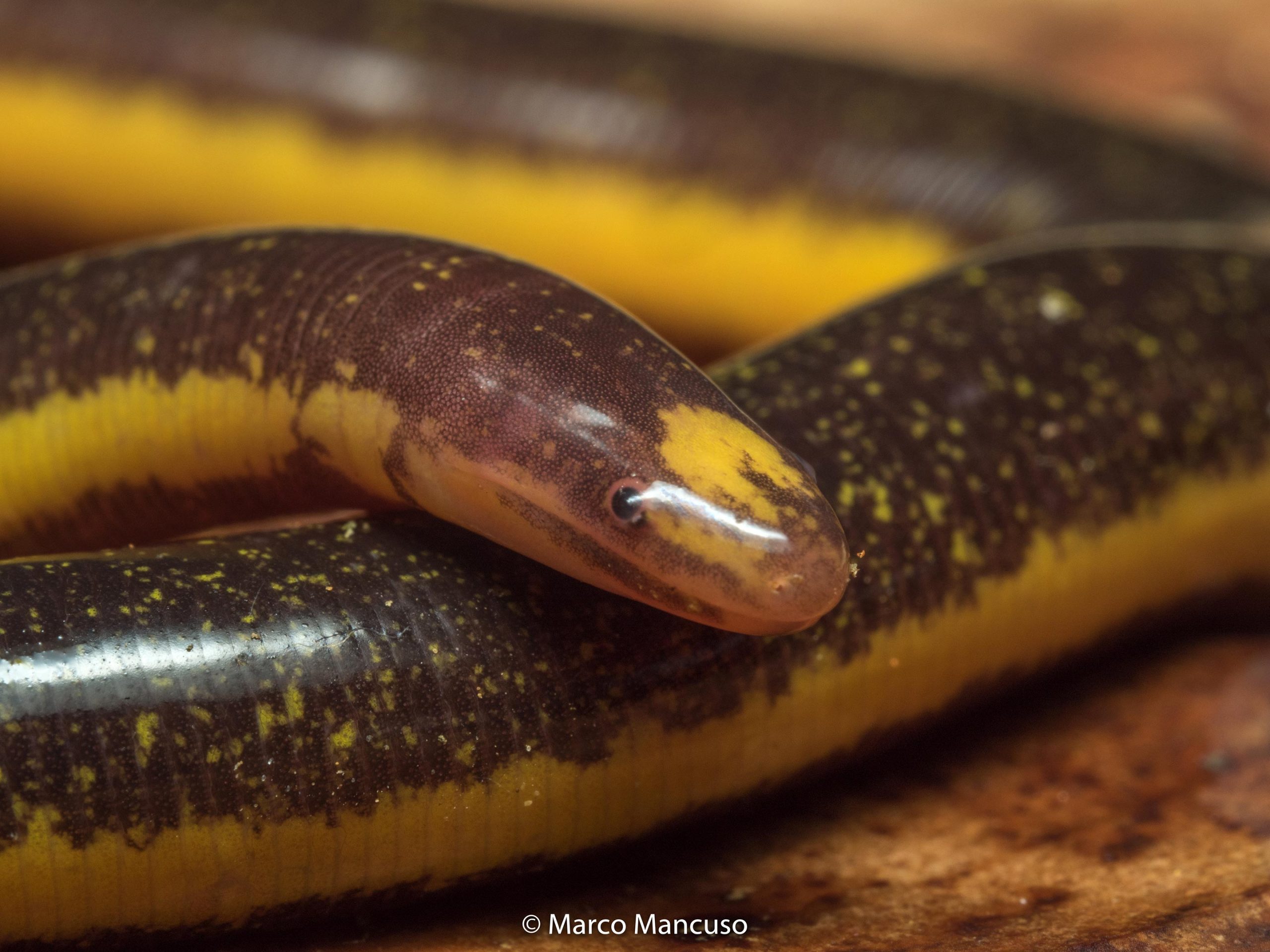
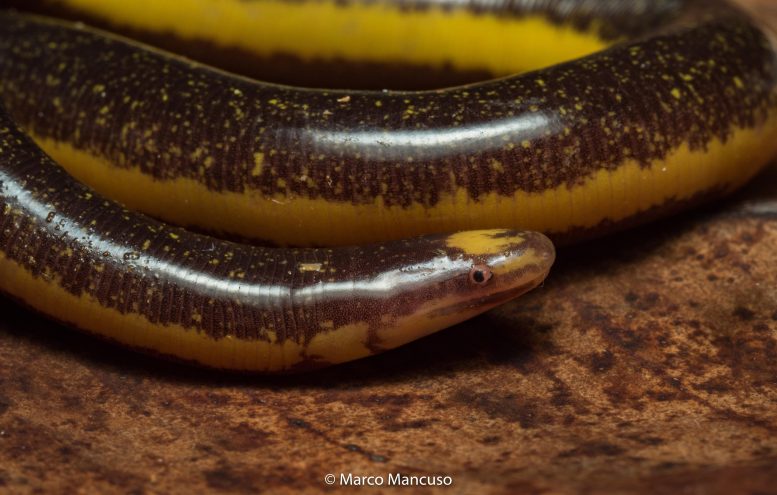
Researchers have discovered exceptional venom resistance in caecilians, a species of legless amphibians, believed to be an evolutionary response to predation by venomous elapid snakes. This resistance, developed through three unique biological mechanisms, provides a fascinating insight into predator-prey evolutionary dynamics.
An international team of researchers has uncovered “unprecedented” snake venom resistance in an unexpected species – the legless amphibian known as caecilians.
The University of Queensland’s Associate Professor Bryan Fry led the study, which he said provides a solid model for the fundamental evolutionary concept of predator-prey interactions.
“Our research provides a textbook example of how a single predatory pressure can trigger an evolutionary cascade where the same way of fighting back arises independently multiple times in a species’ different lineages,” Dr. Fry said.
Elapid Snakes: A Predatory Pressure
“In this case, the key predatory pressure was the rise of the elapid snakes, such as cobras and coral snakes, characterized by the evolution of a new way of delivering venom via their hollow, fixed, syringe-like fangs.
“Despite being quite slippery, caecilians are worm-like in their locomotion and speed and were incredibly easy prey to cobras and other snakes, which used their fangs to kill them and eat them later.
“It would have been absolute carnage to the point where elapids were basically grazing on caecilians, contributing to the rapid spread of elapid snakes across Africa, Asia, and the Americas.
“The caecilian’s ability to persevere and evolve despite these pressures is like a movie – like the survivors of Judgement Day fighting back by changing the chemical landscape.”
Study Methodology and Findings
The team studied caecilian species from all known families across the globe, including species in the Seychelles islands never reached by elapid snakes.
Lead author, Marco Mancuso from Vrije Universiteit Brussel’s Amphibian Evolution Lab, said the study involved using tissue collections to sequence a part of the neuromuscular receptor in caecilians bound by toxins in snake venom.
“We showed that resistance to elapid snake venom neurotoxins has evolved at least 15 times – which is absolutely without precedent,” Mr. Mancuso said.
“A particularly interesting validation of the theory was that the caecilians on the Seychelles islands were not resistant to snake venom, which is consistent with elapid snakes never reaching those islands.
“It’s an extraordinary signal for response to such severe selection pressure, where the survivors of the onslaught were those who were a bit less sensitive to the venom and some had mutations that made them completely immune.
“These were the ones that repopulated the earth after the elapid snake plague.”
Evolutionary Defense Mechanisms
Dr. Fry said the caecilians were able to achieve this never-before-seen venom resistance by deploying three different kinds of biological methods.
“One kind is putting up a form of barricade that blocks the ability of the toxins to reach receptors that would normally elicit a deadly reaction,” he said.
“A second form of resistance is changing the physical shape of the receptor. As the toxins have evolved to be like keys and insert into the lock-like receptor, changing the shape means the toxin no longer fits.
“Lastly, caecilians essentially deploy an electromagnetic ‘weapon’ which reverses the charge during this toxin-receptor interaction.
“The positive-to-positive charge repulsion increases exponentially the closer the objects come together, like trying to force two magnets together.
“This pocket of the receptor is normally negatively charged, so snake toxins have evolved with a positive charge to help guide the binding. The mutation where the receptor is now positively charged like the toxins, electrostatically repels the toxins.”
Educational Significance of Findings
Dr. Fry said while the results won’t lead to any new direct human benefits, such as new antivenom, the results have the benefit of showcasing an important evolutionary interaction in an engaging way to the next generation of scientists.
“Animals killing other animals, and the prey evolving to escape the predators, is something that I think is always fascinating to people, especially young people just getting into science.”
The research is published in the International Journal of Molecular Sciences.
Reference: ” Resistance Is Not Futile: Widespread Convergent Evolution of Resistance to Alpha-Neurotoxic Snake Venoms in Caecilians (Amphibia: Gymnophiona)” by Marco Mancuso, Shabnam Zaman, Simon T. Maddock, Rachunliu G. Kamei, David Salazar-Valenzuela, Mark Wilkinson, Kim Roelants
and Bryan G. Fry, 12 July 2023, International Journal of Molecular Sciences.
DOI: 10.3390/ijms241411353
Never miss a breakthrough: Join the SciTechDaily newsletter.
Follow us on Google and Google News.