
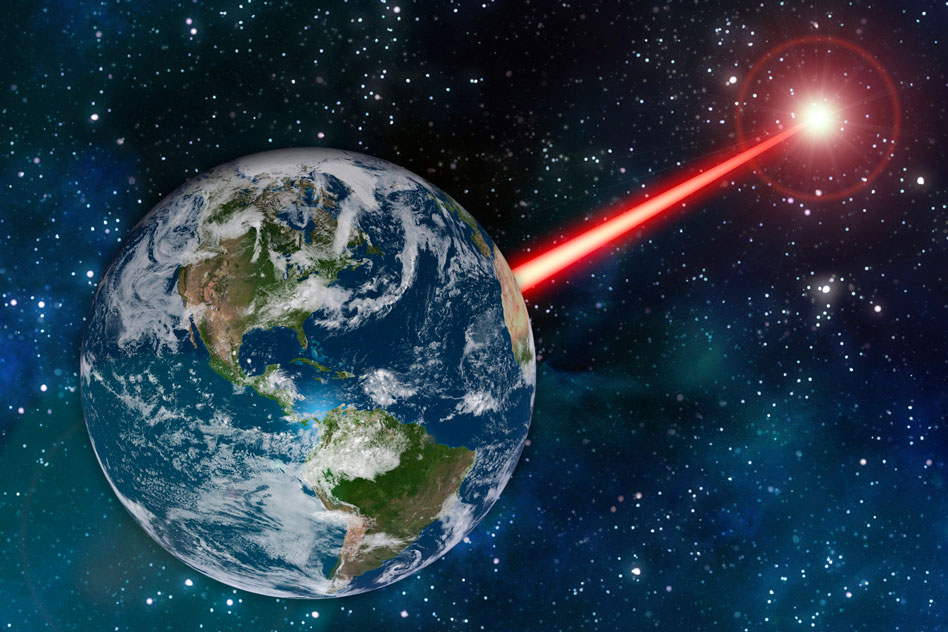
If extraterrestrial intelligence exists somewhere in our galaxy, a new MIT study proposes that laser technology on Earth could, in principle, be fashioned into something of a planetary porch light — a beacon strong enough to attract attention from as far as 20,000 light-years away.
The research, which author James Clark calls a “feasibility study,” appears today in The Astrophysical Journal. The findings suggest that if a high-powered 1- to 2-megawatt laser were focused through a massive 30- to 45-meter (98- to 148-foot) telescope and aimed out into space, the combination would produce a beam of infrared radiation strong enough to stand out from the sun’s energy.
Such a signal could be detectable by alien astronomers performing a cursory survey of our section of the Milky Way — especially if those astronomers live in nearby systems, such as around Proxima Centauri, the nearest star to Earth, or TRAPPIST-1, a star about 40 light-years away that hosts seven exoplanets, three of which are potentially habitable. If the signal is spotted from either of these nearby systems, the study finds, the same megawatt laser could be used to send a brief message in the form of pulses similar to Morse code.
“If we were to successfully close a handshake and start to communicate, we could flash a message, at a data rate of about a few hundred bits per second, which would get there in just a few years,” says Clark, a graduate student in MIT’s Department of Aeronautics and Astronautics and author of the study.
The notion of such an alien-attracting beacon may seem far-fetched, but Clark says the feat can be realized with a combination of technologies that exist now and that could be developed in the near term.
“This would be a challenging project but not an impossible one,” Clark says. “The kinds of lasers and telescopes that are being built today can produce a detectable signal, so that an astronomer could take one look at our star and immediately see something unusual about its spectrum. I don’t know if intelligent creatures around the sun would be their first guess, but it would certainly attract further attention.”
Standing up to the sun
Clark started looking into the possibility of a planetary beacon as part of a final project for 16.343 (Spacecraft, and Aircraft Sensors and Instrumentation), a course taught by Clark’s advisor, Associate Professor Kerri Cahoy.
“I wanted to see if I could take the kinds of telescopes and lasers that we’re building today, and make a detectable beacon out of them,” Clark says.
He started with a simple conceptual design involving a large infrared laser and a telescope through which to further focus the laser’s intensity. His aim was to produce an infrared signal that was at least 10 times greater than the sun’s natural variation of infrared emissions. Such an intense signal, he reasoned, would be enough to stand out against the sun’s own infrared signal, in any “cursory survey by an extraterrestrial intelligence.”
He analyzed combinations of lasers and telescopes of various wattage and size, and found that a 2-megawatt laser, pointed through a 30-meter (98-foot) telescope, could produce a signal strong enough to be easily detectable by astronomers in Proxima Centauri b, a planet that orbits our closest star, 4 light-years away. Similarly, a 1-megawatt laser, directed through a 45-meter (148-foot) telescope, would generate a clear signal in any survey conducted by astronomers within the TRAPPIST-1 planetary system, about 40 light-years away. Either setup, he estimated, could produce a generally detectable signal from up to 20,000 light-years away.
Both scenarios would require laser and telescope technology that has either already been developed, or is within practical reach. For instance, Clark calculated that the required laser power of 1 to 2 megawatts is equivalent to that of the U.S. Air Force’s Airborne Laser, a now-defunct megawatt laser that was meant to fly aboard a military jet for the purpose of shooting ballistic missiles out of the sky. He also found that while a 30-meter (98-foot) telescope considerably dwarfs any existing observatory on Earth today, there are plans to build such massive telescopes in the near future, including the 24-meter Giant Magellan Telescope and the 39-meter (128-foot) European Extremely Large Telescope, both of which are currently under construction in Chile.
Clark envisions that, like these massive observatories, a laser beacon should be built atop a mountain, to minimize the amount of atmosphere the laser would have to penetrate before beaming out into space.
He acknowledges that a megawatt laser would come with some safety issues. Such a beam would produce a flux density of about 800 watts of power per square meter, which is approaching that of the sun, which generates about 1,300 watts per square meter. While the beam wouldn’t be visible, it could still damage people’s vision if they were to look directly at it. The beam could also potentially scramble any cameras aboard spacecraft that happen to pass through it.
“If you wanted to build this thing on the far side of the moon where no one’s living or orbiting much, then that could be a safer place for it,” Clark says. “In general, this was a feasibility study. Whether or not this is a good idea, that’s a discussion for future work.”
Taking E.T.’s call
Having established that a planetary beacon is technically feasible, Clark then flipped the problem and looked at whether today’s imaging techniques would be able to detect such an infrared beacon if it were produced by astronomers elsewhere in the galaxy. He found that, while a telescope 1 meter or larger would be capable of spotting such a beacon, it would have to point in the signal’s exact direction to see it.
“It is vanishingly unlikely that a telescope survey would actually observe an extraterrestrial laser, unless we restrict our survey to the very nearest stars,” Clark says.
He hopes the study will encourage the development of infrared imaging techniques, not only to spot any laser beacons that might be produced by alien astronomers, but also to identify gases in a distant planet’s atmosphere that might be indications of life.
“With current survey methods and instruments, it is unlikely that we would actually be lucky enough to image a beacon flash, assuming that extraterrestrials exist and are making them,” Clark says. “However, as the infrared spectra of exoplanets are studied for traces of gases that indicate the viability of life, and as full-sky surveys attain greater coverage and become more rapid, we can be more certain that, if E.T. is phoning, we will detect it.”
Reference: “Optical detection of lasers with near-term technology at interstellar distances” by James R. Clark1 and Kerri Cahoy, 5 November 2018, The Astrophysical Journal.
DOI: 10.3847/1538-4357/aae380
Never miss a breakthrough: Join the SciTechDaily newsletter.
Follow us on Google and Google News.
18 Comments
It won’t work. It will be seen on a dozen planets, by a dozen different species, who will spend the next 50 years looking for it to repeat again. Just like us.
Laser technology is amazing
Since SETI have not contacted aliens with radio signals, Lasers may be the method to contact them.
It is a total mystery, and always will be. ‘Quantum-biology’ may explain where life comes from, but it will never be able to make life from inanimate matter, even if you throw in a few lightning bolts.
Now, before you go all ‘star trek’ on me, consider that there has not been found one smidgen of spectrographic evidence to the contrary, for ANY telltale signs of life to be found elsewhere in the cosmos, via telescopes or any of the probes we’ve sent out. Maybe it’stime to step away from the sci-fi channel?
Life must always come from a previous life. An unbroken thread. Why? Because I believe that there is only ONE being who is playing all of these seemingly separate parts.
Ok, so it is still an unknown as to what ‘life’ and ‘consciousness’ really is to begin with. Could this be a type of ‘matrix’ that we find ourselves living in? And how is the dream world similar to our waking world? Because in the dream world, we still must make decisions that affect our realm.
It might at first sound like a dumb question, but why it is always from a never-changing, ‘1st person vantage point’ that we find ourselves viewing the world? Could it be that there is only one actual living being that everything is ‘pushed out’ from?
And the origin of this ‘IT’ isn’t to be found ‘out there’ in 3D time and space. ‘It’ is consciousness itself streaming forth, out into the ‘screen’ of space, originating from a much larger dimension?
For example, trees, with their mycorrhizal fungi network become one huge connected organism. They seem to be, from our perspective, completely separate. But now we know better. This could explain why life is unique to planet Earth alone.
‘Life’ appears to me to be coming from one source outward, even though it seems that all living beings are separate entities. Perhaps on the ‘quantum’ scale of things, it could be likened to ‘tentacles’ protruding into our 3D reality?
Remember ‘FLATLAND’, where an ‘orange’ passing through this 2D world would be a circle enlarging, to then diminish and disappear again? Imagine quantum tentacles, coming from a being who is living in a much larger dimension. This could be similar to Flatland, and confusing for us humans to wrap our heads around, what is really going on?
If the Universe is supposedly ‘teeming’ with life, then where are all the aliens? Maybe just on the sci-fi channel?
Laser technology is good enough. We hope that the breakthrough starshot will be launched soon.
Attracting aliens can be dangerous. lets be prepare for the upcoming attack of aliens and be ready to fight with them.
1 meter or larger would be capable of spotting such a beacon, it would have to point in the signal’s exact direction to see it.
contemporary artistic movement that exists. It contributes character to society, each user feels influenced by it and creates their own personalized private wardrobe. Fashion communicates
Good job admin. Keep it up.
However, with its few drawbacks, this laptop is a pretty neat design and a functional machine for students who are on a budget. It’s definitely a must-consider.
good content nice articles
I’m really impressed cabout the info you provide in your articles. I must say am highly overwhelmed by your whole story. It’s not easy to get such quality information online nowadays. I look forward to staying here for a long time.
wood burning sauna kit
WAJA sauna is specialist manufacturer of top quality sauna products. Products include sauna rooms, steam rooms, barrel saunas, wooden hot tubs, and all kinds of sauna accessories.
Propane fryer: The propane one particular are identified to generate meals that are crispier and tastier. The oil also tends to warmth up faster when compared to the other deep fryers; subsequently, you take a shorter the perfect time to get ready your food. https://thetaggy.com/best-air-fryer/
I hope you may write more topics on the browser. Which browser is more secure than anyone else.
And you can see about browsers as below on the link.
https://execracks.com/brave-browser-crack/
In our restaurant Franz Stephan you will find traditional Austrian dishes, selected international dishes and light Mediterranean cuisine
[url=https://mariatheresia.com/]Mariatheresia[/url]
nice