
Close Menu
    Facebook X (Twitter) Instagram
    SciTechDaily
    • Biology
    • Chemistry
    • Earth
    • Health
    • Physics
    • Science
    • Space
    • Technology
    Facebook X (Twitter) Pinterest YouTube RSS
    SciTechDaily
    Home»Physics»Experimental Observations of Multiparty EPR Steering and Genuine Tripartite Entanglement
    Physics

    Experimental Observations of Multiparty EPR Steering and Genuine Tripartite Entanglement

    By Swinburne University of TechnologyJanuary 15, 20151 Comment3 Mins Read
    Facebook Twitter Pinterest Telegram LinkedIn WhatsApp Email Reddit
    Share
    Facebook Twitter LinkedIn Pinterest Telegram Email Reddit
    Extending Einstein-Podolsky-Rosen Quantum Mechanics Paradox
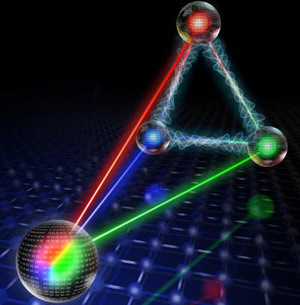
    Scientists have shown that the 1935 Einstein-Podolsky-Rosen (EPR) quantum mechanics paradox can be extended to involve more than two optical systems. Credit: Swinburne University of Technology

    Using an optical network, researchers experimentally confirm that entanglement associated with the EPR paradox can be shared over three or more distinct optical systems.

    An international team, including researchers from Swinburne University of Technology, has demonstrated that the 1935 Einstein-Podolsky-Rosen (EPR) quantum mechanics paradox may be extended to more than two optical systems, paving the way for exploration of larger quantum networks.

    Quantum mechanics is the theory used to describe nature’s smallest systems, like atoms or photons.

    The EPR paradox pointed out that two well-separated systems can have a strange type of quantum connection, so that what happens in one system seems to immediately affect the other.

    This connection has recently been called ‘EPR steering entanglement’.

    EPR steering is the nonlocality – what Albert Einstein called ‘spooky actions at a distance’ – associated with the EPR paradox and has traditionally been investigated between only two parties.

    An experiment performed by researchers from the Australian National University (ANU) and Tianjin University supports the predictions of theoretical work developed by researchers at Swinburne and Peking University.

    “We used an optical network to experimentally confirm how this spooky type of entanglement can be shared over not just two, but three or more distinct optical systems,” Dr. Seiji Armstrong, from the Quantum Computing Center Node at ANU, said.

    Previously, this sort of entanglement had been studied for only two systems.

    “The strength of the entanglement created in our network allows us to confirm rigorously – without using any additional assumptions that would create scientific loopholes – the genuine tripartite entanglement of three of the optical fields. The experiment therefore provides an important step towards validation of mesoscopic quantum mechanics,” Swinburne’s Professor Margaret Reid said.

    ANU’s Professor Ping Koy Lam said the experiment also identified properties that may be useful in establishing secure quantum communication networks where shared sequences of numbers created between two parties need to be kept secret from a third party.

    The important new feature is that the correlation is established with minimal assumptions about the nature of the equipment used to measure all but one of the fields.

    Dr. Qiongyi He from Peking University said that this helps in devising strategies, called device-independent cryptography, to outsmart hackers that may have compromised equipment, such as computers or iPhones.

    Reference: “Multipartite Einstein–Podolsky–Rosen steering and genuine tripartite entanglement with optical networks” by Seiji Armstrong, Meng Wang, Run Yan Teh, Qihuang Gong, Qiongyi He, Jiri Janousek, Hans-Albert Bachor, Margaret D. Reid and Ping Koy Lam, 5 January 2015, Nature Physics.
    DOI: 10.1038/nphys3202

    Never miss a breakthrough: Join the SciTechDaily newsletter.
    Follow us on Google and Google News.

    Quantum Mechanics Quantum Physics Swinburne University of Technology
    Share. Facebook Twitter Pinterest LinkedIn Email Reddit

    Related Articles

    Photons Traverse Optical Obstacles as Both a Wave and Particle Simultaneously

    The Experimental Design of a Space-Time Crystal

    Interpretation of Heisenberg’s Principle is Proven False

    New System Converts Laser Beam Into Controlled Stream of Single Photons

    Quantum Bits Store Data for Nearly Two Seconds Using Laboratory Grown Diamonds

    Experiment Shows That Light Defies the Principles of Classical Physics

    “Schrödinger’s Hat” Conceals Matter Waves Inside an Invisible Container

    Simulating Quantum Walks in Two Dimensions

    Evidence of Elusive Majorana Fermions Raises Possibilities for Quantum Computing

    1 Comment

    1. Brian on January 16, 2015 6:18 am

      It’s always great to see indirect methods of simulation consistently confirm supported theories of physics like this. Hats off to the international team.

      Reply
    Leave A Reply Cancel Reply

    • Facebook
    • Twitter
    • Pinterest
    • YouTube

    Don't Miss a Discovery

    Subscribe for the Latest in Science & Tech!

    Trending News

    Largest-Ever Study Finds Medicinal Cannabis Ineffective for Anxiety, Depression, PTSD

    250-Million-Year-Old Egg Solves One of Evolution’s Biggest Mysteries

    Living With Roommates Might Be Changing Your Gut Microbiome Without You Knowing

    Century-Old Cleaning Chemical Linked to 500% Increased Risk of Parkinson’s Disease

    What if Your Memories Never Happened? Physicists Take a New Look at the Boltzmann Brain Paradox

    One of the Universe’s Largest Stars May Be Getting Ready To Explode

    Scientists Discover Enzyme That Could Supercharge Ozempic-Like Weight Loss Drugs

    Popular Sweetener Linked to DNA Damage – “It’s Something You Should Not Be Eating”

    Follow SciTechDaily
    • Facebook
    • Twitter
    • YouTube
    • Pinterest
    • Newsletter
    • RSS
    SciTech News
    • Biology News
    • Chemistry News
    • Earth News
    • Health News
    • Physics News
    • Science News
    • Space News
    • Technology News
    Recent Posts
    • The Surprising Diet Rule That Makes “Good” Parasites Work
    • This Simple Blood Test Could Outperform “Bad Cholesterol” in Preventing Heart Disease
    • Scientists Uncover Potential Brain Risks of Popular Fish Oil Supplements
    • Scientists Prove There Are Just Six Degrees of Separation in a Social Network
    • Bee Bacteria Could Fix a Major Flaw in Plant-Based Milk
    Copyright © 1998 - 2026 SciTechDaily. All Rights Reserved.
    • Science News
    • About
    • Contact
    • Editorial Board
    • Privacy Policy
    • Terms of Use

    Type above and press Enter to search. Press Esc to cancel.