
Close Menu
    Facebook X (Twitter) Instagram
    SciTechDaily
    • Biology
    • Chemistry
    • Earth
    • Health
    • Physics
    • Science
    • Space
    • Technology
    Facebook X (Twitter) Pinterest YouTube RSS
    SciTechDaily
    Home»Space»Expert Gives a Guided Tour of Stunning Webb Telescope Stephan’s Quintet Image
    Space

    Expert Gives a Guided Tour of Stunning Webb Telescope Stephan’s Quintet Image

    By California Institute of TechnologyAugust 25, 2022No Comments2 Mins Read
    Facebook Twitter Pinterest Telegram LinkedIn WhatsApp Email Reddit
    Share
    Facebook Twitter LinkedIn Pinterest Telegram Email Reddit
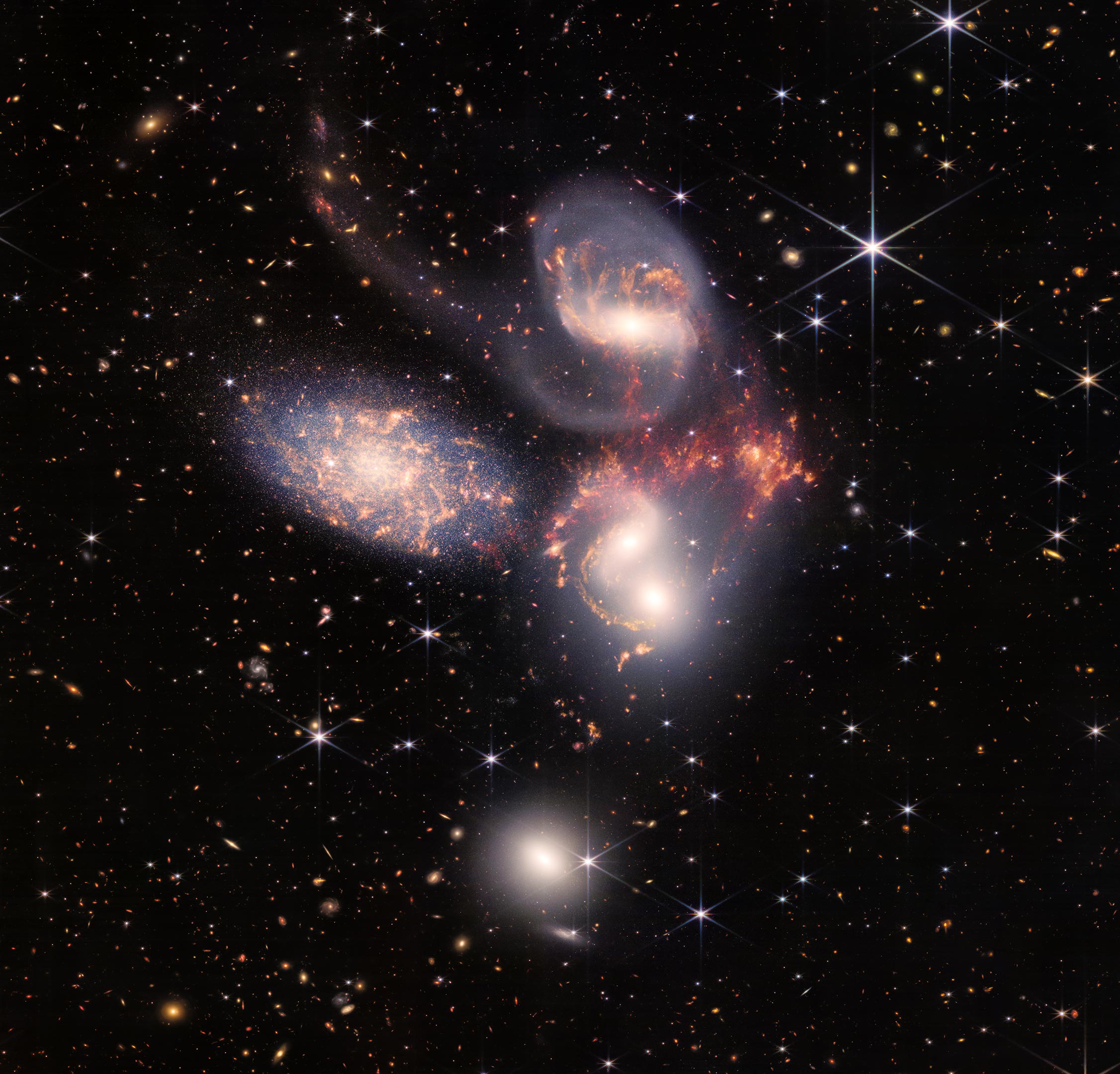
    Stephan's Quintet Webb
    An enormous mosaic of Stephan’s Quintet is the largest image to date from NASA’s James Webb Space Telescope, covering about one-fifth of the Moon’s diameter. It contains over 150 million pixels and is constructed from almost 1,000 separate image files. The visual grouping of five galaxies was captured by Webb’s Near-Infrared Camera (NIRCam) and Mid-Infrared Instrument (MIRI). Credit: NASA, ESA, CSA, STScI

    Last month, NASA released a batch of long-awaited, jaw-dropping images from its newest and most powerful space observatory, the James Webb Space Telescope (JWST). In unprecedented detail, pictures revealed distant wonders such as the Carina Nebula, the Southern Ring Nebula, and Stephan’s Quintet—a collection of five dazzling galaxies, some of which are actively colliding with each other.

    In this video, Philip Appleton, a staff scientist at Caltech’s IPAC astronomy center, walks us through the new image of the quintet. Four of the five galaxies are gravitationally bound and make up a compact galaxy group located hundreds of millions of light-years away in the Pegasus constellation. At least three galaxies in this group are actively colliding with each other, producing shock waves that trigger new star formation.

    Appleton and his colleagues have studied this turbulent region for nearly 20 years using other telescopes such as the now-retired Spitzer Space Telescope, whose data archive is based at IPAC. Spitzer was managed by the Jet Propulsion Laboratory (JPL), which the California Institute of Technology (Caltech) manages for NASA.

    Never miss a breakthrough: Join the SciTechDaily newsletter.
    Follow us on Google and Google News.

    California Institute of Technology
    Share. Facebook Twitter Pinterest LinkedIn Email Reddit

    Related Articles

    Solar Flares in a Lab? Caltech’s Miniature Marvels Unlock Cosmic Secrets

    Through a Gravity Lens: Astronomers Capture Bizarre “Extremely Warped” Supernova

    Evidence That Earth Is Enveloped in Slow-Rolling Sea of Gravitational Waves

    Astronomers “Blown Away” by Weird Two-Faced Star

    Birth of Our Planet: Caltech Uncovers New Details of Earth’s Formation

    Star Devours Planet, Brightens Spectacularly

    Mars in Unprecedented Detail: Get Lost in the Red Planet’s 5.7 Terapixel Landscape!

    Physicists Create New Model of Ringing Black Holes

    New Solution to Old Mystery: Why Doesn’t the Inside of the Solar System Spin Faster?

    Leave A Reply Cancel Reply

    • Facebook
    • Twitter
    • Pinterest
    • YouTube

    Don't Miss a Discovery

    Subscribe for the Latest in Science & Tech!

    Trending News

    New Pill Lowers Stubborn Blood Pressure and Protects the Kidneys

    Humans May Have Hidden Regenerative Powers, New Study Suggests

    Scientists Just Solved the Mystery of Why Crabs Walk Sideways

    Doctors Are Surprised by What This Vaccine Is Doing to the Heart

    This Popular Supplement May Boost Your Brain, Not Just Your Muscles

    Scientists Say This Simple Supplement May Actually Reverse Heart Disease

    Warming Oceans Could Trigger a Dangerous Methane Surge

    This Simple Movement Could Be Secretly Cleaning Your Brain

    Follow SciTechDaily
    • Facebook
    • Twitter
    • YouTube
    • Pinterest
    • Newsletter
    • RSS
    SciTech News
    • Biology News
    • Chemistry News
    • Earth News
    • Health News
    • Physics News
    • Science News
    • Space News
    • Technology News
    Recent Posts
    • Scientists Warn Sitting Too Much Can Harm Your Body in Surprising Ways
    • Your Blood Pressure Reading Could Be Wrong Because of One Simple Mistake
    • Scientists Discover Cheap Material That Kills Deadly Superbugs
    • This Magnetic Field Trick Creates Entirely New Forms of Matter
    • Astronomers Stunned by Ancient Galaxy With No Spin
    Copyright © 1998 - 2026 SciTechDaily. All Rights Reserved.
    • Science News
    • About
    • Contact
    • Editorial Board
    • Privacy Policy
    • Terms of Use

    Type above and press Enter to search. Press Esc to cancel.