
Close Menu
    Facebook X (Twitter) Instagram
    SciTechDaily
    • Biology
    • Chemistry
    • Earth
    • Health
    • Physics
    • Science
    • Space
    • Technology
    Facebook X (Twitter) Pinterest YouTube RSS
    SciTechDaily
    Home»Earth»Exploring Earth From Space: Washington State – Through the Lens of Brand New Landsat 9
    Earth

    Exploring Earth From Space: Washington State – Through the Lens of Brand New Landsat 9

    By European Space Agency (ESA)February 28, 20221 Comment3 Mins Read
    Facebook Twitter Pinterest Telegram LinkedIn WhatsApp Email Reddit
    Share
    Facebook Twitter LinkedIn Pinterest Telegram Email Reddit
    Washington State Satellite View
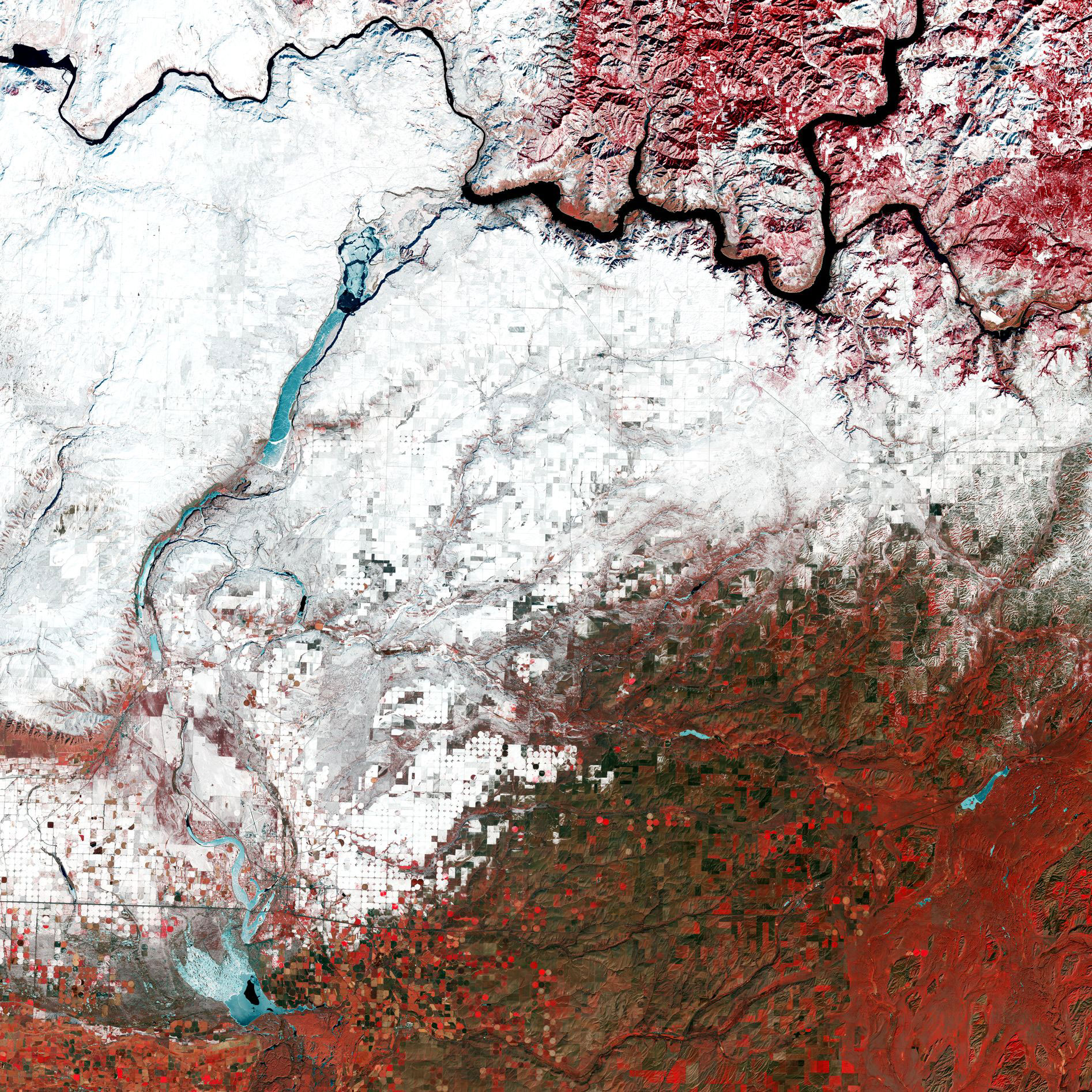
    This false-color image, captured on February 12, 2022, by Landsat 9, has been processed using the satellite’s near-infrared channel. This channel is frequently used to highlight vegetation, which is particularly evident in the lower half of the image. Fields that are currently cultivated can be seen in bright red, while unvegetated areas appear in green and brown. Circular shapes, predominantly in the bottom-left, are center-pivot irrigation fields – where equipment rotates around a central pivot and crops are watered with sprinklers. Washington is a leading agricultural state, with the top crops being apples, milk, potatoes, and wheat. Credit: USGS/NASA Landsat/ESA

    To celebrate the recent data release from Landsat 9, we take a closer look at a part of Washington state – the northwesternmost state of the US – through the lens of Landsat 9.

    Data from Landsat 9, which was launched in September 2021, is now publicly available for users and researchers across the world. The satellite will continue the program’s critical role in monitoring, understanding, and managing the land resources needed to sustain human life.

    A partnership between NASA and the US Geological Survey, the satellite carries two science instruments, the Operational Land Imager 2 (OLI-2) and the Thermal Infrared Sensor 2 (TIRS-2). The OLI–2 captures observations of the Earth’s surface in visible, near-infrared, and shortwave-infrared bands, and TIRS-2 measures thermal infrared radiation, or heat, emitted from Earth’s surface.

    This false-color image, captured on February 12, 2022, by Landsat 9, has been processed using the satellite’s near-infrared channel. This channel is frequently used to highlight vegetation, which is particularly evident in the lower half of the image. Fields that are currently cultivated can be seen in bright red, while unvegetated areas appear in green and brown. Circular shapes, predominantly in the bottom-left, are center-pivot irrigation fields – where equipment rotates around a central pivot and crops are watered with sprinklers. Washington is a leading agricultural state, with the top crops being apples, milk, potatoes, and wheat.

    Columbia River, the largest river in the Pacific Northwest, is visible in the top of the image in black. The river rises in the Rocky Mountains of British Columbia, Canada, flows through Washington and Oregon, before emptying into the Pacific Ocean. The river is one of the world’s greatest sources of hydroelectric power and, with its tributaries, represents a third of the potential hydropower of the United States.

    As water absorbs a fair amount of radiation, water bodies, such as the Columbia River, appear black in the image. However certain icy water bodies dotted in the left of the image can be seen in turquoise as ice reflects less in the near-infrared channel than in the visible part of the spectrum.

    The Landsat series is part of ESA’s Third-Party Missions program which consists of almost 50 satellite missions, and also forms part of ESA’s Heritage Space program.

    Never miss a breakthrough: Join the SciTechDaily newsletter.
    Follow us on Google and Google News.

    European Space Agency Geography
    Share. Facebook Twitter Pinterest LinkedIn Email Reddit

    Related Articles

    Breathtaking View of Andros, Bahamas From Space [Video]

    Stunning Views of Houston Texas From Copernicus Sentinel-1 Satellite

    Earth From Space: Bolivian Highland Heart [Video]

    Flevoland, Netherlands From Space: One of the Largest Land Reclamation Projects in the World

    Earth From Space: Lake George, Uganda – A Center for Biological Diversity [Video]

    Deforestation in Bolivia Spied From Space Satellite

    Earth From Space: Japanese Archipelago [Video]

    Earth From Space: Faroe Islands [Video]

    Earth From Space: Tromsø, Norway [Video]

    1 Comment

    1. JD Prendergast on March 7, 2022 9:09 pm

      Alaska would be the northwesternmost state of the US.

      Reply
    Leave A Reply Cancel Reply

    • Facebook
    • Twitter
    • Pinterest
    • YouTube

    Don't Miss a Discovery

    Subscribe for the Latest in Science & Tech!

    Trending News

    New “Nanozyme Hypothesis” Could Rewrite the Story of Life’s Origins

    Anatomy Isn’t Finished: The Human Body Still Holds Secrets

    “Pretty Close to Home”: The Hidden Earthquake Threat Beneath Seattle

    The Surprising Reason You Might Want To Sleep Without a Pillow

    Scientists Say This Natural Hormone Reverses Obesity by Targeting the Brain

    35-Million-Year-Old Mystery: Strange Arachnid Discovered Preserved in Amber

    Is AI Really Just a Tool? It Could Be Altering How You See Reality

    JWST Reveals a “Forbidden” Planet With a Baffling Composition

    Follow SciTechDaily
    • Facebook
    • Twitter
    • YouTube
    • Pinterest
    • Newsletter
    • RSS
    SciTech News
    • Biology News
    • Chemistry News
    • Earth News
    • Health News
    • Physics News
    • Science News
    • Space News
    • Technology News
    Recent Posts
    • Scientists Capture Hidden Electron Patterns Inside Quantum Materials
    • New Study Challenges Alzheimer’s Theories: It’s Not Just About Plaques
    • Scientists Discover Way To Treat Lung Cancer and Its Deadly Side Effect Together
    • Artificial Sweeteners May Harm Future Generations, Study Suggests
    • The Ocean Current Stronger Than All Rivers Changed Earth Forever
    Copyright © 1998 - 2026 SciTechDaily. All Rights Reserved.
    • Science News
    • About
    • Contact
    • Editorial Board
    • Privacy Policy
    • Terms of Use

    Type above and press Enter to search. Press Esc to cancel.