
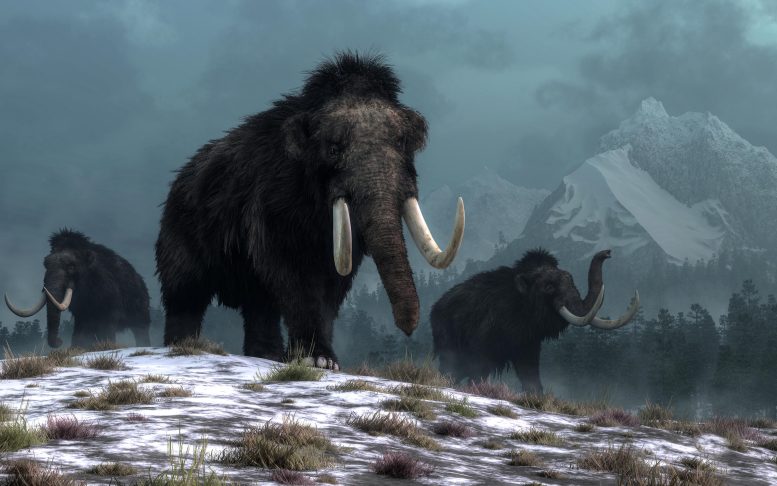
Researchers found that when giant grazers like mammoths and bison went extinct, grassland fires surged.
From 50,000 years to 6,000 years ago, many of the world’s largest animals, including such iconic grassland grazers as the woolly mammoth, giant bison, and ancient horses, went extinct. The loss of these grazing species triggered a dramatic increase in fire activity in the world’s grasslands, according to a new Yale-led study to be published on November 26, 2021, in the journal Science.
In collaboration with the Utah Natural History Museum, Yale scientists compiled lists of extinct large mammals and their approximate dates of extinction across four continents. The data showed that South America lost the most grazers (83% of all species), followed by North America (68%). These losses were significantly higher than in Australia (44%) and Africa (22%).
Charcoal Records Link Extinctions to Rising Fires
They then compared these findings with records of fire activity as revealed in lake sediments. Using charcoal records from 410 global sites, which provided a historical record of regional fire activity across continents, they found that fire activity increased after the megagrazer extinctions. Continents that lost more grazers (South America, then North America) saw larger increases in fire extent, whereas continents that saw lower rates of extinction (Australia and Africa) saw little change in grassland fire activity.
“These extinctions led to a cascade of consequences,” said Allison Karp, a postdoctoral associate in Yale’s Department of Ecology & Evolutionary Biology and corresponding author of the paper. “Studying these effects helps us understand how herbivores shape global ecology today.”
Widespread megaherbivore extinctions had major impacts on ecosystems — ranging from predator collapse to loss of fruit-bearing trees that once depended on herbivores for dispersal. But Karp and senior author Carla Staver, associate professor of ecology and evolutionary biology in Yale’s Faculty of Arts and Sciences, wondered if there was also an increase in fire activity in the world’s ecosystems, specifically due to a buildup of dry grass, leaves, or wood caused by the loss of giant herbivores. They found that, in grasslands, grass-fueled fires increased.
However, Karp and Staver note that many ancient browser species — such as mastodons, diprotodons, and giant sloths, which foraged on shrubs and trees in wooded areas — also went extinct during the same period but that their losses had less impact on fires in wooded areas.
Grasslands Rebuilt by Livestock and New Grazers
Grassland ecosystems across the world were transformed after the loss of grazing-tolerant grasses due to the loss of herbivores and increase in fires. New grazers, including livestock, eventually adapted to the new ecosystems.
That’s why scientists should consider the role of grazing livestock and wild grazers in fire mitigation and climate change, the authors said. “This work really highlights how important grazers may be for shaping fire activity,” Staver said. “We need to pay close attention to these interactions if we want to accurately predict the future of fires.”
Reference: “Global response of fire activity to late Quaternary grazer extinctions” by Allison T. Karp, J. Tyler Faith, Jennifer R. Marlon and A. Carla Staver, 26 November 2021, Science.
DOI: 10.1126/science.abj1580
Never miss a breakthrough: Join the SciTechDaily newsletter.
Follow us on Google and Google News.
5 Comments
It’s kind of sad that the first wave of western hemisphere inhabitants had murdered everything except buffalo before europe got here. We could have gone extinction-grade hunting together and enjoyed our shared love for killing very large animals.
Your assumption that it was hunting that exterminated all the large animals — herbivores and carnivores alike — except the plains bison, despite intensive hunting later by a larger population of indigenous peoples, is overly simplistic. Nor does your assumption explain why the extinction of grazers was higher in South America than in North America when South America ostensibly had a lower population of humans who arrived later than in North America.
https://scitechdaily.com/new-dna-research-shows-humans-did-not-cause-woolly-mammoths-to-go-extinct-climate-change-did/
“This work really highlights how important grazers may be for shaping fire activity,”
This may help explain the recent rise in California wildfires. The importance of ranching has declined in the state, and introduced exotic plants like cheat grass and yellow star thistle have increased the flammability of the landscape.
I’m sorry..How can we blame the poor animals for the increase in wildfires? Maybe, perhaps, the increase in the world’s temps and the comeback from the Ice Age..warmer temps a drier climate????? Maybe even sunspot activity???
You have it backwards! Any ‘blame’ being assigned is for the lack of megafauna, not for what they did. The problem is what they didn’t do.