
Close Menu
    Facebook X (Twitter) Instagram
    SciTechDaily
    • Biology
    • Chemistry
    • Earth
    • Health
    • Physics
    • Science
    • Space
    • Technology
    Facebook X (Twitter) Pinterest YouTube RSS
    SciTechDaily
    Home»Science»Extraordinary Discovery: First-Ever Mixed-Species Dinosaur Herd Tracks Found in Canada
    Science

    Extraordinary Discovery: First-Ever Mixed-Species Dinosaur Herd Tracks Found in Canada

    By University of ReadingAugust 4, 20251 Comment3 Mins Read
    Facebook Twitter Pinterest Telegram LinkedIn WhatsApp Email Reddit
    Share
    Facebook Twitter LinkedIn Pinterest Telegram Email Reddit
    Multiple Species Dinosaur Herd
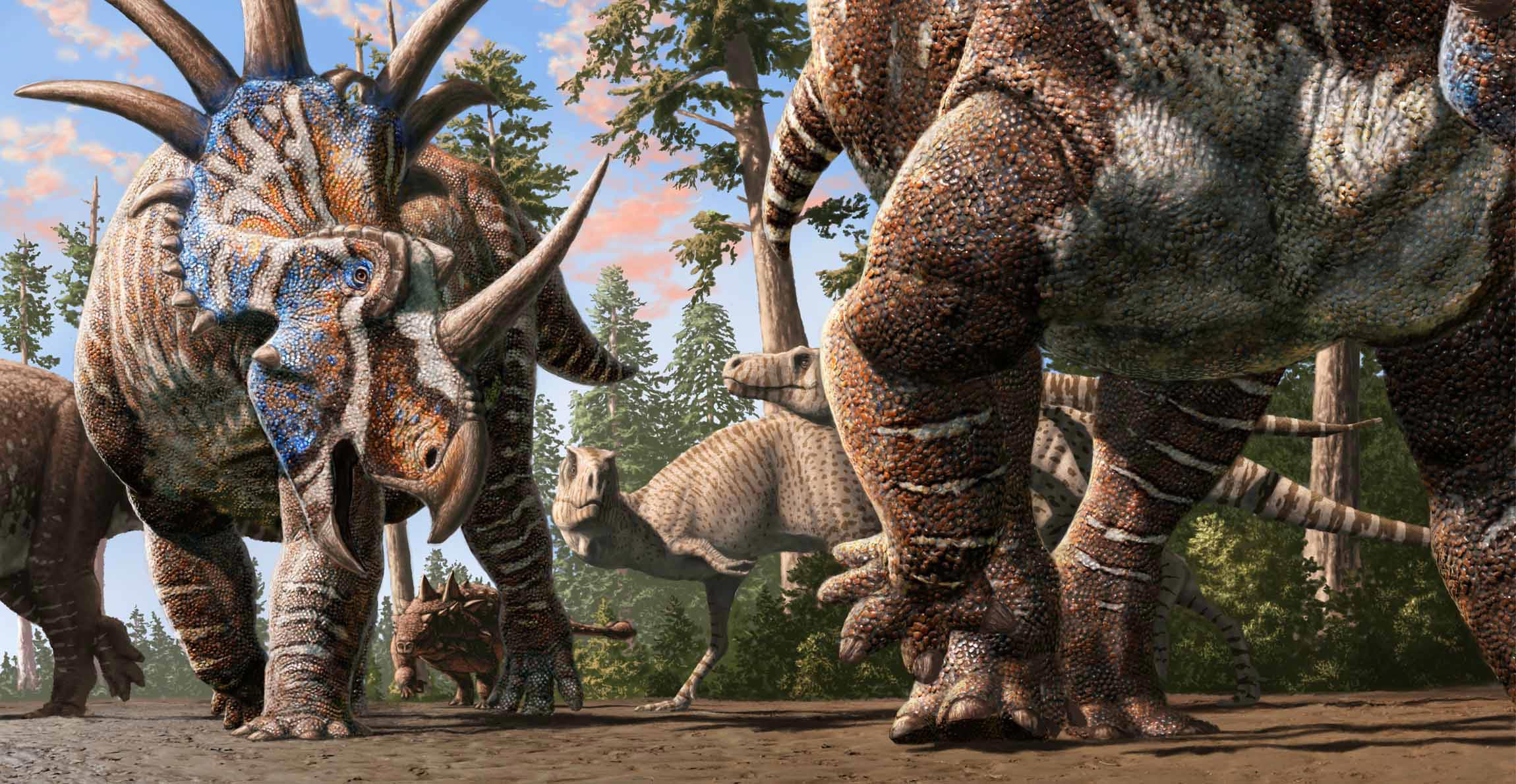
    A collection of footprints from a group of ceratopsians and an Ankylosaurus could be the first evidence of dinosaur herds that were made up of multiple species. Credit: Julius Csotonyi

    A groundbreaking discovery in Canada reveals that different dinosaur species may have traveled together in herds.

    A newly published study in PLOS ONE reveals a remarkable discovery in Canada: fossilized footprints showing multiple dinosaur species moving together, offering rare evidence of interspecies social behavior dating back 76 million years.

    This find comes from Dinosaur Provincial Park in Alberta, a site renowned worldwide for its wealth of dinosaur fossils. Despite its fame, the park had yielded almost no dinosaur footprints until now, making this tracksite a groundbreaking addition to its paleontological record.

    Uncovered during an international field course in July 2024, the site preserves the tracks of several dinosaur species walking side by side. These footprints suggest that different types of dinosaurs may have traveled together in herds, much like how wildebeest and zebras migrate in groups today across the African savanna.

    The researchers were also surprised to find the tracks of two large tyrannosaurs walking side by side and perpendicular to the herd, raising the prospect that multispecies herding may have been a defense strategy against common apex predators. However, more evidence is needed to confirm this.

    Details of the Tracksite and Its Inhabitants

    The international team, led by Dr. Brian Pickles (University of Reading, UK), Dr. Phil Bell (University of New England, Australia), and Dr. Caleb Brown (Royal Tyrrell Museum of Palaeontology, Canada), excavated 29 square metres of the site, revealing 13 ceratopsian (horned dinosaur) tracks from at least five animals walking side by side, with a probable ankylosaurid (armoured dinosaur) walking in the midst of the others.

    Ankylosaurus Footprints
    Footprints belonging to the tank-link armoured dinosaur called Ankylosaurus were found among the ceratopsian tracks. Credit: Dr. Brian Pickles, University of Reading

    One footprint of a small meat-eating dinosaur was also discovered. The tracksite extends further into the hillside.

    Dr. Phil Bell, University of New England, said: “I’ve collected dinosaur bones in Dinosaur Provincial Park for nearly 20 years, but I’d never given footprints much thought. This rim of rock had the look of mud that had been squelched out between your toes, and I was immediately intrigued.

    “The tyrannosaur tracks give the sense that they were really eyeing up the herd, which is a pretty chilling thought, but we don’t know for certain whether they actually crossed paths.”

    Dr. Brian Pickles, University of Reading, said: “It was incredibly exciting to be walking in the footsteps of dinosaurs 76 million years after they laid them down.

    “Using the new search images for these footprints, we have been able to discover several more track sites within the varied terrain of the Park, which I am sure will tell us even more about how these fascinating creatures interacted with each other and behaved in their natural environment.”

    Dr. Caleb Brown, Royal Tyrrell Museum of Palaeontology, added: “This discovery shows just how much there is still to uncover in dinosaur paleontology. Dinosaur Park is one of the best-understood dinosaur assemblages globally, with more than a century of intense collection and study, but it is only now that we are getting a sense for its full potential for dinosaur trackways.”

    Reference: “A ceratopsid-dominated tracksite from the Dinosaur Park Formation (Campanian) at Dinosaur Provincial Park, Alberta, Canada” by Phil R. Bell, Brian J. Pickles, Sarah C. Ashby, Issy E. Walker, Sally Hurst, Michael Rampe, Paul Durkin and Caleb M. Brown, 23 July 2025, PLOS ONE.
    DOI: 10.1371/journal.pone.0324913

    Never miss a breakthrough: Join the SciTechDaily newsletter.
    Follow us on Google and Google News.

    Dinosaurs Fossils Paleontology University of Reading
    Share. Facebook Twitter Pinterest LinkedIn Email Reddit

    Related Articles

    Research Reveals First Complete Chemical Analysis of ‘Dinobird’ Feathers

    World’s Oldest Dinosaur Bonebed Reveals How Dinosaur Embryos Grew and Developed

    Stubby-Tailed Oviraptors Had Tails for Courtship Displays

    Xenoceratops, A New Species of Horned Dinosaur Discovered in Canada

    How Tyrannosaurus Rex Ate Triceratops Horridus

    Fossils Reveal Headbutts May Have Been Used as a Dinosaur Courtship Behavior

    Cretaceous Period Sankofa Pyrenaica Fossilized Eggs Are Unusually Shaped

    Microraptor Feathers Were Black With Iridescent Sheen

    Jurassic Period Super-Sized Fleas Had Armored Mouthparts to Attack the Thick Hide of Dinosaurs

    1 Comment

    1. Cindy Wu on August 4, 2025 11:47 pm

      Amazing what some fossil footprints reveal.

      Reply
    Leave A Reply Cancel Reply

    • Facebook
    • Twitter
    • Pinterest
    • YouTube

    Don't Miss a Discovery

    Subscribe for the Latest in Science & Tech!

    Trending News

    JWST Finds a “Star” 100 Billion Times Brighter Than Any Star Should Be

    Scientists Find a Hidden Biological Link Across Different Forms of Autism

    Astronomers Discover a Ghostly River of Stars That Could Reveal Dark Matter

    Why Is Colorectal Cancer Rising in People Under 50? New Clues Point to the Environment

    Quantum Fluctuations Break a Crystal’s Symmetry Rules

    Why Does an Irregular Heartbeat Strike 40 Years Early in Some People?

    Scientists Reveal How ADHD Could Fuel Creative Thinking

    Scientists Find Just 3 Minutes of Sprinting Can Transform Blood Chemistry

    Follow SciTechDaily
    • Facebook
    • Twitter
    • YouTube
    • Pinterest
    • Newsletter
    • RSS
    SciTech News
    • Biology News
    • Chemistry News
    • Earth News
    • Health News
    • Physics News
    • Science News
    • Space News
    • Technology News
    Recent Posts
    • A 20-Year Study Finds Preschool Can Influence Success for Years
    • 55-Million-Year-Old Penguin Fossils Preserve Clues to a Warmer Antarctica
    • A 35,000-Year-Old Neanderthal Pelvis May Explain Why Men and Women Walk Differently
    • Hidden Brain Wiring May Help Preserve Thinking As Gray Matter Shrinks
    • Dual Stem Cell Treatment Restores Vision in First Human Trial
    Copyright © 1998 - 2026 SciTechDaily. All Rights Reserved.
    • Science News
    • About
    • Contact
    • Editorial Board
    • Privacy Policy
    • Terms of Use

    Type above and press Enter to search. Press Esc to cancel.