
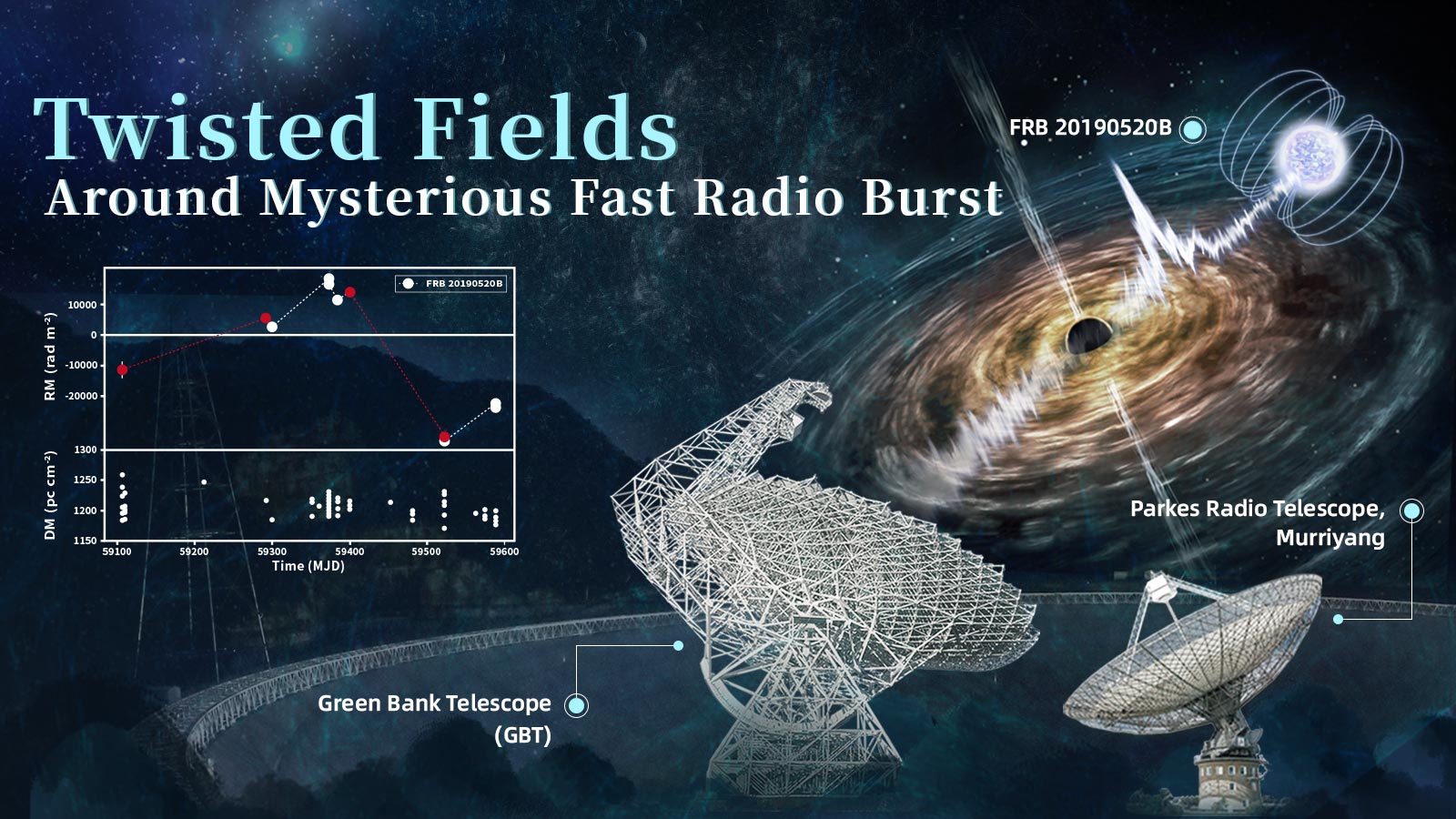
Scientists led by Dr. Di Li from the NAOC have discovered an extreme field reversal around Fast Radio Burst FRB 20190520B, indicating the signal may pass through a turbulent, magnetized plasma field. This discovery brings us closer to understanding the origin of these intense cosmic explosions, possibly linked to black holes or massive stars.
Fast Radio Bursts (FRBs) are the brightest millisecond-duration cosmic explosions in radio bands. Their unknown origin poses challenges for astronomy as well as physics.
The Commensal Radio Astronomy FAST Survey (CRAFTS), a key program of the Five-hundred-meter Spherical radio Telescope (FAST), discovered the world’s first persistently active repeating FRB, known as FRB 20190520B. Now this FRB has provided clues that may help clarify the origin of FRBs.
An international team led by Dr. Di Li from the National Astronomical Observatories of the Chinese Academy of Sciences (NAOC) carried out a monitoring campaign of FRB 20190520B, using the Parkes telescope in Australia and the Green Bank Telescope (GBT) in the United States. The combined analyses have revealed an extreme field reversal around this constantly bursting source.
The study, based on observational efforts across three continents, was published in the journal Science on May 11.
Unique Characteristics of FRB 20190520B
Unlike all other FRBs, FRB 20190520B has produced bursts, detectable by at least one and sometimes multiple telescopes, every time it was viewed. Such reliability makes it an ideal target for multiband follow-up observational studies.
“A total of 113 bursts from FRB 20190520B were detected by the Parkes telescope, exceeding the sum of the number of fast radio bursts previously discovered at Parkes, accentuating the value of FRB 20190520B,” said Dr. Shi Daifrom Western Sydney University, PI of the FRB 20190520B project at Parkes.
Through a combined analysis of data from GBT and Parkes, Dr. Yi Feng, an NAOC PhD graduate now at Zhejiang Laboratory, and Ms. Anna-Thomas from West Virginia University (WVU) measured its polarization properties and found that the Faraday rotation measure (RM) twice changed its sign in dramatic fashion: from ~10,000 units to ~-10,000 units and vice versa. Other key contributors include Dr. Liam Connor from Caltech and Dr. Sarah Burke-Spolaor from WVU.
Magnetic Field Reversals and Turbulence
During the propagation of a burst signal, the polarization characteristics can be affected by the surrounding plasma. “The RM can be approximated by the integral product of magnetic field and electron density. Variation in RM can be caused by either factor, but a sign change has to arise from the reversal of magnetic fields, as the electron density cannot go negative,” said Dr. Di Li, corresponding author of the study.
This reversal could result from propagation through a turbulent, magnetized screen of plasma located between 10-5 to 100 parsecs of the FRB source. “The turbulent components of the magnetic field around repeating fast radio bursts may be as messy as a ball of wool,” said Prof. Yuanpei Yang from Yunnan University, a co-author of the study.
The likely scenario for producing such a mess includes the signal passing through the halo of a companion, be it a black hole or a massive star with winds. Understanding drastic changes in the magnetized environment around the FRB is an important step toward understanding the origin of such cosmic explosions.
Reference: “Magnetic field reversal in the turbulent environment around a repeating fast radio burst” by Reshma Anna-Thomas, Liam Connor, Shi Dai, Yi Feng, Sarah Burke-Spolaor, Paz Beniamini, Yuan-Pei Yang, Yong-Kun Zhang, Kshitij Aggarwal, Casey J. Law, Di Li, Chenhui Niu, Shami Chatterjee, Marilyn Cruces, Ran Duan, Miroslav D. Filipovic, George Hobbs, Ryan S. Lynch, Chenchen Miao, Jiarui Niu, Stella K. Ocker, Chao-Wei Tsai, Pei Wang, Mengyao Xue, Ju-Mei Yao, Wenfei Yu, Bing Zhang, Lei Zhang, Shiqiang Zhu and Weiwei Zhu, 11 May 2023, Science.
DOI: 10.1126/science.abo6526
Never miss a breakthrough: Join the SciTechDaily newsletter.
Follow us on Google and Google News.
2 Comments
I found extreme twisted magnetic fields around your mother’s breasts!
This is an interesting discovery! So is the FRB beginning as wideband noise, travelling through the magnetic field, cohering it into a FRB? Giant Travelling Wave Tube!