
Close Menu
    Facebook X (Twitter) Instagram
    SciTechDaily
    • Biology
    • Chemistry
    • Earth
    • Health
    • Physics
    • Science
    • Space
    • Technology
    Facebook X (Twitter) Pinterest YouTube RSS
    SciTechDaily
    Home»Space»Extremely Large Telescope: World’s Largest Telescope Mirror Will Bring the Stars Closer to Earth
    Space

    Extremely Large Telescope: World’s Largest Telescope Mirror Will Bring the Stars Closer to Earth

    By European Southern Observatory (ESO)July 3, 2024No Comments5 Mins Read
    Facebook Twitter Pinterest Telegram LinkedIn WhatsApp Email Reddit
    Share
    Facebook Twitter LinkedIn Pinterest Telegram Email Reddit
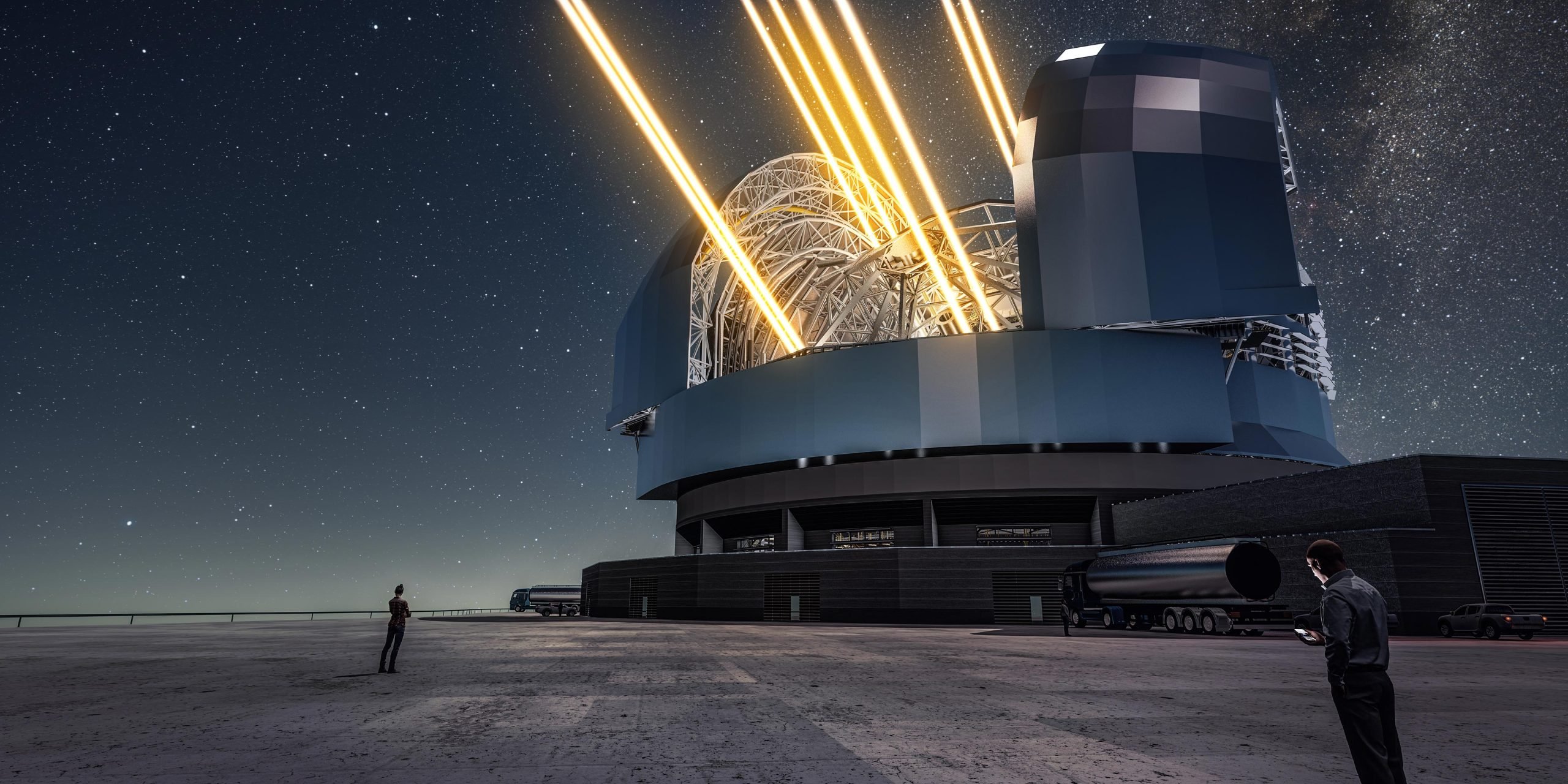
    Extremely Large Telescope (ELT) in Operation Rendering
    This artist’s rendering shows a night view of the Extremely Large Telescope in operation on Cerro Armazones in northern Chile. The telescope is shown using lasers to create artificial stars high in the atmosphere. Credit: ESO/L. Calçada

    Last Segment of the World’s Largest Telescope Mirror Successfully Cast

    Set for completion this decade, the Extremely Large Telescope in Chile will be the largest telescope globally, with a main mirror spanning 39 meters and made from 798 precision-engineered segments. It represents a significant international effort in astronomy.

    Currently under construction in the Chilean Atacama Desert, the European Southern Observatory’s Extremely Large Telescope (ESO’s ELT) is one step closer to completion. German company SCHOTT has successfully delivered the blank for the last of the 949 segments commissioned for the telescope’s primary mirror (M1). With a diameter of more than 39 meters, M1 will be by far the largest mirror ever made for a telescope.

    Innovations in Telescope Mirror Design

    Too large to be made from a single piece of glass, M1 will consist of 798 hexagonal segments, each about five centimeters thick and 1.5 meters across, working together to collect tens of millions of times as much light as the human eye. An additional 133 segments have been produced to facilitate the maintenance and recoating of the segments once the telescope is operational. ESO has also procured 18 spare segments, bringing the total number to 949.

    949th ELT Mirror Segment Is Cast
    The primary mirror of ESO’s Extremely Large Telescope (ELT), known as M1, will be by far the largest mirror ever made for a telescope. With a diameter of more than 39 meters, M1 is too large to be made from a single piece of glass and will instead consist of 798 hexagonal segments, each about five centimeters thick and 1.5 meters across, working together to collect tens of millions of times as much light as the human eye. An additional 133 segments have been produced to facilitate the maintenance and recoating of the segments once the telescope is operational. ESO has also procured 18 spare segments, bringing the total number to 949. Now, German company SCHOTT has successfully cast the blank for the last of the 949 segments, seen in this photo. The M1 blanks, shaped pieces of material that are later polished to become the mirror segments, are made from ZERODUR©, a low-expansion glass-ceramic material developed by SCHOTT and optimized for the extreme temperature ranges at the ELT’s site in the Atacama Desert. The 949th segment is seen in this image before being cut into its hexagonal shape and polished — steps that will be performed by French company Safran Reosc. Credit: SCHOTT

    Advanced Materials and Production Techniques

    The M1 blanks, shaped pieces of material that are later polished to become the mirror segments, are made from ZERODUR®, a low-expansion glass-ceramic material developed by SCHOTT and optimized for the extreme temperature ranges at the ELT’s site in the Atacama Desert. This company has also manufactured the blanks of three other ELT mirrors — M2, M3, and M4 — at their facilities in Mainz, Germany.

    Collaboration and Precision Engineering

    “What ESO ordered from SCHOTT is more than just ZERODUR®,” says Marc Cayrel, Head of ELT Optomechanics at ESO. “In close collaboration with ESO, SCHOTT fine-tuned every single production step, tailoring the product to meet and often exceed the ELT’s very demanding requirements. The outstanding quality of the blanks was maintained throughout the mass production of more than 230 tonnes of this super-performing material. ESO is thus very thankful for the professionalism of the skilled teams at SCHOTT, our trusted partner.”

    Extremely Large Telescope (ELT) Main Mirror (M1)
    Computer rendering showing the main mirror (M1) of the ESO Extremely Large Telescope. Credit: ESO

    Thomas Werner, ELT Project Lead at SCHOTT, says: “Our entire team is thrilled to conclude what has been the largest single order of ZERODUR® in the history of our company. For this project, we successfully concluded the serial production of hundreds of ZERODUR® mirror substrates, when we usually have a single-piece operation. It’s been an honor for all of us to play a part in shaping the future of astronomy.”

    International Logistics and Assembly

    Once cast (see video below), all segments follow a multi-step, international journey. After a slow cooling and heat treatment sequence, the surface of each blank is shaped by ultra-precision grinding at SCHOTT. The blanks are then transported to French company Safran Reosc, where each of them is cut into an hexagon shape and polished to a precision of 10 nanometers across the entire optical surface — meaning the surface irregularities of the mirror will be less than one-thousandth of the width of a human hair.

    Also involved in the work done on the M1 segment assemblies are: Dutch company VDL ETG Projects BV, which is producing the segment supports; the German-French FAMES consortium, which has developed and is finalising manufacturing for the 4500 nanometric-accuracy sensors monitoring the relative position of each segment; German company Physik Instrumente, which designed and is manufacturing the 2500 actuators able to position the segment to nanometric precision; and Danish company DSV, which is in charge of transporting the segments to Chile.

    Once polished and assembled, each M1 segment is shipped across the ocean to reach the ELT Technical Facility at ESO’s Paranal Observatory in the Atacama Desert — a 10,000-kilometer journey that over 70 M1 segments have already completed. In Paranal, only a few kilometers away from the construction site of the ELT, each segment is coated with a silver layer to become reflective, after which it will be carefully stored until the telescope’s main structure is ready to receive them.

    Final Stages and Future Impact

    When it starts operating later this decade, ESO’s ELT will be the world’s largest eye on the sky. It will tackle the biggest astronomical challenges of our time and make as-yet unimaginable discoveries.

    Never miss a breakthrough: Join the SciTechDaily newsletter.
    Follow us on Google and Google News.

    Astronomy European Southern Observatory
    Share. Facebook Twitter Pinterest LinkedIn Email Reddit

    Related Articles

    Supermassive Black Holes on a Collision Course: Closest Pair of Supermassive Black Holes to Earth Ever Discovered

    Black Hole Discovered Lurking in Star Cluster Outside Our Galaxy

    Discovery in a Galaxy Over 12 Billion Light-Years Away – Reveals How Element Found in Our Bones Is Forged in the Universe

    Strange 160 Mile-Long “Dog-Bone” Asteroid Kleopatra Captured in Detailed Images

    Astronomers Find Small Rocky Planet – Just Half the Mass of Venus

    First Clear Detection of a Moon-Forming Disc Around a Planet Outside Our Solar System

    Mystery Solved: Astronomers Unravel the Puzzle of Betelgeuse’s “Great Dimming”

    Stunning Galactic Fireworks: New ESO Images Reveal Spectacular Features of Nearby Galaxies

    Astronomers Were Puzzled by “Great Dimming” of Betelgeuse – Now the Mystery Is Solved

    Leave A Reply Cancel Reply

    • Facebook
    • Twitter
    • Pinterest
    • YouTube

    Don't Miss a Discovery

    Subscribe for the Latest in Science & Tech!

    Trending News

    Scientists Discover Stem Cells That Could Regrow Teeth and Bone

    Early Cannabis Use May Stall Key Brain Skills in Teens

    Popular Vitamin D Supplement Has “Previously Unknown” Negative Effect, Study Finds

    Study Reveals Malaria’s Hidden Role in Human Evolution

    The Hidden Risk of Taking Breaks From Weight-Loss Drugs Like Ozempic

    Scientists Warn That This Common Pet Fish Can Wreck Entire Ecosystems

    Scientists Make Breakthrough in Turning Plastic Trash Into Clean Fuel Using Sunlight

    This Popular Supplement May Interfere With Cancer Treatment, Scientists Warn

    Follow SciTechDaily
    • Facebook
    • Twitter
    • YouTube
    • Pinterest
    • Newsletter
    • RSS
    SciTech News
    • Biology News
    • Chemistry News
    • Earth News
    • Health News
    • Physics News
    • Science News
    • Space News
    • Technology News
    Recent Posts
    • Beyond Inflammation: Scientists Uncover New Cause of Persistent Rheumatoid Arthritis
    • Cancer-Like Mutations Found in the Brain May Be Driving Alzheimer’s Disease
    • A Simple Molecule Could Unlock Safer, Easier Weight Loss
    • Stretching Diamonds Unlocks Powerful New Quantum Sensing Abilities
    • This Robot Could Explore Mars 3x Faster Than Today’s Rovers
    Copyright © 1998 - 2026 SciTechDaily. All Rights Reserved.
    • Science News
    • About
    • Contact
    • Editorial Board
    • Privacy Policy
    • Terms of Use

    Type above and press Enter to search. Press Esc to cancel.