
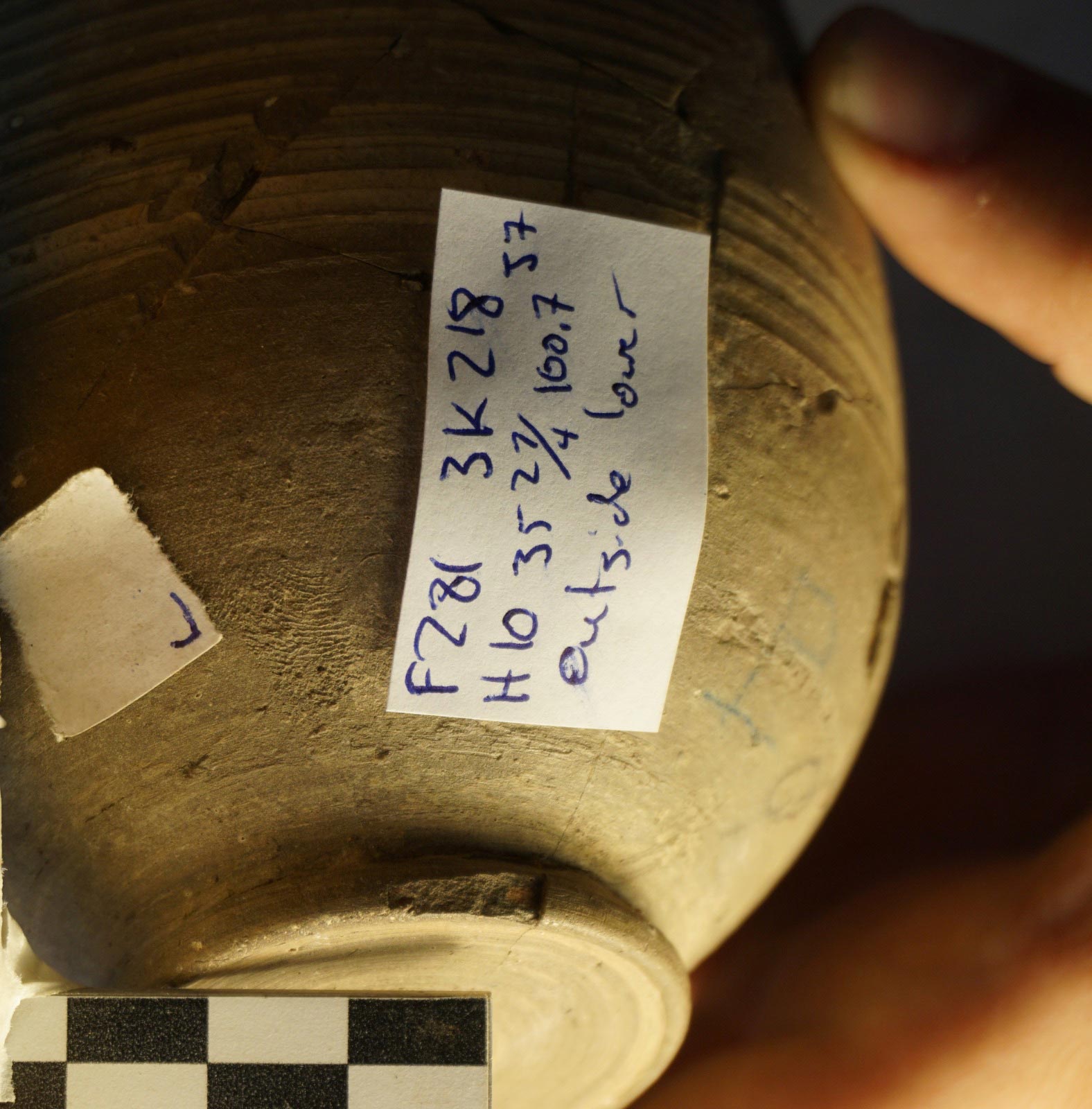
Archaeologists found that children in the Ebla Kingdom mass-produced pottery but also made their own creative figurines.
Archaeologists from Tel Aviv University and the National Museum in Copenhagen analyzed 450 pottery vessels from Tel Hama, a town on the outskirts of the Ebla Kingdom—one of the most influential Syrian kingdoms of the Early Bronze Age, dating back approximately 4,500 years. Their study revealed that about two-thirds of these vessels were crafted by children, some as young as seven or eight years old.
In addition to evidence of children’s labor supporting the kingdom’s production needs, researchers also identified pottery made independently by children outside the formal industrial framework. These personal creations provide insight into childhood expression even within early urban societies.
The research, led by Dr. Akiva Sanders, a Dan David Fellow at Tel Aviv University’s Entin Faculty of Humanities, was published in the journal Childhood in the Past.
Fingerprints Reveal Ancient Child Workers
Dr. Sanders: “Our research allows us a rare glimpse into the lives of children who lived in the area of the Ebla Kingdom, one of the oldest kingdoms in the world. We discovered that at its peak, roughly from 2400 to 2000 BCE, the cities associated with the kingdom began to rely on child labor for the industrial production of pottery. The children worked in workshops starting at the age of seven and were specially trained to create cups as uniformly as possible – which were used in the kingdom in everyday life and at royal banquets.”
As is well known, a person’s fingerprints do not change throughout their life. For this reason, the size of the palm can be roughly deduced from measuring the density of the margins of the fingerprint – and from the size of the palm, the age and sex of the person can estimated.

The pottery from Tel Hama, on the southern border of the Kingdom of Ebla, was excavated in the 1930s, and since then has been kept in the National Museum in Denmark. From the analysis of the fingerprints of the pottery it appears that most of them were made by children. In the city of Hama two-thirds of the pottery was made by children – the other third was created by older men.
The Impact of Urbanization on Pottery Production
“At the beginning of the Early Bronze Age, some of the world’s first city-kingdoms arose in the Levant and Mesopotamia,” says Dr. Sanders. “We wanted to use the fingerprints on the pottery to understand how processes such as urbanization and the centralization government functions affected the demographics of the ceramic industry. In the town of Hama, an ancient center for the production of ceramics, we initially see potters around the age of 12 and 13, with half the potters being under 18, and with boys and girls in equal proportions. This statistic changes with the formation of the Kingdom of Ebla, when we see that potters were starting to produce more goblets for banquets. And since more and more alcohol-fueled feasts were held, the cups were frequently broken – and therefore more cups needed to be made. Not only did the Kingdom begin to rely more and more on child labor, but the children were trained to make the cups as similar to each other as possible. This is a phenomenon we also see in the industrial revolution in Europe and America: it is very easy to control children and teach them specific movements to create standardization in handicrafts.”
However, there was one bright spot in the children’s lives: making tiny figurines and miniature vessels for themselves.
“These children taught each other to make miniature figurines and vessels, without the involvement of the adults,” says Dr. Sanders. “It is safe to say that they were created by children – and probably including those skilled children from the cup-making workshops. It seems that in these figurines the children expressed their creativity and their imagination.”
Reference: “Child and Clay: Fingerprints of a Dual Engagement at Hama, Syria” by Akiva Sanders, 25 July 2024, Childhood in the Past.
DOI: 10.1080/17585716.2024.2380137
Never miss a breakthrough: Join the SciTechDaily newsletter.
Follow us on Google and Google News.
1 Comment
can’t trust jewish archaeology, too many forgeries and false data in their archaeological modeling in the past. james the so called jesus brother plus thousands of other forgeries, plus their archaeological agenda is to prove Moloch the god of abraham and sarah is a real tangible person. moloch was is and always has been the god of child sacrifice. do some research