
Close Menu
    Facebook X (Twitter) Instagram
    SciTechDaily
    • Biology
    • Chemistry
    • Earth
    • Health
    • Physics
    • Science
    • Space
    • Technology
    Facebook X (Twitter) Pinterest YouTube RSS
    SciTechDaily
    Home»Space»First Direct Evidence That Intergalactic “Wind” is Stripping Galaxies of Star-Forming Gas
    Space

    First Direct Evidence That Intergalactic “Wind” is Stripping Galaxies of Star-Forming Gas

    By Dunlap Institute for Astronomy & AstrophysicsNovember 17, 2014No Comments4 Mins Read
    Facebook Twitter Pinterest Telegram LinkedIn WhatsApp Email Reddit
    Share
    Facebook Twitter LinkedIn Pinterest Telegram Email Reddit
    Intergalactic Wind is Stripping Galaxies of Star-Forming Gas
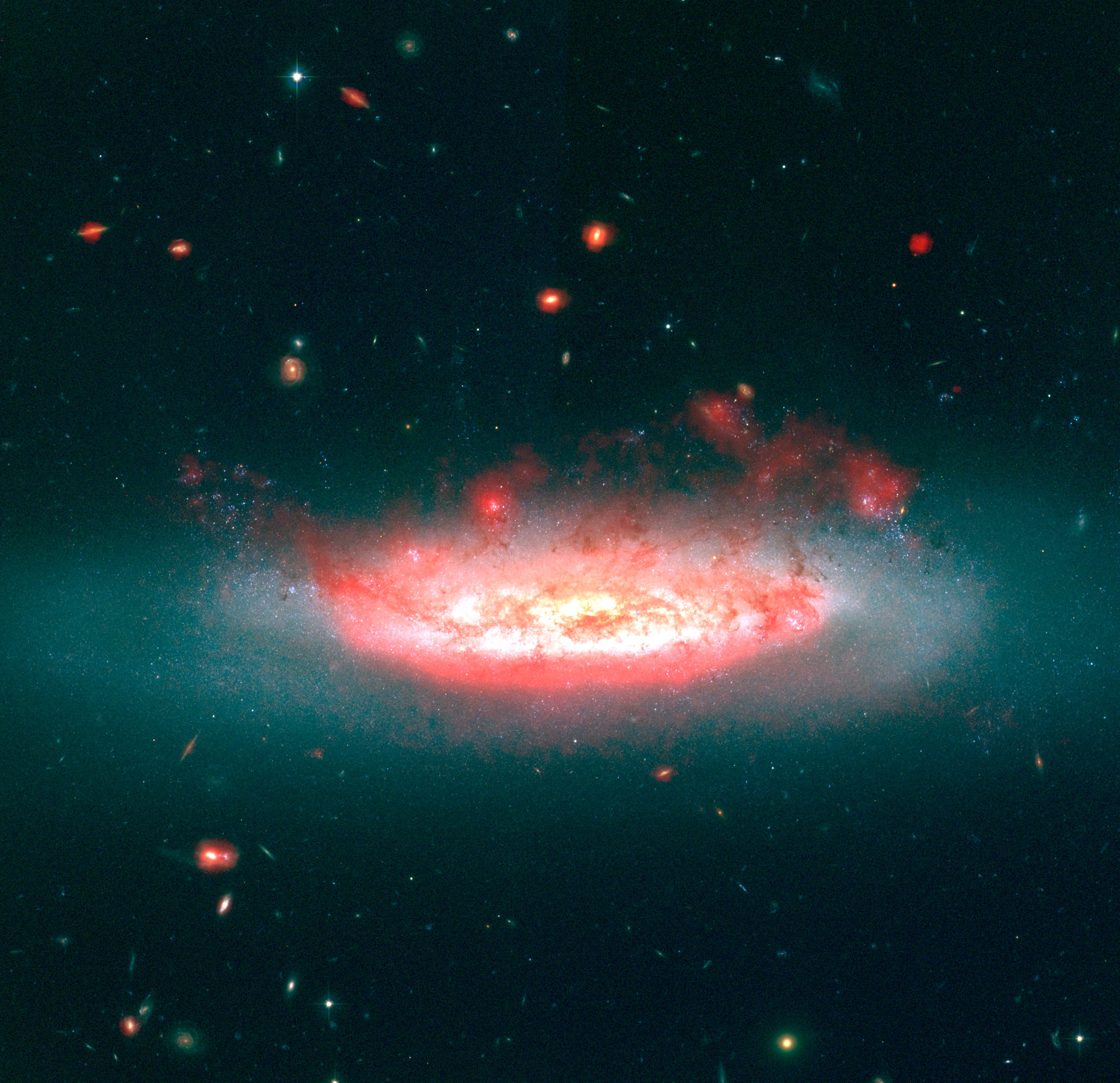
    A composite image shows the galaxy NGC 4522 in the Virgo Cluster, the nearest large cluster of galaxies to our own local group of galaxies, and the “wake” of gas and dust being blown from the galaxy. The galaxy appears blue in the Hubble Space Telescope image in visible light. The superimposed red image is from Spitzer data and shows emissions from dust that traces molecular hydrogen. In the image, the galaxy is moving down and into the plane of the photo. Credit: Suresh Sivanandam; Dunlap Institute for Astronomy & Astrophysics

    A newly published study provides the first direct evidence that an intergalactic “wind” is stripping galaxies of star-forming gas as they fall into clusters of galaxies, helping explain why galaxies found in clusters are known to have relatively little gas and less star formation when compared to non-cluster or “field” galaxies.

    Toronto, Ontario – Astronomers from the University of Toronto and the University of Arizona have theorized that as a field galaxy falls into a cluster of galaxies, it encounters the cloud of hot gas at the center of the cluster. As the galaxy moves through this intra-cluster medium at thousands of kilometers per second, the cloud acts like a wind, blowing away the gas within the galaxy without disturbing its stars. The process is known as ram-pressure stripping.

    Previously, astronomers had seen the very tenuous atomic hydrogen gas surrounding a galaxy get stripped. But it was believed that the denser molecular hydrogen clouds where stars form would be more resistant to the wind. “However, we found that the molecular hydrogen gas is also blown from the in-falling galaxy,” says Suresh Sivanandam of the Dunlap Institute at the University of Toronto, “much like smoke blown from a candle being carried into a room.”

    Previous observations showed indirect evidence of ram-pressure stripping of star-forming gas. Astronomers have observed young stars trailing from a galaxy; the stars would have formed from gas newly stripped from the galaxy. A few galaxies also have tails of very tenuous gas. But the latest observations show the stripped, molecular hydrogen itself, which can be seen as a wake trailing from the galaxy in the direction opposite to its motion.

    “For more than 40 years we have been trying to understand why galaxies in dense clusters have so few young stars compared with ones like our Milky Way Galaxy, but now we see the quenching of star formation in action,” says George Rieke of the University of Arizona. “Cutting off the gas that forms stars is a key step in the evolution of galaxies from the early Universe to the present.”

    The results, published in the Astrophysical Journal on November 10, are from observations of four galaxies. Sivanandam, Rieke, and colleague Marcia Rieke (also from the University of Arizona) had already established that one of the four galaxies had been stripped of its star-forming gas by this wind. But by observing four galaxies, they have now shown that this effect is common.

    The team made their analysis using optical, infrared, and hydrogen-emission data from the Spitzer and Hubble space telescopes, as well as archival ground-based data. The team used an infrared spectrograph on the Spitzer because direct observation of the molecular hydrogen required observations in the mid-infrared part of the spectrum—something that’s almost impossible to do from the ground.

    “Seeing this stripped molecular gas is like seeing a theory on display in the sky,” says Marcia Rieke. “Astronomers have assumed that something stopped the star formation in these galaxies, but it is very satisfying to see the actual cause.”

    Reference: “Tracing Ram-Pressure Stripping with Warm Molecular Hydrogen Emission” by Suresh Sivanandam, Marcia J. Rieke and George H. Rieke, 10 November 2014, The Astrophysical Journal.
    DOI: 10.1088/0004-637X/796/2/89

    Never miss a breakthrough: Join the SciTechDaily newsletter.
    Follow us on Google and Google News.

    Astronomy Astrophysics Dunlap Institute University of Toronto
    Share. Facebook Twitter Pinterest LinkedIn Email Reddit

    Related Articles

    Dark Matter Was the Key: Astrophysicists Solve Longstanding “Final Parsec Problem”

    Mysterious Origins: Polarized Light Transforms Our Understanding of Fast Radio Bursts

    Pioneering Discovery of Binary Stripped Stars Unlocks Cosmic Secrets

    A Vast “Magnetic Tunnel” May Surround Earth and Our Entire Solar System

    Astronomers Show Planetary Harmonies Save The TRAPPIST-1 System From Destruction

    Kepler Finds Evidence of Daily Weather Cycles on Exoplanets

    Astrophysicists Examine the Possibility of Planets Forming around HL Tauri

    Herschel Data Reveals Clues About High-Mass Star Formation

    Researchers Observed the Atmosphere of a Jupiter-Like Planet Beyond Our Solar System

    Leave A Reply Cancel Reply

    • Facebook
    • Twitter
    • Pinterest
    • YouTube

    Don't Miss a Discovery

    Subscribe for the Latest in Science & Tech!

    Trending News

    Millions of People Have Osteopenia Without Realizing It – Here’s What You Need To Know

    Researchers Discover Boosting a Single Protein Helps the Brain Fight Alzheimer’s

    World-First Study Reveals Human Hearts Can Regenerate After a Heart Attack

    Why Your Dreams Feel So Real Sometimes and So Strange Other Times

    This Simple Home Device May Boost Brain Power in Adults Over 40

    Enormous Prehistoric Insects Puzzle Scientists

    Scientists Develop Bioengineered Chewing Gum That Could Help Fight Oral Cancer

    After 37 Years, the World’s Longest-Running Soil Warming Experiment Uncovers a Startling Climate Secret

    Follow SciTechDaily
    • Facebook
    • Twitter
    • YouTube
    • Pinterest
    • Newsletter
    • RSS
    SciTech News
    • Biology News
    • Chemistry News
    • Earth News
    • Health News
    • Physics News
    • Science News
    • Space News
    • Technology News
    Recent Posts
    • Researchers Identify the Most Common Recessive Neurodevelopmental Disorder Ever Discovered
    • This Is What Makes You Irresistible to Mosquitoes
    • Shockingly Powerful Giant Octopuses Ruled the Seas 100 Million Years Ago
    • After 100 Years, Scientists Uncover Hidden Rule Governing Cosmic Rays
    • The Milky Way Has a Hidden Edge and Scientists Finally Mapped It
    Copyright © 1998 - 2026 SciTechDaily. All Rights Reserved.
    • Science News
    • About
    • Contact
    • Editorial Board
    • Privacy Policy
    • Terms of Use

    Type above and press Enter to search. Press Esc to cancel.