
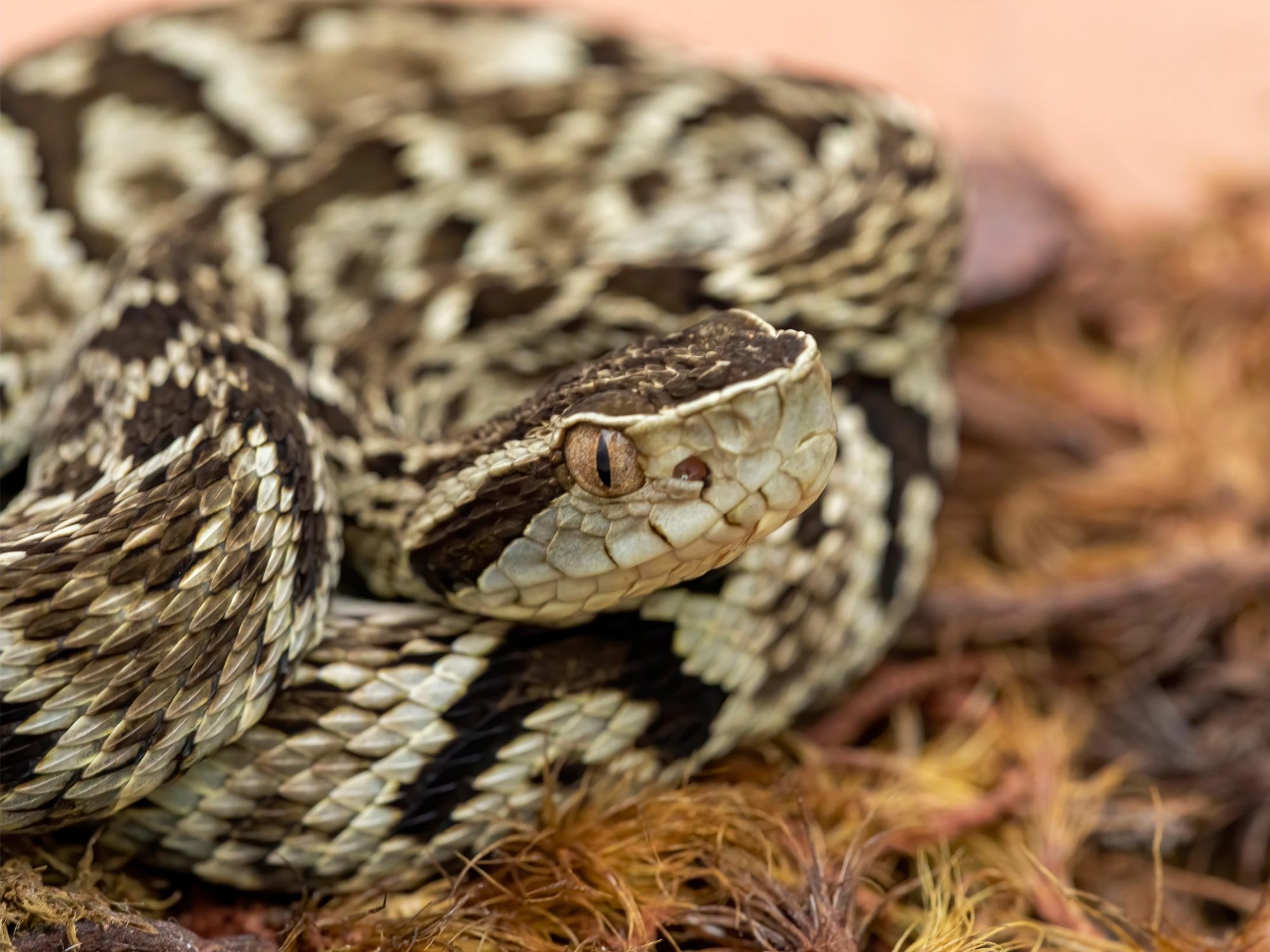
In an article published in PNAS, researchers affiliated with Butantan Institute describe the genome of Bothrops jararaca and suggest the origin of genes responsible for toxins in its venom.
A group led by researchers at Butantan Institute and funded by São Paulo Research Foundation — FAPESP has completed the first sequencing of a Brazilian snake’s genome. The study is reported in an article published in the journal PNAS. It suggests that the nine genes that encode toxins produced by the jararaca pit viper Bothrops jararaca probably originated in genes that had different functions in the ancestral species.
“In sequencing the snake’s genome, we identified markers that enabled us to compare toxin genes with genes in the same position in the genomes of other animals, such as snakes without venom, lizards, and amphibians. We found nine of the 12 toxin genes in the jararaca to be highly similar to those occupying the same position in the DNA of these other species. We concluded that most of the toxin genes probably arose from elements that already existed in the same part of the genome of the ancestor common to all these animals,” said Inácio Junqueira de Azevedo, a researcher at Butantan Institute and last author of the article.
Azevedo is a principal investigator at the Center for Research on Toxins, Immune Response and Cell Signaling (CeTICS), one of the Research, Innovation and Dissemination Centers (RIDCs) funded by FAPESP.

Ancient Genes Repurposed as Toxins
“These genes had physiological functions in the common ancestor of all these species. At some point they probably began playing a role similar to toxin genes or were selected for this route and lost their original functions. Our study located elements that will help scientists understand the evolution of toxins and the mechanisms that led to the recruitment of certain genes to perform this new function in the production of venom,” said Diego Dantas Almeida, first author of the article. The study was conducted during his PhD research, which was supported by FAPESP.
The sequencing also showed that two genes that encode important toxins probably originated in duplication. In any organism, a gene normally evolves more freely and ends up performing different functions when a copy performs its original functions.
In the jararaca, the copies must have come under selective pressure to produce two families of toxins that account for most of the venom’s action: snake venom metalloproteinases (SVMPs) and phospholipases A2 (PLA2). Most of the genes that encode toxins in this snake were already thought to have originated in this manner. It was impossible to determine the origin of only one of the 12 gene families that encode its toxins.
“We were able to show that non-toxic ‘ancestral’ genes exist in these two families. They’re still present in the DNA, right alongside the toxin genes. The ancestral genes have completely disappeared from the other families. They’ve probably been transformed into toxin genes,” said Vincent Louis Viala, a co-author of the article and former recipient of a postdoctoral fellowship from FAPESP.
Research Effort
The Butantan Institute group began sequencing this snake’s genome in 2013. B. jararaca is responsible for a large proportion of snake-bite accidents in Brazil and is one of the most studied snakes for this reason. The sequencing produced the fundamental information on the origins of its venom they had lacked hitherto.
In addition to enhancing knowledge of the genes in an organism, sequencing its genome assembles them in the right order. This is one of the most complex parts of the task because sequencing generates a vast amount of data, which has to be processed using computational tools.
Only in recent years, after combining several methods, did the group succeed in assembling the genome satisfactorily, with the collaboration of researchers at Ohio State University in the United States. The complete genome sequence is available online to anyone who wishes to study it.
The project produced answers to several other key questions. In 2009, an analysis by Japanese researchers of certain toxin genes from Protobothrops flavoviridis, which belongs to the same family as the jararaca (Viperidae), suggested the gene that encodes the toxin VEGF-F, also present in the Brazilian snake, probably resulted from duplication of the gene VEGF-A. The Brazilian group have now shown that it is more likely to have originated in a different gene family known in the scientific literature as “PGF-like”.
Implications for Drug Development and Evolutionary Biology
The group also assembled more evidence that bradykinin-potentiating peptides (BPP), which are the basis for the anti-hypertensive drug captopril, probably originated in the gene CNP, which encodes C-type natriuretic peptides present in other vertebrates, including humans.
“The study illustrates the need to identify the context in which genes are inserted in order to understand their origin and evolution correctly,” Azevedo said.
The researchers are now working on more refined versions of the jararaca’s genome and those of other venomous snake families, hoping to find novel toxins and link them to proteins of relevance in the physiology of other organisms.
Reference: “Tracking the recruitment and evolution of snake toxins using the evolutionary context provided by the Bothrops jararaca genome” by Diego Dantas Almeida, Vincent Louis Viala, Pedro Gabriel Nachtigall, Michael Broe, H. Lisle Gibbs, Solange Maria de Toledo Serrano, Ana Maria Moura-da-Silva, Paulo Lee Ho, Milton Yutaka Nishiyama-Jr and Inácio L. M. Junqueira-de-Azevedo, 18 May 2021, Proceedings of the National Academy of Sciences.
DOI: 10.1073/pnas.2015159118
The study was also funded via a Thematic Project conducted under the aegis of the FAPESP Research Program on Biodiversity Characterization, Conservation, Restoration and Sustainable Use (BIOTA-FAPESP) and a Regular Research Grant awarded to Azevedo.
Never miss a breakthrough: Join the SciTechDaily newsletter.
Follow us on Google and Google News.