
Close Menu
    Facebook X (Twitter) Instagram
    SciTechDaily
    • Biology
    • Chemistry
    • Earth
    • Health
    • Physics
    • Science
    • Space
    • Technology
    Facebook X (Twitter) Pinterest YouTube RSS
    SciTechDaily
    Home»Space»First Glimpse: OSIRIS-REx’s Historic Return With Asteroid Bennu Sample
    Space

    First Glimpse: OSIRIS-REx’s Historic Return With Asteroid Bennu Sample

    By European Space Agency (ESA)September 23, 2023No Comments3 Mins Read
    Facebook Twitter Pinterest Telegram LinkedIn WhatsApp Email Reddit
    Share
    Facebook Twitter LinkedIn Pinterest Telegram Email Reddit
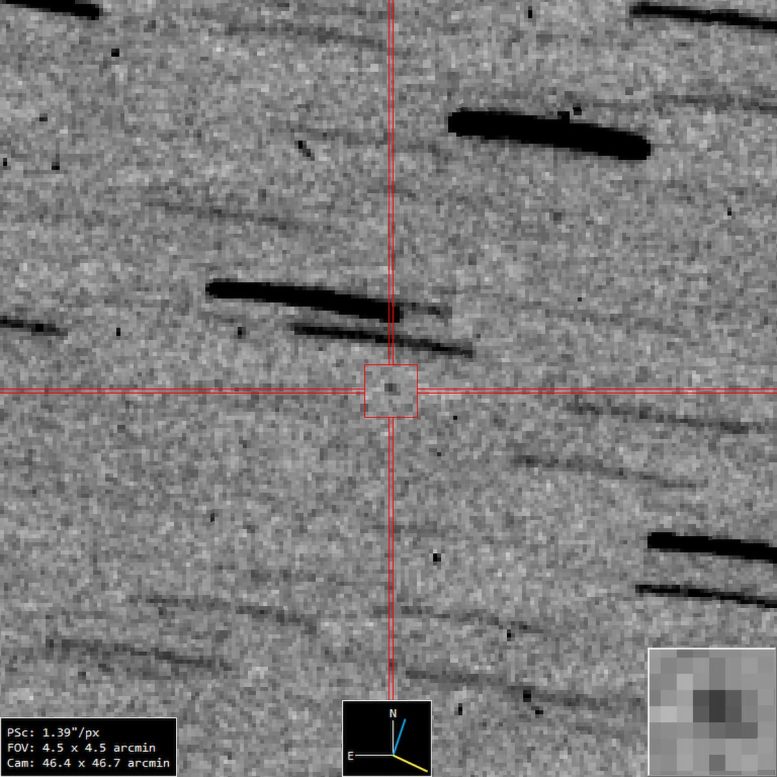
    OSIRIS-REx OGS Telescope
    NASA’s OSIRIS-REx, after visiting the ancient asteroid Bennu, is en route to Earth with a sample from the asteroid. Captured in this image by ESA’s Optical Ground Station (OGS) telescope on September 16, the spacecraft is seen 4.66 million km away from our planet. Credit: ESA

    NASA’s OSIRIS-REx spacecraft is returning from asteroid Bennu with a sample, set to land on Earth on September 24. ESA’s telescope captured the spacecraft 2.90 million miles away.

    Is it a spacecraft? An asteroid? Well, both. This small central speck is the first image of a spacecraft on its way home, carrying with it a sample from an asteroid hundreds-of-millions, if-not-billions-of-years old. The spacecraft is NASA’s OSIRIS-REx, the asteroid is Bennu.

    On Sunday, September 24, the mission will drop its rocky sample off to fall through Earth’s atmosphere and land safely back home, before it continues on to study the once rather scary asteroid Apophis.
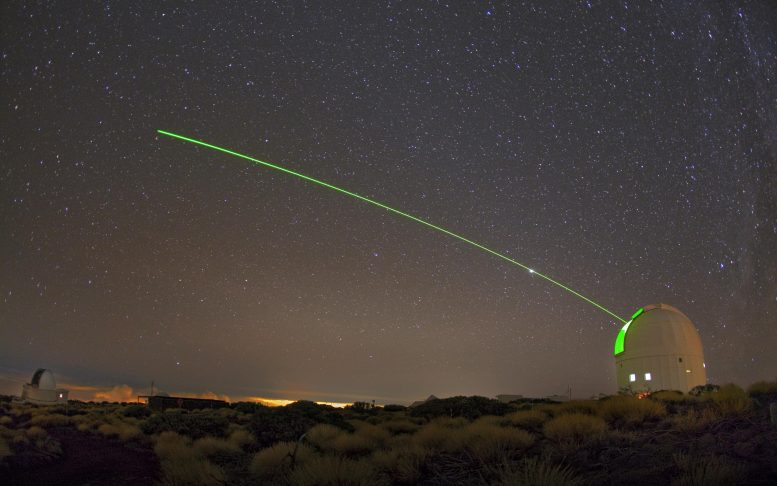
    ESA's Optical Ground Station
    A visible green laser shone from ESA’s Optical Ground Station (OGS). Part of Teide Observatory, the OGS located 2400 m above sea level on the volcanic island of Tenerife, used for the development of optical communication systems for space as well as space debris and near-Earth orbject surveys and quantum communication experiments. The laser looks curved because this picture was taken with a fisheye lens. Credit: IAC– Daniel López

    Spotted on September 16 by ESA’s Optical Ground Station (OGS) telescope in Tenerife, OSIRIS-REx was 2.90 million miles (4.66 million km) from Earth. This image is a combination of 90 individual images, each 36-second exposures. They have been combined in a way that takes into account the motion of the spacecraft, which is not traveling in a straight line, causing the seemingly stretched background stars to curve and warp.

    ESA’s 1-meter OGS telescope was originally built to observe space debris in orbit and test laser communication technologies, but since broadened its horizons to also conduct surveys and follow-up observations of near-Earth asteroids and make night-time astronomy observations and has even discovered dozens of minor planets.

    For this observation, ESA’s Near-Earth Object Coordination Centre (NEOCC) took over the reins, directing it at the returning asteroid explorer. The NEOCC, part of the Agency’s Planetary Defence Office, is a little like Europe’s asteroid sorting hat; the center and its experts are scanning the skies for risky space rocks, computing their orbits and calculating their risk of impact.

    From our small but mighty Space Safety telescope, we say ‘Hello, OSIRIS-REx, good luck NASA and welcome safely to Earth, asteroid Bennu!’.
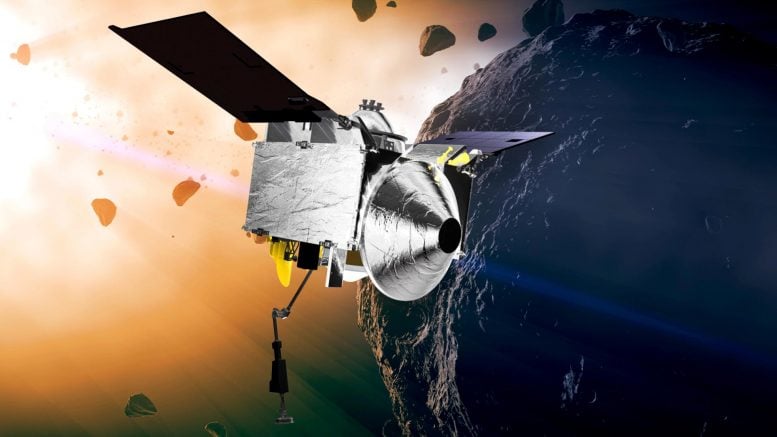
    NASA's OSIRIS-REx Asteroid Sample Return Mission
    NASA’s OSIRIS-REx Asteroid Sample Return Mission. Credit: NASA’s Goddard Space Flight Center

    NASA’s OSIRIS-REx Mission

    The OSIRIS-REx mission, which stands for Origins, Spectral Interpretation, Resource Identification, Security, Regolith Explorer, is a NASA-led endeavor aimed at studying the near-Earth asteroid Bennu. Launched on September 8, 2016, the mission’s primary goal is to bring back a sample from the asteroid to Earth. This effort is particularly significant as it allows scientists to study pristine materials from the solar system’s early history, possibly providing insights into the origins of life on Earth.

    Key Milestones:

    • Launch: September 8, 2016, from Cape Canaveral Air Force Station, Florida.
    • Bennu Arrival: OSIRIS-REx arrived at Bennu on December 3, 2018.
    • Sample Collection: On October 20, 2020, the spacecraft successfully touched down on Bennu, collecting a sample.
    • Sample Return: The spacecraft is expected to deliver the sample to Earth on September 24, 2023.

    Never miss a breakthrough: Join the SciTechDaily newsletter.
    Follow us on Google and Google News.

    Asteroid European Space Agency OSIRIS-REx
    Share. Facebook Twitter Pinterest LinkedIn Email Reddit

    Related Articles

    Brian May (Lead Guitarist of Rock Band Queen) Works to Probe Origin of Asteroids

    NASA’s OSIRIS-REx Spacecraft Discovers Water on Asteroid Bennu

    NASA’s OSIRIS-REx Spacecraft Arrives at Asteroid Bennu

    OSIRIS-REx Captures ‘Super-Resolution’ Image of Asteroid Bennu

    OSIRIS-REx Spacecraft Executes First Asteroid Approach Maneuver

    NASA’s OSIRIS-REx Captures First Glimpse of Asteroid Bennu

    New NASA Animation Follows Long, Strange Trip of Asteroid Bennu

    Rosetta Spacecraft Reveals Hidden Crater on Asteroid Lutetia

    NASA’s OSIRIS-REx Mission to Collect Asteroid Sample Moves Into Development Phase

    Leave A Reply Cancel Reply

    • Facebook
    • Twitter
    • Pinterest
    • YouTube

    Don't Miss a Discovery

    Subscribe for the Latest in Science & Tech!

    Trending News

    Popular Sugar-Free Sweetener Linked to Liver Disease, Study Warns

    What Is Hantavirus? The Deadly Disease Raising Alarm Worldwide

    Scientists Just Discovered How the Universe Builds Monster Black Holes

    Scientists Unveil New Treatment Strategy That Could Outsmart Cancer

    A Simple Vitamin May Hold the Key to Treating Rare Genetic Diseases

    Scientists Think the Real Fountain of Youth May Be Hiding in Your Gut

    Ravens Don’t Follow Wolves, They Predict Them

    This Common Knee Surgery May Be Doing More Harm Than Good

    Follow SciTechDaily
    • Facebook
    • Twitter
    • YouTube
    • Pinterest
    • Newsletter
    • RSS
    SciTech News
    • Biology News
    • Chemistry News
    • Earth News
    • Health News
    • Physics News
    • Science News
    • Space News
    • Technology News
    Recent Posts
    • “Totally Unexpected” – Scientists Discover Pancreatic Cancer’s Fatal Addiction
    • A Strange Quantum Effect May Explain One of Biology’s Greatest Mysteries
    • NASA’s Psyche Spacecraft Is About To Fly Shockingly Close to Mars
    • This Mars Rock Refused To Let Go of NASA’s Curiosity Rover
    • James Webb Telescope Reveals the Universe’s Hidden Cosmic Web in Stunning Detail
    Copyright © 1998 - 2026 SciTechDaily. All Rights Reserved.
    • Science News
    • About
    • Contact
    • Editorial Board
    • Privacy Policy
    • Terms of Use

    Type above and press Enter to search. Press Esc to cancel.