
Close Menu
    Facebook X (Twitter) Instagram
    SciTechDaily
    • Biology
    • Chemistry
    • Earth
    • Health
    • Physics
    • Science
    • Space
    • Technology
    Facebook X (Twitter) Pinterest YouTube RSS
    SciTechDaily
    Home»Space»First Image Captured by One of NASA’s Mars Cube One CubeSats
    Space

    First Image Captured by One of NASA’s Mars Cube One CubeSats

    By Andrew Good, Jet Propulsion LaboratoryMay 16, 2018No Comments3 Mins Read
    Facebook Twitter Pinterest Telegram LinkedIn WhatsApp Email Reddit
    Share
    Facebook Twitter LinkedIn Pinterest Telegram Email Reddit
    CubeSat Views Earth
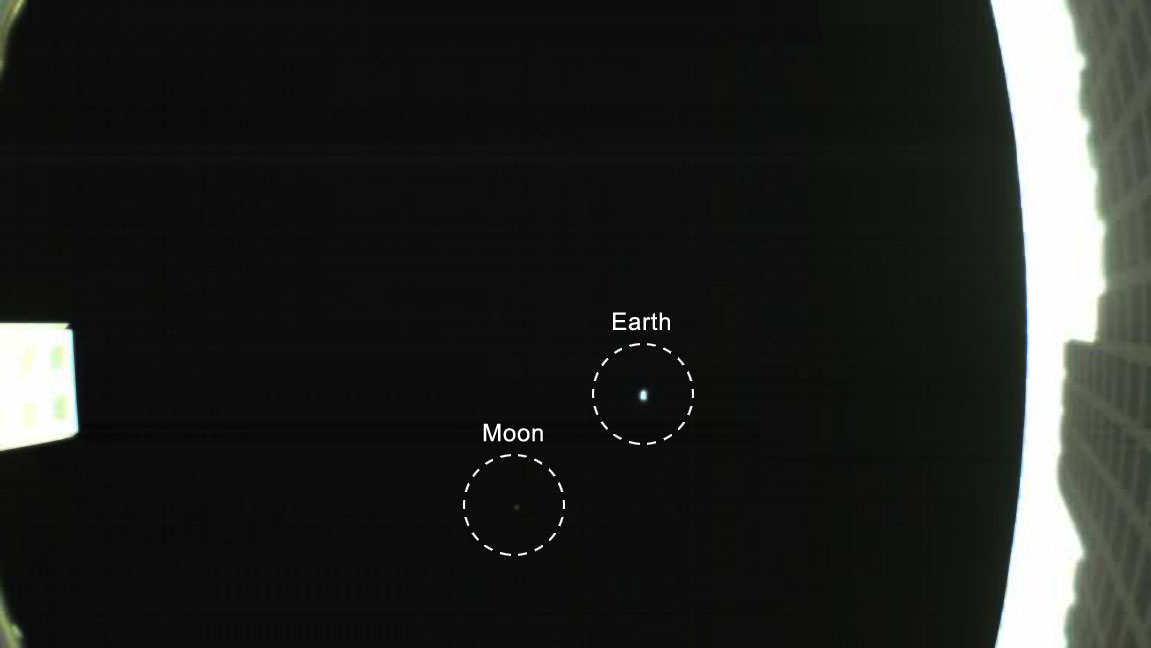
    The first image captured by one of NASA’s Mars Cube One (MarCO) CubeSats. The image, which shows both the CubeSat’s unfolded high-gain antenna at right and the Earth and its moon in the center, was acquired by MarCO-B on May 9. Credit: NASA/JPL-Caltech

    NASA’s Voyager 1 took a classic portrait of Earth from several billion miles away in 1990. Now a class of tiny, boxy spacecraft, known as CubeSats, have just taken their own version of a “pale blue dot” image, capturing Earth and its moon in one shot.

    NASA set a new distance record for CubeSats on May 8 when a pair of CubeSats called Mars Cube One (MarCO) reached 621,371 miles (1 million kilometers) from Earth. One of the CubeSats, called MarCO-B (and affectionately known as “Wall-E” to the MarCO team) used a fisheye camera to snap its first photo on May 9. That photo is part of the process used by the engineering team to confirm the spacecraft’s high-gain antenna has properly unfolded.

    As a bonus, it captured Earth and its moon as tiny specks floating in space.

    “Consider it our homage to Voyager,” said Andy Klesh, MarCO’s chief engineer at NASA’s Jet Propulsion Laboratory, Pasadena, California. JPL built the CubeSats and leads the MarCO mission. “CubeSats have never gone this far into space before, so it’s a big milestone. Both our CubeSats are healthy and functioning properly. We’re looking forward to seeing them travel even farther.”

    The MarCO spacecraft are the first CubeSats ever launched to deep space. Most never go beyond Earth orbit; they generally stay below 497 miles (800 kilometers) above the planet. Though they were originally developed to teach university students about satellites, CubeSats are now a major commercial technology, providing data on everything from shipping routes to environmental changes.

    The MarCO CubeSats were launched on May 5 along with NASA’s InSight lander, a spacecraft that will touch down on Mars and study the planet’s deep interior for the first time. InSight, short for Interior Exploration using Seismic Investigations, Geodesy and Heat Transport, will attempt to land on Mars on November 26. JPL also leads the InSight mission.

    Mars landings are notoriously challenging due to the Red Planet’s thin atmosphere. The MarCO CubeSats will follow along behind InSight during its cruise to Mars. Should they make it all the way to Mars, they will radio back data about InSight while it enters the atmosphere and descends to the planet’s surface. The high-gain antennas are key to that effort; the MarCO team have early confirmation that the antennas have successfully deployed, but will continue to test them in the weeks ahead.

    InSight won’t rely on the MarCO mission for data relay. That job will fall to NASA’s Mars Reconnaissance Orbiter. But the MarCOs could be a pathfinder so that future missions can “bring their own relay” to Mars. They could also demonstrate a number of experimental technologies, including their antennas, radios and propulsion systems, which will allow CubeSats to collect science in the future.

    Later this month, the MarCOs will attempt the first trajectory correction maneuvers ever performed by CubeSats. This maneuver lets them steer towards Mars, blazing a trail for CubeSats to come.

    Never miss a breakthrough: Join the SciTechDaily newsletter.
    Follow us on Google and Google News.

    Astronomy CubeSat
    Share. Facebook Twitter Pinterest LinkedIn Email Reddit

    Related Articles

    NASA Selects 10 New CubeSat Missions To Fly to the International Space Station

    Rocket Lab’s Electron Rocket Sends Series of New CubeSats to Space

    NASA CubeSat Mission Receives Funding to Solve Venusian Mystery

    VISTA Telescope Uses IR to Show Helix Nebula In New Light

    Adaptive Optics Will Put Gemini Twin Telescopes at the Forefront of Astronomy Again

    SN Primo Is Farthest Type Ia Supernova Discovered

    Scientists Convene to Take a Picture of the Supermassive Black Hole at the Center of the Milky Way

    Hubble Observes Rare Blue Stars in Andromeda’s Core

    Astronomers Discover 18 New Planets

    Leave A Reply Cancel Reply

    • Facebook
    • Twitter
    • Pinterest
    • YouTube

    Don't Miss a Discovery

    Subscribe for the Latest in Science & Tech!

    Trending News

    Millions of People Have Osteopenia Without Realizing It – Here’s What You Need To Know

    Researchers Discover Boosting a Single Protein Helps the Brain Fight Alzheimer’s

    World-First Study Reveals Human Hearts Can Regenerate After a Heart Attack

    Why Your Dreams Feel So Real Sometimes and So Strange Other Times

    This Simple Home Device May Boost Brain Power in Adults Over 40

    Enormous Prehistoric Insects Puzzle Scientists

    Scientists Develop Bioengineered Chewing Gum That Could Help Fight Oral Cancer

    After 37 Years, the World’s Longest-Running Soil Warming Experiment Uncovers a Startling Climate Secret

    Follow SciTechDaily
    • Facebook
    • Twitter
    • YouTube
    • Pinterest
    • Newsletter
    • RSS
    SciTech News
    • Biology News
    • Chemistry News
    • Earth News
    • Health News
    • Physics News
    • Science News
    • Space News
    • Technology News
    Recent Posts
    • This New “Sound Laser” Could Measure Gravity With Stunning Precision
    • Quantum Breakthrough: New Algorithm Solves “Impossible” Materials in Seconds
    • Could the Universe’s Hidden Shape Solve One of Physics’ Biggest Mysteries?
    • Rewriting Dinosaur Evolution: Scientists Unearth Remarkable 150-Million-Year-Old Stegosaur Skull
    • Scientists Identify Two Simple Treatments for Cancer-Related Cognitive Impairment
    Copyright © 1998 - 2026 SciTechDaily. All Rights Reserved.
    • Science News
    • About
    • Contact
    • Editorial Board
    • Privacy Policy
    • Terms of Use

    Type above and press Enter to search. Press Esc to cancel.