
Close Menu
    Facebook X (Twitter) Instagram
    SciTechDaily
    • Biology
    • Chemistry
    • Earth
    • Health
    • Physics
    • Science
    • Space
    • Technology
    Facebook X (Twitter) Pinterest YouTube RSS
    SciTechDaily
    Home»Space»NASA CubeSat Captures Its First Image of Mars
    Space

    NASA CubeSat Captures Its First Image of Mars

    By Jon Nelson, NASAOctober 23, 2018No Comments2 Mins Read
    Facebook Twitter Pinterest Telegram LinkedIn WhatsApp Email Reddit
    Share
    Facebook Twitter LinkedIn Pinterest Telegram Email Reddit

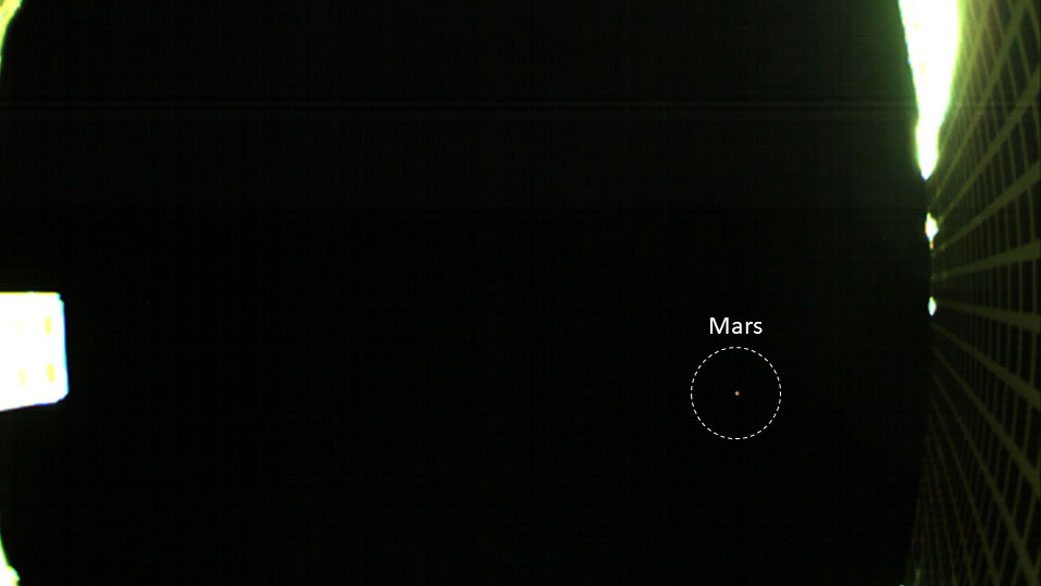
    NASA's First Image of Mars from a CubeSat

    NASA’s MarCO mission was designed to find out if briefcase-sized spacecraft called CubeSats could survive the journey to deep space. Now, MarCO – which stands for Mars Cube One – has Mars in sight.

    One of the twin MarCO CubeSats snapped this image of Mars on October 3 – the first image of the Red Planet ever produced by this class of tiny, low-cost spacecraft. The two CubeSats are officially called MarCO-A and MarCO-B but nicknamed “EVE” and “Wall-E” by their engineering team.

    A wide-angle camera on top of MarCO-B produced the image as a test of exposure settings. The MarCO mission, led by NASA’s Jet Propulsion Laboratory in Pasadena, California, hopes to produce more images as the CubeSats approach Mars ahead of November 26. That’s when they’ll demonstrate their communications capabilities while NASA’s InSight spacecraft attempts to land on the Red Planet. (The InSight mission won’t rely on them, however; NASA’s Mars orbiters will be relaying the spacecraft’s data back to Earth.)

    This image was taken from a distance of roughly 8 million miles (12.8 million kilometers) from Mars. The MarCOs are “chasing” Mars, which is a moving target as it orbits the Sun. In order to be in place for InSight’s landing, the CubeSats have to travel roughly 53 million miles (85 million kilometers). They have already traveled 248 million miles (399 million kilometers).
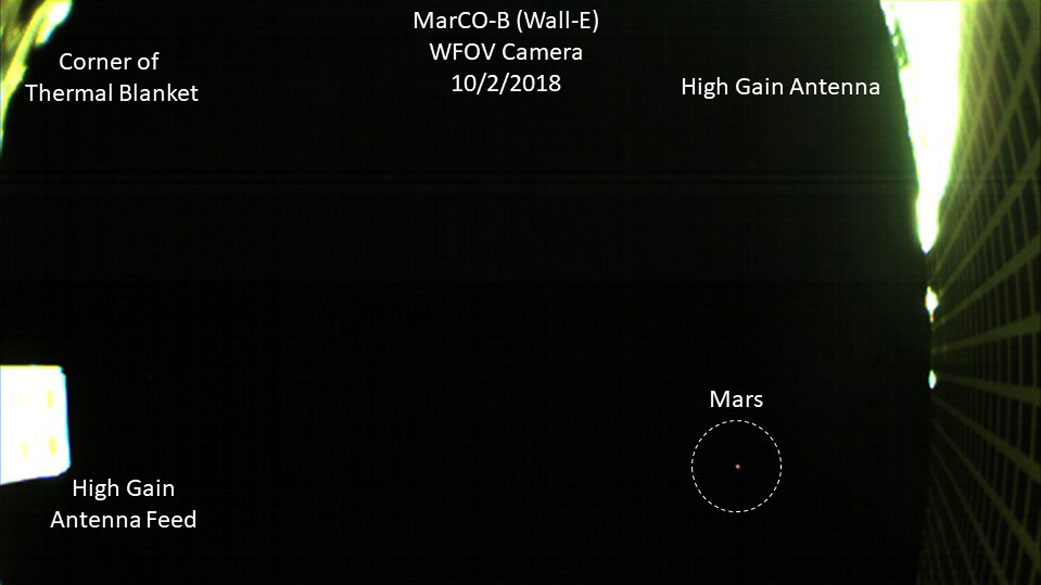
    First Image of Mars from a CubeSat
    One of NASA’s twin MarCO spacecraft took this image of Mars on October 2 — the first time a CubeSat, a kind of low-cost, briefcase-sized spacecraft — has done so. Credit: NASA/JPL-Caltech

    MarCO-B’s wide-angle camera looks straight out from the deck of the CubeSat. Parts related to the spacecraft’s high-gain antenna are visible on either side of the image. Mars appears as a small red dot at the right of the image.
    To take the image, the MarCO team had to program the CubeSat to rotate in space so that the deck of its boxy “body” was pointing at Mars. After several test images, they were excited to see that clear, red pinprick.

    “We’ve been waiting six months to get to Mars,” said Cody Colley, MarCO’s mission manager at JPL. “The cruise phase of the mission is always difficult, so you take all the small wins when they come. Finally seeing the planet is definitely a big win for the team.”

    For more information about MarCO, visit: https://www.jpl.nasa.gov/cubesat/missions/marco.php

    Never miss a breakthrough: Join the SciTechDaily newsletter.
    Follow us on Google and Google News.

    CubeSat Mars Planetary Science
    Share. Facebook Twitter Pinterest LinkedIn Email Reddit

    Related Articles

    NASA’s Curiosity Prepares for Use of Its Arm and Tools

    Curiosity Sends Back Radioed Words and New Telephoto View of Mars

    Curiosity’s ChemCam Laser Yields Good Results

    NASA’s Curiosity Readies for First Drive on Mars

    Color HiRISE Image of Curiosity Rover on Mars

    First 360-Degree Color Panorama From NASA’s Curiosity Mars Rover

    First Full-Resolution Images From Curiosity’s Navigation Cameras

    A Connection Between Volatiles in the Subsurface of Mars and the Impact Process

    Phobos May Provide Evidence of Life on Mars

    Leave A Reply Cancel Reply

    • Facebook
    • Twitter
    • Pinterest
    • YouTube

    Don't Miss a Discovery

    Subscribe for the Latest in Science & Tech!

    Trending News

    Mezcal “Worm” in a Bottle Mystery: DNA Testing Reveals a Surprise

    New Research Reveals That Your Morning Coffee Activates an Ancient Longevity Switch

    This Is What Makes You Irresistible to Mosquitoes

    Shockingly Powerful Giant Octopuses Ruled the Seas 100 Million Years Ago

    Scientists Stunned by New Organic Molecules Found on Mars

    Rewriting Dinosaur Evolution: Scientists Unearth Remarkable 150-Million-Year-Old Stegosaur Skull

    Omega-3 Supplements Linked to Cognitive Decline in Surprising New Study

    First-of-Its-Kind Discovery: Homer’s Iliad Found Embedded in a 1,600-Year-Old Egyptian Mummy

    Follow SciTechDaily
    • Facebook
    • Twitter
    • YouTube
    • Pinterest
    • Newsletter
    • RSS
    SciTech News
    • Biology News
    • Chemistry News
    • Earth News
    • Health News
    • Physics News
    • Science News
    • Space News
    • Technology News
    Recent Posts
    • A Common Nutrient May Play a Surprising Role in Anxiety
    • Doing This After 9 p.m. Could Double Your Risk of Gut Issues
    • New Research Challenges Long-Held Beliefs About How the Brain Makes Decisions
    • Breakthrough Technology Reveals New Treatment Targets for Cancer
    • Scientists Discover New Way To Make Drug-Resistant Cancer Treatable Again
    Copyright © 1998 - 2026 SciTechDaily. All Rights Reserved.
    • Science News
    • About
    • Contact
    • Editorial Board
    • Privacy Policy
    • Terms of Use

    Type above and press Enter to search. Press Esc to cancel.