

Scientists have demonstrated that cannabinol (CBN) from cannabis significantly enhances sleep quality in rats, according to a study published in Neuropsychopharmacology.
Unlike THC, CBN does not cause intoxication but increases both deep and REM sleep. Ongoing human trials also show promising results, hinting at CBN’s potential as a treatment for insomnia.
Cannabis Component for Sleep Identified
Scientists at the University of Sydney have identified a compound in the cannabis plant that improves sleep. This compound, known as cannabinol (CBN), was found to increase sleep in rats, making this the first study to use objective measures to confirm its effects.
Published in the journal Neuropsychopharmacology on November 12, the study explores long-standing folklore suggesting that aged cannabis, which accumulates CBN, makes users feel sleepy. However, until now, there was little scientific evidence to support this belief.
Professor Jonathon Arnold, lead author and Director of Preclinical Research at the Lambert Initiative for Cannabinoid Therapeutics and the Sydney Pharmacy School, explained, “For decades, cannabis folklore has suggested that aged cannabis makes consumers sleepy via the build-up of CBN, however, there was no convincing evidence for this.
“Our study provides the first objective evidence that CBN increases sleep, at least in rats, by modifying the architecture of sleep in a beneficial way.”
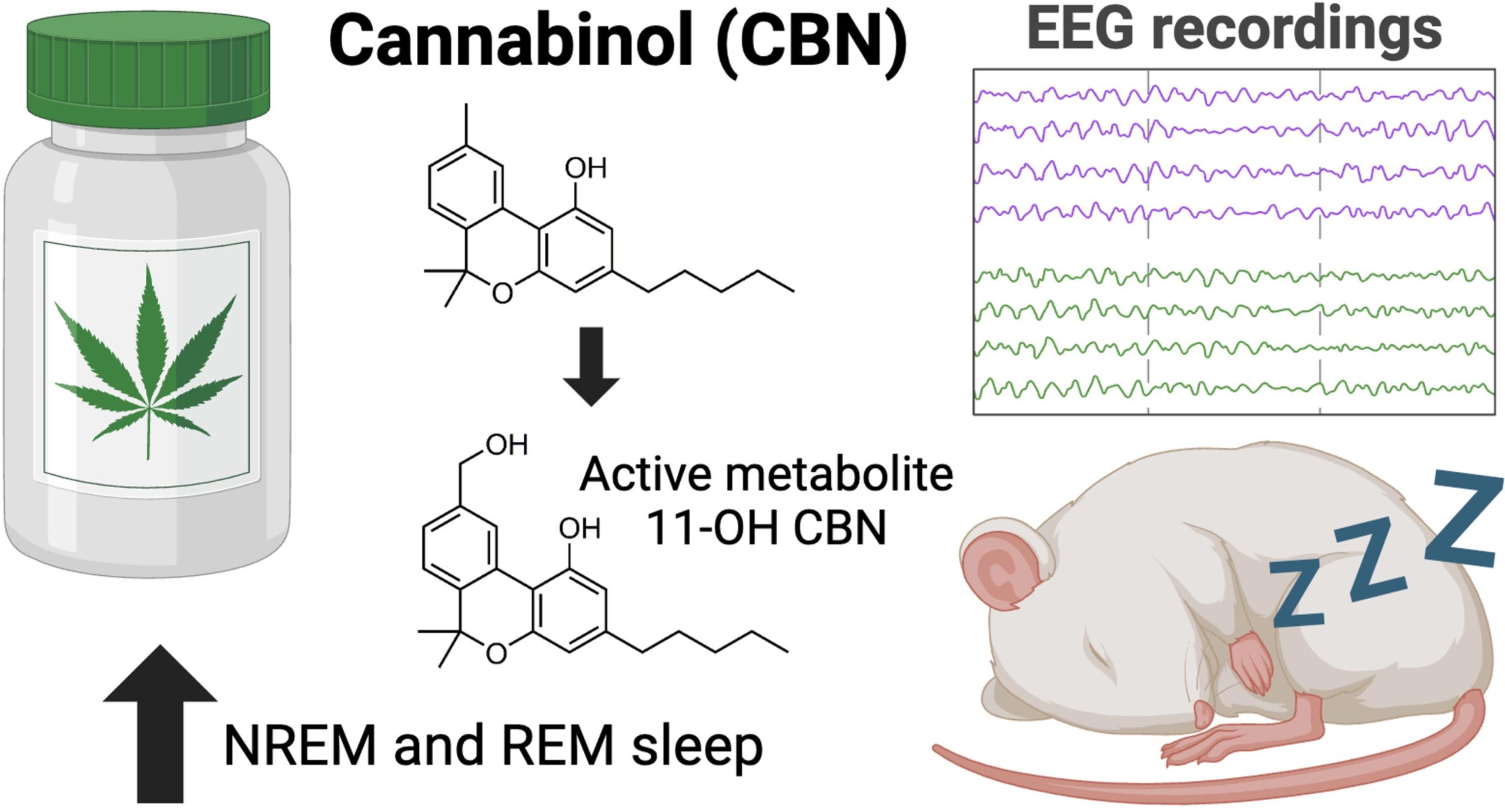
What Is Cannabinol (CBN)?
CBN is an end-product of the main intoxicating constituent of cannabis, delta9-tetrahydrocannabinol (THC). THC in cannabis is slowly converted to CBN over time, which means older cannabis contains higher levels of this compound. It has been suggested that the consumption of older cannabis is associated with a sleepier cannabis “high.”
In the United States, highly purified CBN products are being sold as sleep aids, but there has been little high-quality scientific evidence to support this application.
The research team at the Lambert Initiative for Cannabinoid Therapeutics tested the effects of purified CBN on sleep in rats. Using high-tech monitoring, the experiments provided insights into the rats’ sleep patterns including the amount of non-rapid eye movement (NREM) and rapid eye movement (REM) sleep.
NREM is deep sleep that promotes physical recovery and strengthens memories, while REM sleep is associated with dreaming and processing of emotions.
Professor Arnold said: “CBN was found to increase both NREM and REM sleep, leading to increased total sleep time, with a comparable effect to the known sleep drug zolpidem.”

CBN: Non-Intoxicating
Unlike its parent molecule THC, CBN did not appear to intoxicate rats. THC intoxicates by activating CB1 cannabinoid receptors, which are present in the brain. The study showed that unlike THC, CBN only weakly activates these receptors. To their surprise, the researchers found that a metabolite of CBN had significant effects on cannabinoid CB1 receptors.
A metabolite is a chemical produced via the metabolism of a larger molecule in the body.

Role of CBN Metabolites in Sleep
They also found that the 11-OH CBN metabolite had some impact on sleep architecture, which might contribute to the overall effects of CBN on sleep.
“This provides the first evidence that CBN indeed increases sleep using objective sleep measures. It was a surprise that CBN metabolism in the body can yield a much greater effect on cannabinoid CB1 receptors than the parent molecule CBN, which has much more limited activity,” Professor Arnold said.
“At this stage, our results are confined to testing in rats. Further research is needed to see if this translates to humans.”
Ongoing Human Clinical Trials
In a parallel study, yet to be published, Professor Iain McGregor, Director of Clinical Research at the Lambert Initiative, initiated a placebo-controlled randomized human clinical trial in insomnia patients. This was led by PhD student Isobel Lavender with leading sleep researcher Dr Camilla Hoyos from the Woolcock Institute of Medical Research. The trial has now been completed with very promising results that were recently announced at the International Cannabinoid Research Society and Sleep DownUnder scientific conferences.
“Our research encourages further basic and clinical research on CBN as a new treatment strategy for sleep disorders, including insomnia. Our clinical study only administered CBN on a single occasion. A trial on a larger scale, that includes repeated dosing, is the logical next step,” Professor McGregor said.
Professor Arnold said: “The team has now commenced a preclinical drug discovery program around CBN, as well as observing whether the pro-sleep effects of CBN can be further amplified by other molecules found in cannabis, or by conventional sleep aids, such as melatonin.”
Reference: “A sleepy cannabis constituent: cannabinol and its active metabolite influence sleep architecture in rats” by Jonathon C. Arnold, Cassandra V. Occelli Hanbury-Brown, Lyndsey L. Anderson, Miguel A. Bedoya-Pérez, Michael Udoh, Laura A. Sharman, Joel S. Raymond, Peter T. Doohan, Adam Ametovski and Iain S. McGregor, 12 November 2024, Neuropsychopharmacology.
DOI: 10.1038/s41386-024-02018-7
Never miss a breakthrough: Join the SciTechDaily newsletter.
Follow us on Google and Google News.