
Close Menu
    Facebook X (Twitter) Instagram
    SciTechDaily
    • Biology
    • Chemistry
    • Earth
    • Health
    • Physics
    • Science
    • Space
    • Technology
    Facebook X (Twitter) Pinterest YouTube RSS
    SciTechDaily
    Home»Health»First Treatment for a Rare Form of Cancer Discovered
    Health

    First Treatment for a Rare Form of Cancer Discovered

    By Brigham and Women's HospitalAugust 3, 2022No Comments2 Mins Read
    Facebook Twitter Pinterest Telegram LinkedIn WhatsApp Email Reddit
    Share
    Facebook Twitter LinkedIn Pinterest Telegram Email Reddit
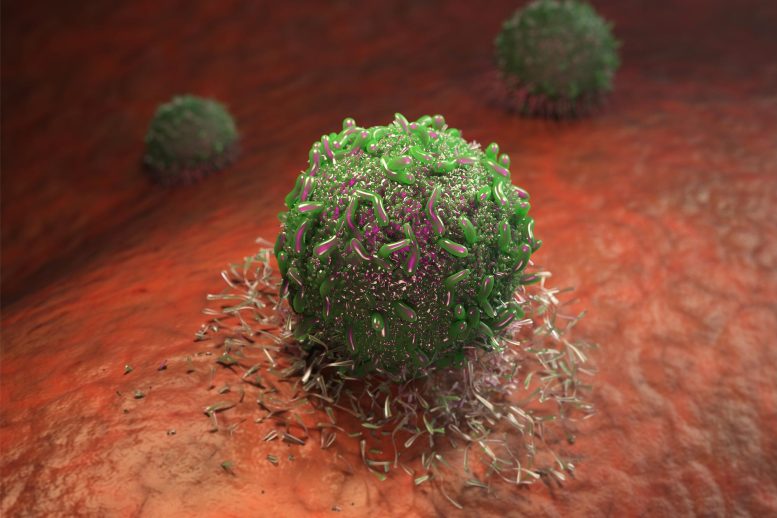
    Cancer Cells Spreading
    There are presently no effective treatments for chromophobe renal cell carcinoma, a rare type of kidney cancer.

    A Novel Treatment for a Rare Kind of Kidney Cancer Has Been Uncovered

    There are currently no proven treatments for metastatic or irresectable chromophobe renal cell carcinoma (ChRCC), a rare type of kidney cancer.

    Researchers provide the first evidence that ChRCC can be treated with ferroptosis in a study headed by Brigham and Women’s Hospital researchers. Ferroptosis is a sort of programmed cell death that happens when excessive quantities of iron cause lipid peroxides to build up in the cell membrane.

    By depriving ChRCC cells of cysteine, the team was able to induce ferroptosis, and they discovered evidence that this approach would be useful in the treatment of ChRCC.

    “Targeted therapies are urgently needed to treat chromophobe RCC,” said corresponding author Elizabeth P. Henske, MD, of the Division of Pulmonary and Critical Care Medicine at Brigham.

    “Through our study, we’ve found strong evidence that ChRCC can be therapeutically targeted by taking advantage of the cells’ hypersensitivity to ferroptosis. This represents an important breakthrough in our understanding as we think about treatment for patients with this rare disease.”

    Reference: “Hypersensitivity to ferroptosis in chromophobe RCC is mediated by a glutathione metabolic dependency and cystine import via solute carrier family 7 member 11” by Long Zhang, Charbel S. Hobeika, Damir Khabibullin, Deyang Yu, Harilaos Filippakis, Michel Alchoueiry, Yan Tang, Hilaire C. Lam, Peter Tsvetkov, George Georgiou, Candice Lamb, Everett Stone, Pere Puigserver, Carmen Priolo and Elizabeth P. Henske, 8 July 2022, Proceedings of the National Academy of Sciences.
    DOI: 10.1073/pnas.2122840119

    The study was funded by the NIH/National Institutes of Health, the Tuttle Family, the van Hecke Family, the Christelis Family, and the Cohen/Levin Family.

    Never miss a breakthrough: Join the SciTechDaily newsletter.
    Follow us on Google and Google News.

    Brigham and Women's Hospital Cancer Kidney National Institutes of Health
    Share. Facebook Twitter Pinterest LinkedIn Email Reddit

    Related Articles

    Study Finds Vitamin D Supplements Reduce Risk of Developing Advanced Cancer

    Engineers Design a Reusable, Silicone Rubber Face Mask With an N95 Filter

    New Test Can Quickly Detect Potentially Cancer-Causing DNA Damage

    Warning: Increased Breast Cancer Risk Linked to Permanent Hair Dye and Straighteners

    New Medical Treatments Possible With “Right-Handed” Nanoparticles

    New Delivery Technique Enables Rapid Treatment for Inflammation

    Adhesive Patch Delivers Therapy to Tumor Sites

    Researchers Uncover an Easily Detectable Precancerous State in Blood

    Targeted Chemotherapy Delivery Could Kill Tumor Cells More Effectively

    Leave A Reply Cancel Reply

    • Facebook
    • Twitter
    • Pinterest
    • YouTube

    Don't Miss a Discovery

    Subscribe for the Latest in Science & Tech!

    Trending News

    Scientists Discover Game-Changing New Way To Treat High Cholesterol

    This Small Change to Your Exercise Routine Could Be the Secret to Living Longer

    Scientists Discover 430,000-Year-Old Wooden Tools, Rewriting Human History

    AI Could Detect Early Signs of Alzheimer’s in Under a Minute – Far Before Traditional Tests

    What if Dark Matter Has Two Forms? Bold New Hypothesis Could Explain a Cosmic Mystery

    This Metal Melts in Your Hand – and Scientists Just Discovered Something Strange

    Beef vs. Chicken: Surprising Results From New Prediabetes Study

    Alzheimer’s Breakthrough: Scientists Discover Key Protein May Prevent Toxic Protein Clumps in the Brain

    Follow SciTechDaily
    • Facebook
    • Twitter
    • YouTube
    • Pinterest
    • Newsletter
    • RSS
    SciTech News
    • Biology News
    • Chemistry News
    • Earth News
    • Health News
    • Physics News
    • Science News
    • Space News
    • Technology News
    Recent Posts
    • Revolutionary Imaging Technique Unlocks Secrets of Matter at Extreme Speeds
    • Where Does Mass Come From? Scientists Find Evidence of a New Exotic Nuclear State
    • Quantum Breakthrough: Unhackable Keys Sent Over 120 km Using Quantum Dots
    • Researchers Discover Unknown Beetle Species Just Steps From Their Lab
    • Jellyfish Caught Feasting on Exploding Sea Worms for the First Time
    Copyright © 1998 - 2026 SciTechDaily. All Rights Reserved.
    • Science News
    • About
    • Contact
    • Editorial Board
    • Privacy Policy
    • Terms of Use

    Type above and press Enter to search. Press Esc to cancel.