

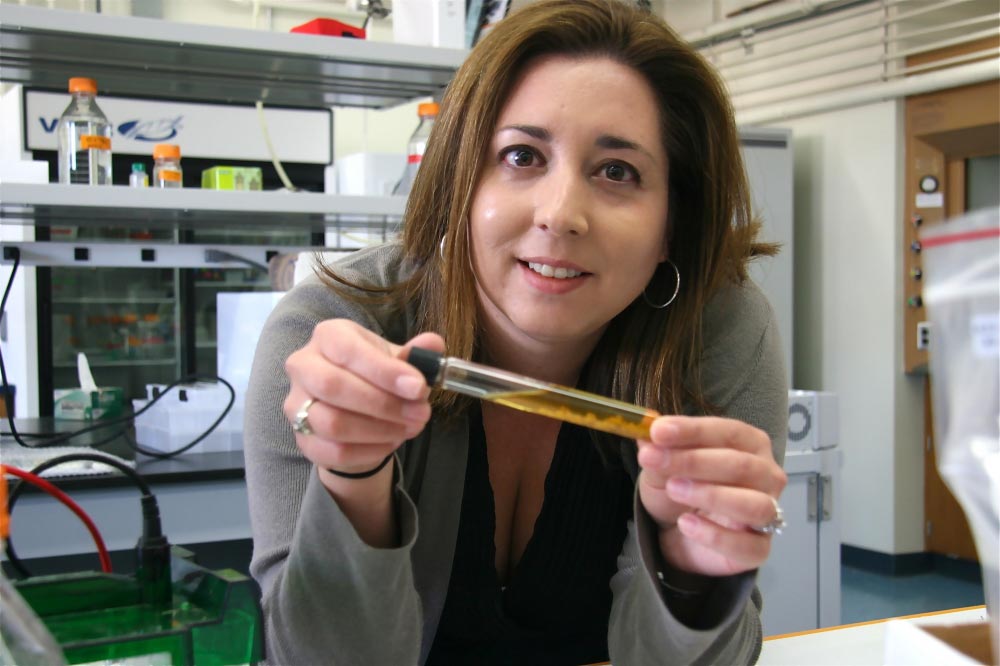
In Michelle O’Malley’s lab, a simple approach suggests a big leap forward in addressing the challenge of antibiotic-resistant bacteria.
Scientists have long been aware of the dangerous overuse of antibiotics and the increasing number of antibiotic-resistant microbes that have resulted. While over-prescription of antibiotics for medicinal use has unsettling implications for human health, so too does the increasing presence of antibiotics in the natural environment. The latter may stem from the improper disposal of medicines, but also from the biotechnology field, which has depended on antibiotics as a selection device in the lab.
“In biotech, we have for a long time relied on antibiotic and chemical selections to kill cells that we don’t want to grow,” said UC Santa Barbara chemical engineer Michelle O’Malley. “If we have a genetically engineered cell and want to get only that cell to grow among a population of cells, we give it an antibiotic resistance gene. The introduction of an antibiotic will kill all the cells that are not genetically engineered and allow only the ones we want — the genetically modified organisms [GMOs] — to survive. However, many organisms have evolved the means to get around our antibiotics, and they are a growing problem in both the biotech world and in the natural environment. The issue of antibiotic resistance is a grand challenge of our time, one that is only growing in its importance.”
Further, GMOs come with a containment issue. “If that GMO were to get out of the lab and successfully replicate in the environment, you could not predict what traits it would introduce into the natural biological world,” O’Malley explained. “With the advent of synthetic biology, there is increasingly a risk that things we’re engineering in the lab could escape and proliferate into ecosystems where they don’t belong.”
A Fluoride-Based Alternative
Now, research conducted in O’Malley’s lab and published in the journal Nature Communications describes a simple method to address both the overuse of antibiotics, as well as containment of GMOs. It calls for replacing antibiotics in the lab with fluoride.
O’Malley described fluoride as “a pretty benign chemical that is abundant in the world, including in groundwater.” But, she notes, it is also toxic to microorganisms, which have evolved a gene that encodes a fluoride exporter that protects cells by removing fluoride encountered in the natural environment.
The paper describes a process developed by Justin Yoo, a former graduate student researcher in O’Malley’s lab. It uses a common technique called homologous recombination to render non-functional the gene in a GMO that encodes a fluoride exporter, so the cell can no longer produce it. Such a cell would still thrive in the lab, where fluoride-free distilled water is normally used, but if it escaped into the natural environment, it would die as soon as it encountered fluoride, thus preventing propagation.
Prior to this research, Yoo was collaborating with the paper’s co-author Susanna Seppala, a project scientist in O’Malley’s lab, in an effort to use yeast to characterize fluoride transport proteins that Seppala had identified in anaerobic fungi. A first step in this project was for Yoo to remove native yeast fluoride transporters.
Shortly after generating the knockout yeast strain, Yoo attended a synthetic biology conference where he heard a talk on a novel biocontainment mechanism intended to prevent genetically modified E. coli bacteria from escaping lab environments. At that talk, he recalled, “I realized that the knockout yeast strain I had generated could potentially act as an effective biocontainment platform for yeast.”
Fluoride as a Biocontainment Mechanism
“Essentially, what Justin did was to create a series of DNA instructions you can give to cells that will enable them to survive when fluoride is around,” O’Malley said. “Normally, if I wanted to select for a genetically engineered cell in the lab, I’d make a plasmid [a genetic structure in a cell, typically a small circular DNA strand, that can replicate independently of the chromosomes] that had an antibiotic resistance marker so that it would survive if an antibiotic was around. Justin is replacing that with the gene for these fluoride exporters.”
The method, which O’Malley characterized as “low-hanging fruit — Justin did all of these studies in about a month,” also addresses a simple economic limitation to antibiotic-driven cell selection in biotechnology labs. Aside from fueling the rise of resistant strains of bacteria, she continued, “From a biotech standpoint, the process of creating antibiotic-resistant organisms is also pretty darn expensive. If you were going to run a ten-thousand-liter fermentation, and it may cost you thousands of dollars per fermentation to add some antibiotics, that’s a crazy amount of money.” Notably, using fluoride at a low concentration would cost only about four cents per liter.
A Simpler, Cheaper, Safer Approach
Clearly, said Seppala, “we’d much rather use a chemical like fluoride that’s relatively benign, abundant, and cheap, and can be used to do the same thing that is achieved using a conventional antibiotic.”
Yoo explained that the role of the fluoride transporters had only recently been elucidated, in 2013, when this project began. Emerging approaches to implementing biocontainment have focused on using biological parts that are foreign to the organism of interest, shifting focus toward what Yoo described as “brilliant, yet complex, systems,” while perhaps diverting attention from this simpler approach.
Reference: “Engineered fluoride sensitivity enables biocontainment and selection of genetically-modified yeasts” by Justin I. Yoo, Susanna Seppälä and Michelle A. OʼMalley, 29 October 2020, Nature Communications.
DOI: 10.1038/s41467-020-19271-1
Never miss a breakthrough: Join the SciTechDaily newsletter.
Follow us on Google and Google News.
3 Comments
Fluoride interferes with growth of cartilage. Its important to rinse it out after using fluorinated tooth paste. It has other side effects.
Adolph Hitler used mass amounts of it in his concentration camps to keep them lethargic and simple minded.
Yes, it kills super bacteria.
Excellent science conducted by Yoo. Refreshing to see female scientists emulating their male colleagues and taking credit for someone else’s work.
I find it interesting that the antibiotics and GMO’s are being blatantly vilified in this article. The antibiotics are a tool. The GMO is a result of a human decision making process. Antibiotics are ESSENTIAL for the isolation and identification of many pathogenic organisms in the clinical laboratory. Further, it is impossible to test for antibiotic resistance without using antibiotics (at this time). Without antibiotic resistance testing we risk creating new strains of “super” bugs. This is interesting only for its implications in clinical research and possibly in the use of crispr for the development of future treatments of infection by antibiotic resistant organisms. While GMO’s do represent a risk- I do not think vilifying them, or the lifesaving antibiotics used to treat bacterial infections, is the key. We should focus instead on the role of GMO’s in a research setting (and the subsequent risk should these organisms gain a foothold in the ecology of our time), and the proper use and management of antibiotics which are one of the greatest discoveries of the last two hundred years. I applaud the research but condone the message. The use of crispr to genetically modify a bacterial pathogen which is in the act of killing a human being is the most promising application for this research that I see. I look forward to that paper Dr. O’Malley!