
The typical American adult gets one of every five calories from a restaurant, but eating out is a recipe for meals of poor nutritional quality in most cases, according to a new study by researchers at the Friedman School of Nutrition Science and Policy at Tufts University.
Published today (January 29, 2020) in The Journal of Nutrition, the study analyzed the dietary selections of more than 35,000 U.S. adults from 2003-2016 in the National Health and Nutrition Examination Survey (NHANES) who dined at full-service (those with wait staff) or fast-food restaurants, which included pizza shops and what has become known as fast-casual. The researchers assessed nutritional quality by evaluating specific foods and nutrients in the meals, based on the American Heart Association 2020 diet score.
“Our findings show dining out is a recipe for unhealthy eating most of the time.” Dariush Mozaffarian
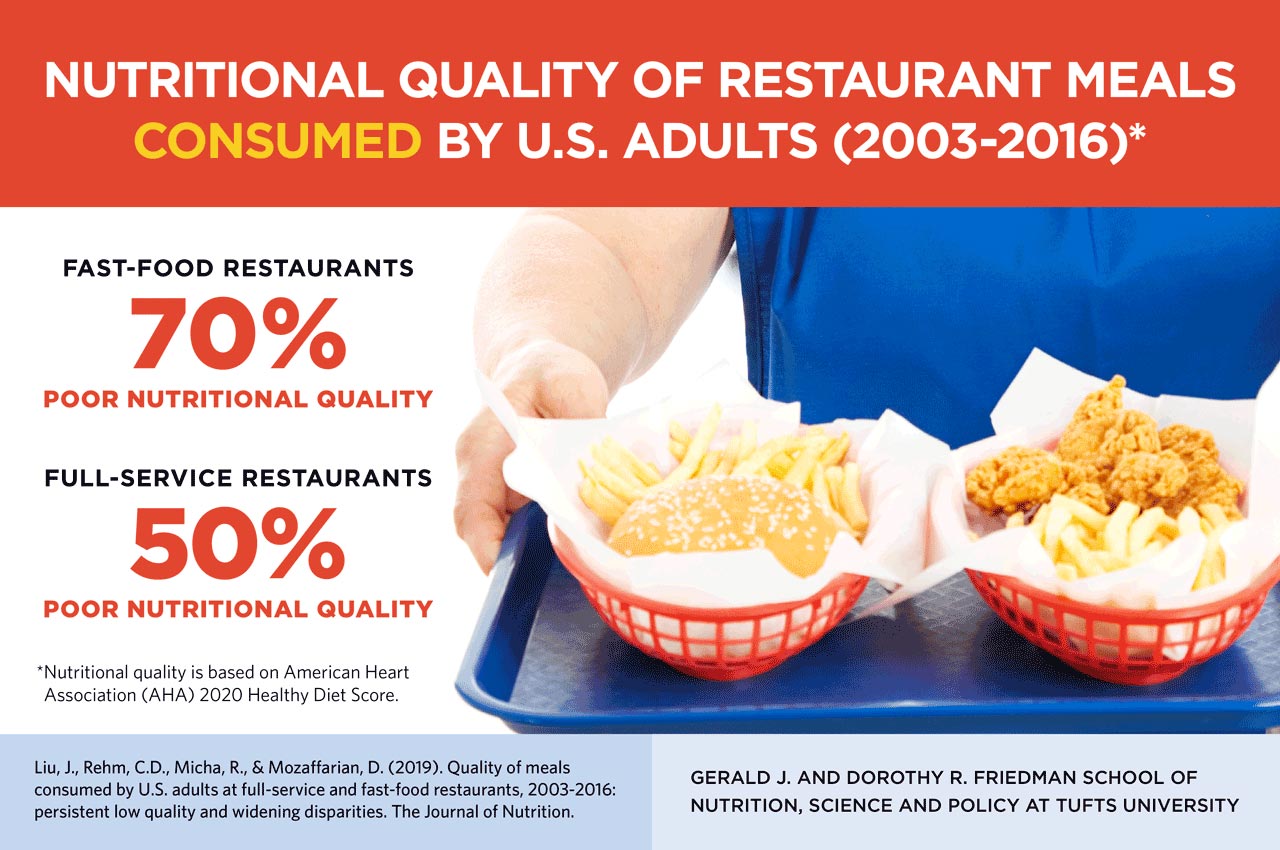
At fast-food restaurants, 70 percent of the meals Americans consumed were of poor dietary quality in 2015-16, down from 75 percent in 2003-04. At full-service restaurants, about 50 percent were of poor nutritional quality, an amount that remained stable over the study period. The remainder were of intermediate nutritional quality.
Notably, the authors found that less than 0.1 percent — almost none — of all the restaurant meals consumed over the study period were of ideal quality.
“Our findings show dining out is a recipe for unhealthy eating most of the time,” said Dariush Mozaffarian, senior author and dean of the Friedman School. “It should be a priority to improve the nutritional quality of both full-service and fast-food restaurant meals, while reducing disparities so that all Americans can enjoy the pleasure and convenience of a meal out that is also good for them.”
The disparities documented by the study authors show some groups ate more healthfully than others while dining out. For example, the quality of fast-food meals consumed by non-Hispanic whites and Mexican-Americans improved, but there was no change in the quality of fast-food meals consumed by non-Hispanic blacks. Also, the proportion of poor-quality fast-food meals decreased from 74 percent to 60 percent over this period for people with college degrees, but remained high at 76 percent for people without a high school diploma.
The researchers also looked at the extent to which Americans relied on restaurants during the study period and found:
- Restaurant meals accounted for 21 percent of Americans’ total calorie intake.
- Full-service restaurant meals represented 9 percent of total calories consumed.
- Fast-food meals represented 12 percent of total calories consumed.
- Fast-food breakfasts increased from just over 4 percent to nearly 8 percent of all breakfasts eaten in America.
Dariush Mozaffarian, senior author and dean of the Friedman School of Nutrition Science and Policy at Tufts University, discusses the goals of a study, published today (January 29, 2020) in The Journal of Nutrition. The study found that most of what Americans ate while dining out over a 14-year period was of poor nutritional quality. Credit: Tufts University
The researchers assessed specific foods and nutrients in restaurant meals and identified priorities for improvement. “We found the largest opportunities for enhancing nutritional quality would be adding more whole grains, nuts and legumes, fish, and fruits and vegetables to meals while reducing salt,” said first author Junxiu Liu, a postdoctoral scholar at the Friedman School. She noted the study findings showed no improvement in sodium levels in fast-food meals and worsening levels in full-service dishes consumed.
“Our food is the number one cause of poor health in the country, representing a tremendous opportunity to reduce diet-related illness and associated healthcare spending,” Mozaffarian said. “At restaurants, two forces are at play: what’s available on the menu, and what Americans are actually selecting. Efforts from the restaurant industry, consumers, advocacy groups, and governments should focus on both these areas.”
Dariush Mozaffarian, senior author and dean of the Friedman School of Nutrition Science and Policy at Tufts University, discusses the importance of a study finding that most of what Americans ate while dining out over a 14-year period was of poor nutritional quality. Credit: Tufts University
NHANES participants are representative of the national population and completed at least one valid 24-hour dietary recall questionnaire from nine consecutive cycles of NHANES between 2003-2016, including types of foods and beverages consumed and the source.
The study authors used the American Heart Association (AHA) diet score to assess meal quality, which is based on the AHA 2020 Strategic Impact Goals and is a validated risk factor for cardiovascular and metabolic outcomes. The AHA diet score includes both a primary and secondary scores. The primary score assesses the consumption of fruits and vegetables, fish/shellfish, whole grains, sodium, and sugar-sweetened beverages, and the secondary score assesses the intake of nuts/seeds/legumes, processed meat, and saturated fat.
Researchers also evaluated individual food groups and nutrients based on the USDA Food Patterns Equivalents Database (FPED) and MyPyramid Equivalents Database (MPED) associated with chronic illnesses.
Limitations of the study include the fact that self-reported food recall data is subject to measurement error due to daily variations in food intake. Participants may also overreport or underreport healthy or unhealthy foods due to social desirability perceptions.
Reference: “Quality of meals consumed by US adults at full-service and fast-food restaurants, 2003-2016: Persistent low quality and widening disparities” by Liu, J., Rehm, C.D., Micha, R., & Mozaffarian, D. (2020), 29 January 2020, The Journal of Nutrition.
DOI: 10.1093/jn/nxz299
This study is a part of the Food Policy Review and Intervention Cost-Effectiveness (Food-PRICE) research initiative, a National Institutes of Health-funded collaboration led by researchers at the Friedman School working to identify cost-effective nutrition strategies to improve population health in the United States.
Additional authors are Colin D. Rehm at Albert Einstein College of Medicine and Renata Micha at the Friedman School at Tufts University.
This work was supported by awards from the National Institutes of Health’s National Heart, Lung, and Blood Institute (R01HL130735) and a postdoctoral fellowship from the American Heart Association. The content of this announcement is solely the responsibility of the authors and does not necessarily represent the official views of the National Institutes of Health. Please see the study for conflicts of interest.
Never miss a breakthrough: Join the SciTechDaily newsletter.
Follow us on Google and Google News.
1 Comment
I agree that it is almost impossible to eat a healthy meal in a restaurant, but it is for different reasons than the AHA thinks. We need to base our diet decisions on long term scientific studies of humans. We need to avoid the conjecture that has misled the AHA and caused them to give harmful diet advice. For example, it has been documented that cereal grains have been harming human health since humans began farming (for 10,000 years). See the work of Brenna Hassett. As for AHA’s recommendations on fat, see the PURE study. Truly what we need is a low glycemic diet, something you cannot have with a low fat diet. There are many traditional diets throughout the world that avoid our metabolic syndrome inducing AHA diet. These diets span virtually the entirely meat based Inuit and Masai diets, to almost entirely vegetarian diets, for example the traditional Okinawan diet. Unfortunately the Okinawan’s are dying at younger ages with the introduction of western eating habits.