
Close Menu
    Facebook X (Twitter) Instagram
    SciTechDaily
    • Biology
    • Chemistry
    • Earth
    • Health
    • Physics
    • Science
    • Space
    • Technology
    Facebook X (Twitter) Pinterest YouTube RSS
    SciTechDaily
    Home»Chemistry»New Pesticide Compounds Discovered in Traditional Chinese Medicinal Plant
    Chemistry

    New Pesticide Compounds Discovered in Traditional Chinese Medicinal Plant

    By American Chemical SocietyJanuary 29, 2020No Comments2 Mins Read
    Facebook Twitter Pinterest Telegram LinkedIn WhatsApp Email Reddit
    Share
    Facebook Twitter LinkedIn Pinterest Telegram Email Reddit
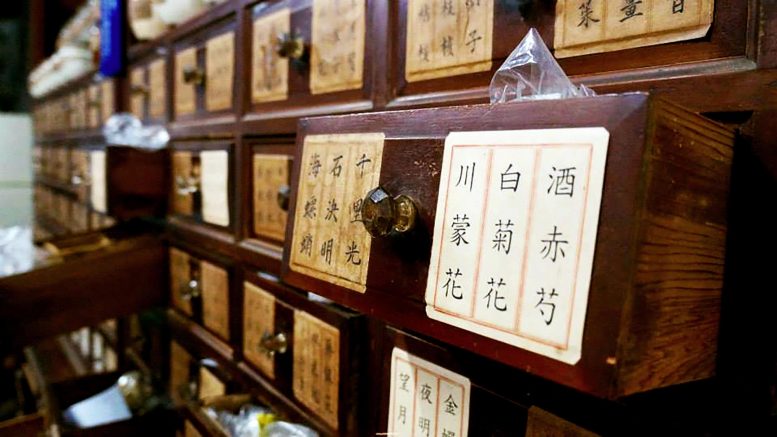
    Chinese Medicine Cabinet
    A traditional Chinese medicine store typically features a medicine cabinet labeled with various herbs commonly used in Chinese medicine.

    For hundreds of years, practitioners of traditional Chinese medicine have used an herb called Stemona sessilifolia as a remedy for parasitic infections, such as those caused by pinworms and lice. Now, researchers reporting in ACS’ Journal of Agricultural and Food Chemistry have identified 10 compounds that might be responsible for the herb’s effectiveness. But there’s a twist: The insecticides are produced by symbiotic microbes that live within the plant’s cells — not by S. sessilifolia itself.

    Endophytes are microorganisms that live inside plant cells but do not cause apparent disease. Instead, some endophytes help plants survive by enhancing growth, nutrient acquisition, or resistance to drought or pests. Therefore, scientists are investigating endophytes as potential sources of new medicines and agrichemicals. Xiachang Wang, Lihong Hu and colleagues wanted to screen endophytes from S. sessilifolia for insecticidal activity.

    To isolate endophytes, the researchers spread fresh, cut-up pieces of S. sessilifolia on agar plates. They then collected the bacteria that grew on the plates, analyzed the DNA, and identified the microbes as Streptomyces clavuligerus. Using nuclear magnetic resonance spectroscopy and mass spectrometry, the team purified 10 new compounds from the bacteria with structures similar to a class of insecticides known as pyrroles. Testing the substances on insects revealed that they were strongly toxic to aphids and moderately toxic to spider mites. A bacterial extract containing all of the compounds had greater lethal activity than any compound alone. These substances, or the bacteria that produce them, could be promising new natural pesticides, the researchers say.

    Reference: “Insecticidal Endostemonines A-J Produced by an Endophytic Streptomyces from Stemona sessilifolia” by Huimin Zhao, Aiping Yang, Nan Zhang, Shiyang Li, Tianjie Yuan, Ning Ding, Siwang Zhang, Sheng Bao, Chang Wang, Yinan Zhang, Xiachang Wang and Lihong Hu, 29 January 2020, Journal of Agricultural and Food Chemistry.
    DOI: 10.1021/acs.jafc.9b06755

    The authors acknowledge funding from the National Key R&D Program, the Nature Science Foundation of Jiangsu Higher Education Institutions of China, the Outstanding Scientific and Technological Innovation Team Program of Jiangsu Higher Education Institutions, Jiangsu Provincial “Double Creation Program” and the Priority Academic Program Development of Jiangsu Higher Education Institutions.

    Never miss a breakthrough: Join the SciTechDaily newsletter.
    Follow us on Google and Google News.

    Agriculture American Chemical Society Insecticide Microbiology Popular
    Share. Facebook Twitter Pinterest LinkedIn Email Reddit

    Related Articles

    Using the “Smell of Fear” To Protect Gardens and Crops From Destructive Insects

    Handheld “MasSpec Pen” Reveals Meat and Fish Fraud in Seconds

    Rice Genetically Altered to Contain Anti-Hypertensive Peptides – Eating a Spoonful Lowers Blood Pressure

    Diagnostic Biosensor Detects SARS-CoV-2 From Nasopharyngeal Swab in Less Than a Minute

    Does Soap Actually ‘Kill’ the Coronavirus? Here’s the Chemistry [Video]

    Chemists Design New Compounds That Thwart Viruses – Blocks Replication of Coronavirus

    The US Government Issued Sailors and Soldiers Shark Repellent That Didn’t Work – Here’s Why [Video]

    New Medicines & ‘Green’ Insecticides Possible With Efficient Synthesis of Ginkgo Compound

    Chocolate Interferes With Cannabis Potency Testing

    Leave A Reply Cancel Reply

    • Facebook
    • Twitter
    • Pinterest
    • YouTube

    Don't Miss a Discovery

    Subscribe for the Latest in Science & Tech!

    Trending News

    Breakthrough Bowel Cancer Trial Leaves Patients Cancer-Free for Nearly 3 Years

    Natural Compound Shows Powerful Potential Against Rheumatoid Arthritis

    100,000-Year-Old Neanderthal Fossils in Poland Reveal Unexpected Genetic Connections

    Simple “Gut Reset” May Prevent Weight Gain After Ozempic or Wegovy

    2.8 Days to Disaster: Scientists Warn Low Earth Orbit Could Suddenly Collapse

    Common Food Compound Shows Surprising Power Against Superbugs

    5 Simple Ways To Remember More and Forget Less

    The Atomic Gap That Could Cost the Semiconductor Industry Billions

    Follow SciTechDaily
    • Facebook
    • Twitter
    • YouTube
    • Pinterest
    • Newsletter
    • RSS
    SciTech News
    • Biology News
    • Chemistry News
    • Earth News
    • Health News
    • Physics News
    • Science News
    • Space News
    • Technology News
    Recent Posts
    • After 37 Years, the World’s Longest-Running Soil Warming Experiment Uncovers a Startling Climate Secret
    • NASA Satellite Captures First-Ever High-Res View of Massive Pacific Tsunami
    • ADHD Isn’t Just a Deficit: Study Reveals Powerful Hidden Strengths
    • Scientists Uncover “Astonishing” Hidden Property of Light
    • Scientists Discover Stem Cells That Could Regrow Teeth and Bone
    Copyright © 1998 - 2026 SciTechDaily. All Rights Reserved.
    • Science News
    • About
    • Contact
    • Editorial Board
    • Privacy Policy
    • Terms of Use

    Type above and press Enter to search. Press Esc to cancel.