
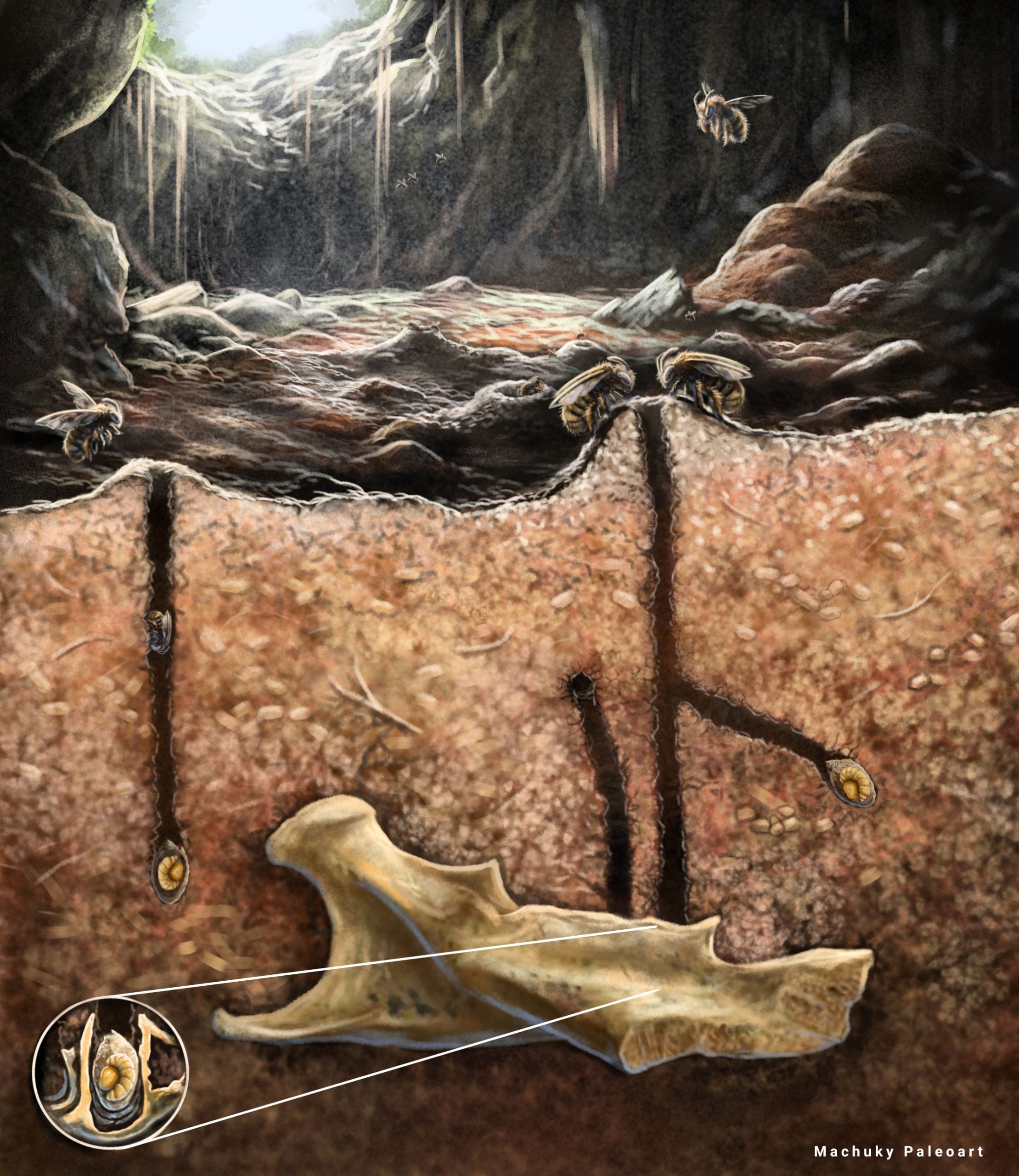
Paleontologists have discovered the first known fossilized bee nests built inside ancient bones, uncovered in a cave that came close to being used as a latrine.
A cave on Hispaniola preserves rare evidence that ancient bees nested inside fossil cavities. The find suggests an unusual local environment and a much deeper story about what brought so many remains into the cave.
A giant barn owl, a rodent known as a hutia, and a burrowing bee went into a cave. Only two later left. Which one remained behind? Hint: It’s the one that can’t fly.
This likely happened thousands of years ago on Hispaniola in the Caribbean. The owl carried the hutia back to its cave, apparently as food for its family. For the hutia, the visit ended quickly, because the owl delivered it to waiting chicks. The bee showed up far later, after the feeding was long finished and the hutia’s remains had been scattered and buried within the cave.
Searching for a safe place to raise its young, the bee began excavating a tunnel through fine, clay-rich silt that had built up in the cave’s darker interior. Before the tunnel reached the depth the bee preferred, it hit an unexpected obstacle: remnants of the owl’s ancient meal.
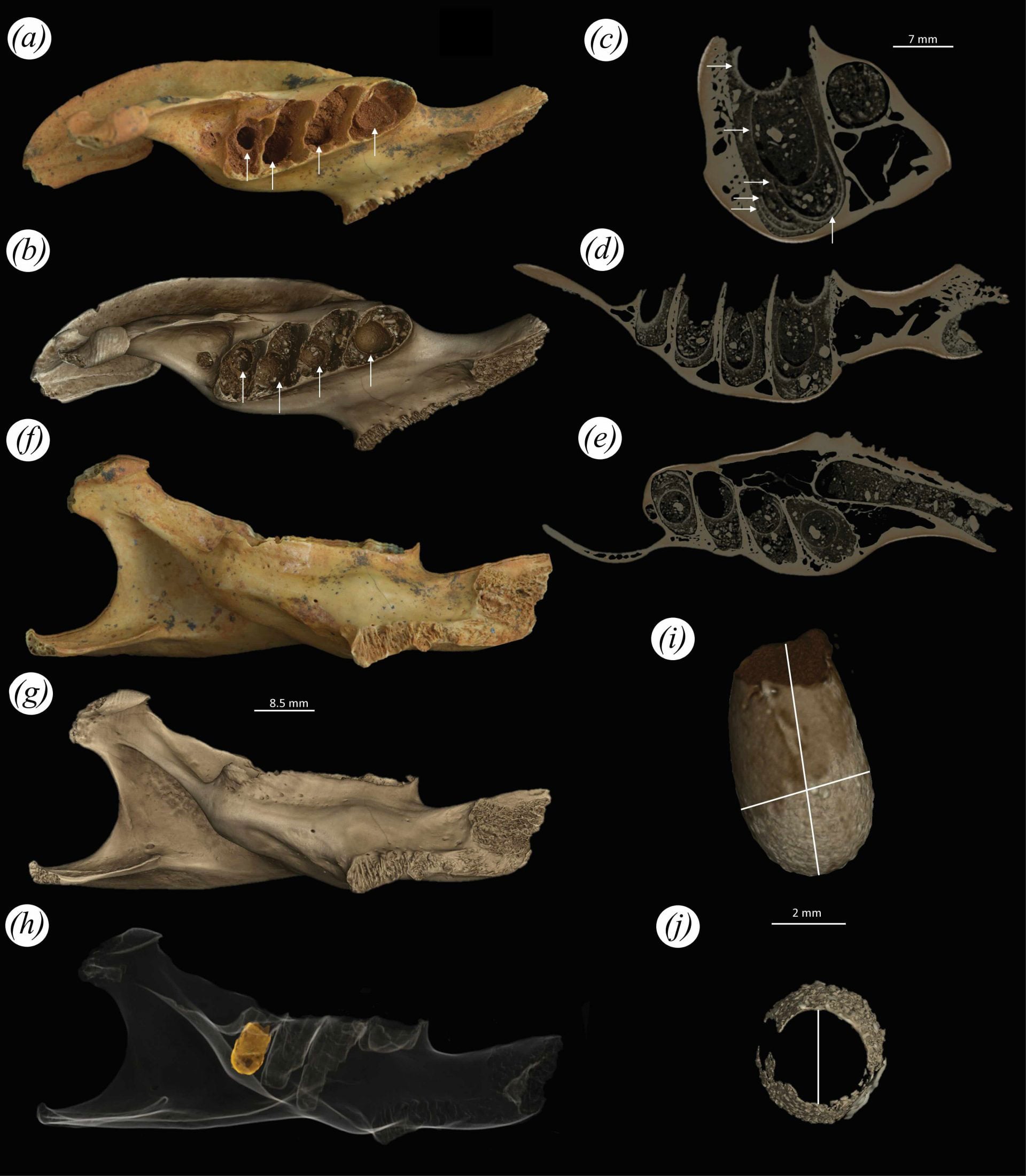
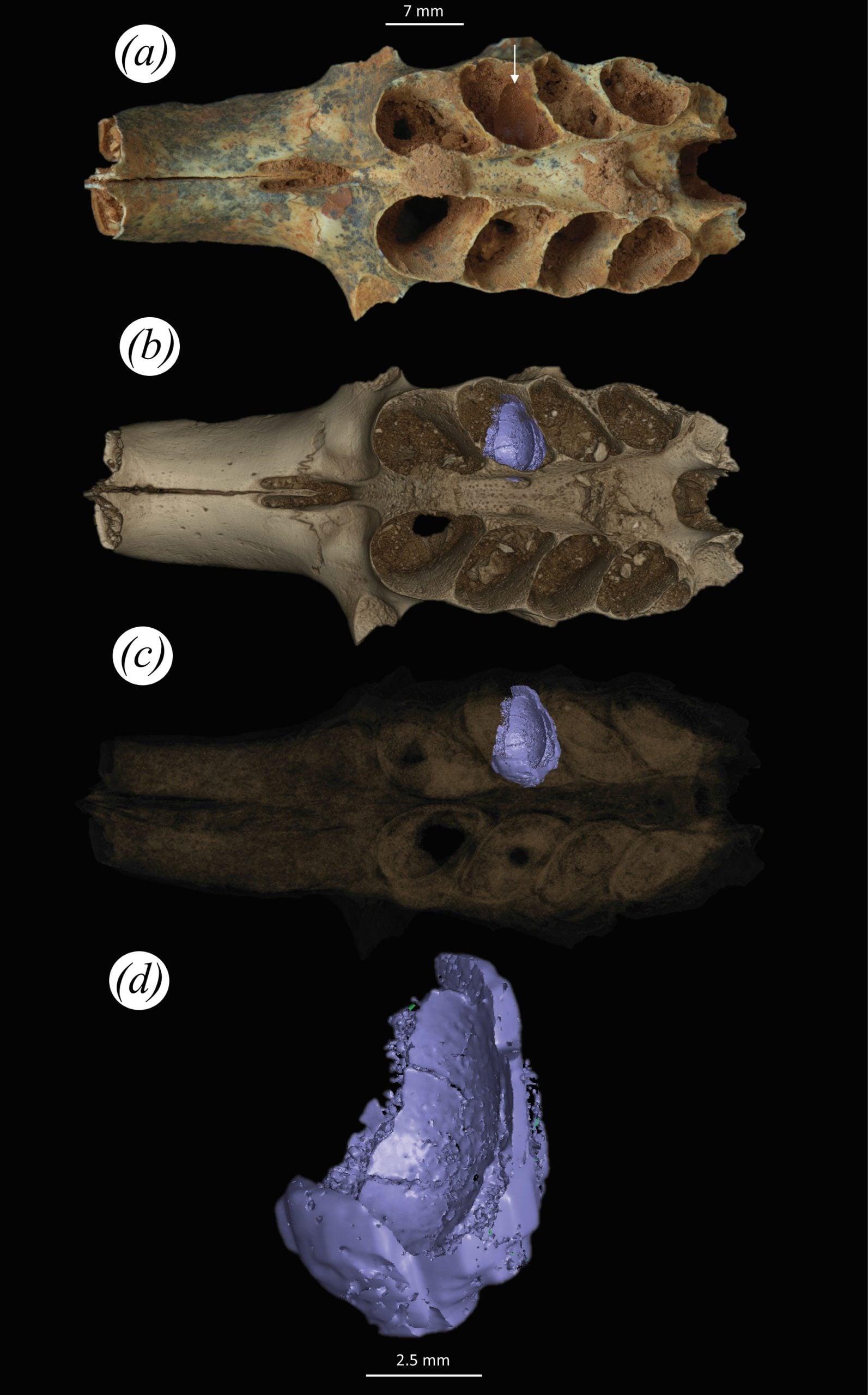
That discovery may have helped the bee. The hutia’s teeth were about the right size for the kind of nesting chamber the insect aimed to make. The teeth themselves were missing, likely displaced elsewhere in the cave, but the tooth sockets in the jaw (called alveoli) were still preserved and, importantly, already empty.
The rest is history. A swarm of such bees made their nests in the cave’s fossils for an unknown length of time. Later, that history was carefully excavated by paleontologists many thousands of years after the owl, hutia and potentially the bee had gone extinct.
A Curious Observation
The story might have ended there, had it not been for a keen eye and a friendly competition between colleagues.
“Usually, when collecting fossils, you get all the sediment out of the alveoli while cleaning the specimen,” said Lazaro Viñola Lopez, who excavated the fossils while working as a doctoral student at the Florida Museum of Natural History.
But Viñola Lopez was particularly interested in this species of hutia, for which fossils were incredibly rare across the island, consisting of a few isolated teeth and partial mandibles. In this single cave, called the Cueva de Mono, in the southern Dominican Republic, he found thousands of hutia fossils, most belonging to the same, previously rare, species.
Apparently, the giant barn owls that lived in the cave had repeated the same dinner scene throughout multiple generations, slowly turning the cave into a charnel house. In other instances, the birds likely consumed their prey while hunting, in which cases the bones would have been condensed into a pellet that the owls later regurgitated in the cave.
Instead of mindlessly placing the fossil in a bag bound for the lab and a thorough cleaning, Viñola Lopez took his time to inspect it before putting it away. He noticed that one alveolus had a smooth inner lining, unlike the rest, which had the rough texture of bone.
From Wasps to Bees
“I’d seen something similar in Montana when I was collecting dinosaur fossils in 2014,” he said. At the time, he and his colleagues kept finding isolated wasp cocoons interspersed with the bones in the rocky matrix. He assumed what he found in the cave was more of the same. He recalls thinking, “It would be nice to write a short paper reporting the occurrence of these wasp nests in the mandibles.”
Viñola Lopez proposed the idea to his colleague Mitchell Riegler, also a doctoral student at the museum and present for the excavation. Riegler, who studied extinct lizards and had a dissertation to finish, was skeptical. “I was like, Lazaro, that’s a niche project, and I have a lot of other things to do.”
So, for a time, the idea was shelved along with the specimens. Until, that is, Riegler received a challenge from his former undergraduate advisor at the University of Texas at Austin.
“He and I played this game back and forth in which we tried to write a paper in a week.”
Riegler had lost the first round and was itching for a rematch. The wasp nests, he thought, might just be the thing he needed to win.
“I told Lazaro we could do it only because I thought it’d be fast,” he said. “We’d scan them, describe their shape and say that they were there. Boy, was I wrong.”
A Surprising Discovery
Things initially went well. Selby Olsen, another doctoral student at the museum, also signed on to the project. “We locked ourselves in Lazaro’s apartment for five straight days and didn’t stop writing,” Riegler said. “Each of us sat in a corner and wrote a section, then swapped.”
They emerged feeling confident they’d win. Later, Viñola Lopez and Riegler independently came across the same study on ichnofossils, a term used to describe indirect fossil evidence of an organism, such as a footprint, preserved poop and — in this case — nests. The study contained a description of wasp nests, which they realized differed from theirs in one key regard.
The Wrong Insect
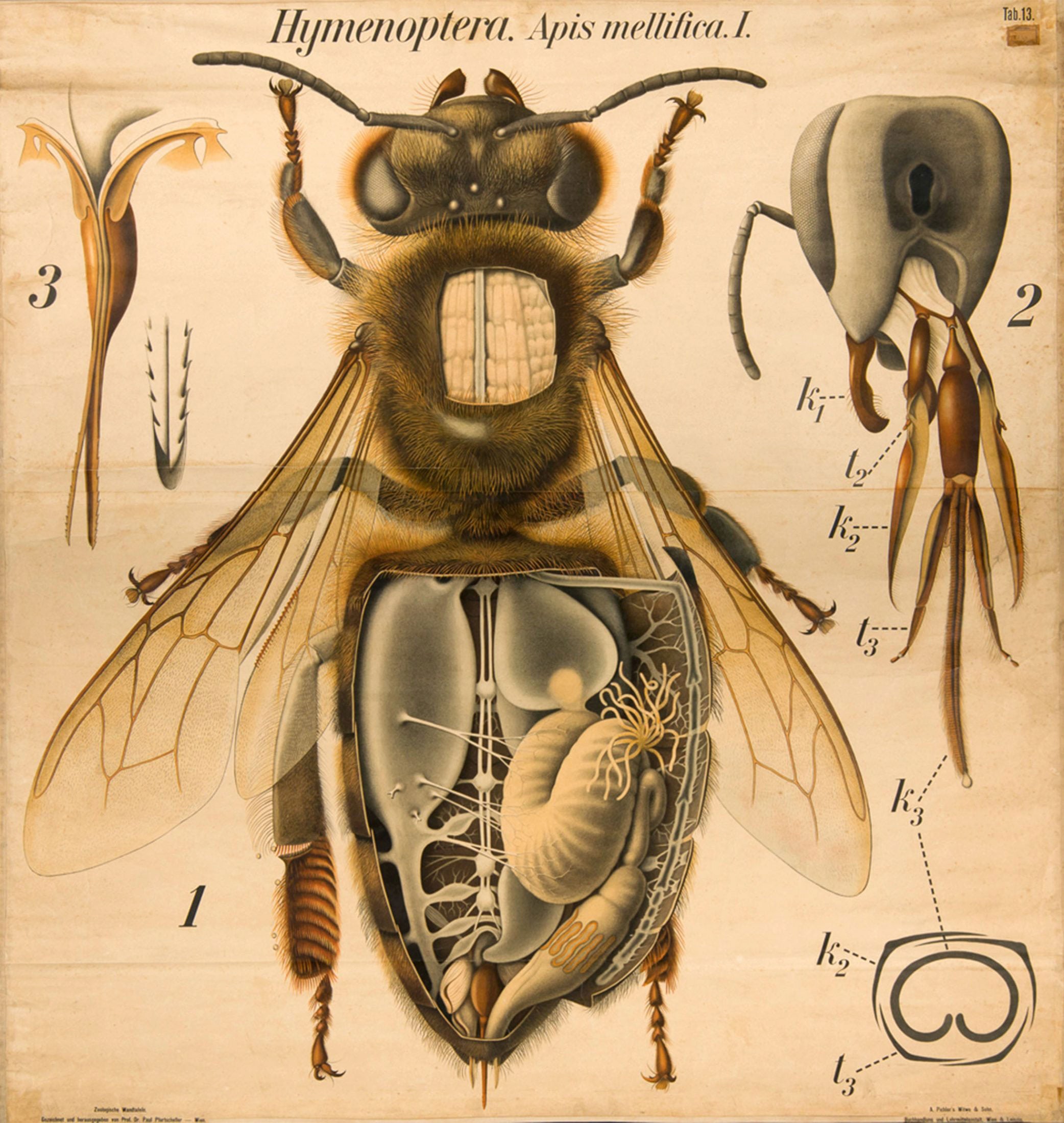
Wasp nests are made from a mix of saliva and chewed plant fibers or dirt, which gives the interior and exterior walls a rough texture. But bees are more fastidious. After constructing the nest out of compacted soil, many will secrete a waxy substance from a specialized gland, which they use to generously coat the inside of the nest, making it waterproof. This also makes the inside of their nests look smooth, precisely like the ones they’d found in the hutia mandibles.
They’d written about the wrong insects.
This wasn’t necessarily a fatal blow to their now tenuous victory. It wouldn’t take much work to swap out the information they’d included on wasps with that of bees, and they still had a little time left. But now things were getting interesting.
There is only one other documented case of a burrowing bee nesting inside a cave, and there are no documented cases at all of bees making their nests in a pre-existing fossil structure. A study published in 2001 gives a macabre report of human bones from an ancient Roman necropolis that bees that drilled into, but bees nesting inside fossils without altering them was something new.
From Sprint to Marathon
They conceded the race and adopted a more measured approach. They consulted with scientists who study modern bees and consigned themselves to a year-long dive into literature on entomology. Viñola Lopez travelled back to the cave to study its stratigraphy. At some point along the way, someone decided they wanted to build a house nearby and turn the cave into a septic tank. Given that the person who wanted to build on the land didn’t actually own it, their plans were ultimately thwarted, but the paleontologists didn’t take any chances while the cave’s fate was in limbo.
“We had to go on a rescue mission and get as many fossils out as possible, and we got a lot of them,” Viñola Lopez said.
Now, with the final publication of the expanded paper, their hard work has arguably paid off. It features a rich account of the cave’s natural history and stratigraphy and descriptions of two other fossil types in which the bees made their nests.
Fossils Within Fossils
In one unique instance, a nest was found inside the pulp cavity of a sloth tooth. Tree sloths were once common in parts of the Caribbean, but they went extinct following the arrival of humans. Another nest was found in the cavity of a hutia vertebra, though which its spinal cord would have passed when it was alive.
CT scans of the specimens showed that — in some cases — they’d actually gotten multiple nests for the price of one. Rather than having to make a new tunnel every time they need to lay eggs, some burrowing bees will craw down into existing burrows to see if their tenants have hatched or not. If empty, the bee may decide to place a new nest in the same spot.
The unlucky hutia that dropped by for dinner had a total of six nests in one alveolus, cupped inside each other like Russian dolls.
Why Bees Went Underground
The study also contains a plausible explanation for why the bees bucked tradition and made nests inside a cave rather than somewhere out in the open, which Riegler learned about firsthand. “The area we were collecting in is karst, so it’s made of sharp, edgy limestone, and it’s lost all of its natural soils,” he said. “I actually fell on it at one point, so I can tell you all about it.” The soils that do manage to build up over time are periodically washed into the thousands of caves that dot the island, where they accumulate and provide some of the only suitable habitat for burrowing bees in that region.
The authors are currently working on several other fossils retrieved from the cave that will be described in future studies published at a leisurely pace.
Reference: “Trace fossils within mammal remains reveal novel bee nesting behaviour” by Lázaro W. Viñola-López, Mitchell Riegler, Selby V. Olson, Johanset Orihuela, Julio A. Genaro and América Sánchez-Rosario, 17 December 2025, Proceedings of the Royal Society B: Biological Sciences.
DOI: 10.1098/rsos.251748
Never miss a breakthrough: Join the SciTechDaily newsletter.
Follow us on Google and Google News.