
Detailed pictures of one of the first galaxies show growth in the early Universe was much faster than first thought.
Astronomers are currently enjoying a fruitful period of discovery, investigating the many mysteries of the early Universe.
The successful launch of the James Webb Space Telescope (JWST), a successor to NASA’s Hubble Space Telescope, has pushed the limit of what we can see.
Observations are now entering the first 500 million years after the Big Bang when the Universe was less than five percent of its current age. For humans, this time would place the Universe firmly in the toddler stage.
Yet the galaxies we are observing are certainly not infantile, with new observations revealing galaxies more massive and mature than previously expected for such early times, helping to rewrite our understanding of galaxy formation and evolution.
Our international research team recently made unprecedentedly detailed observations of one of the earliest known galaxies – dubbed Gz9p3, and now published in Nature Astronomy.
Its name comes from the Glass collaboration (the name of our international research team) and the fact the galaxy is at a redshift of z=9.3 where redshift is one way to describe the distance to an object – hence G and z9p3.
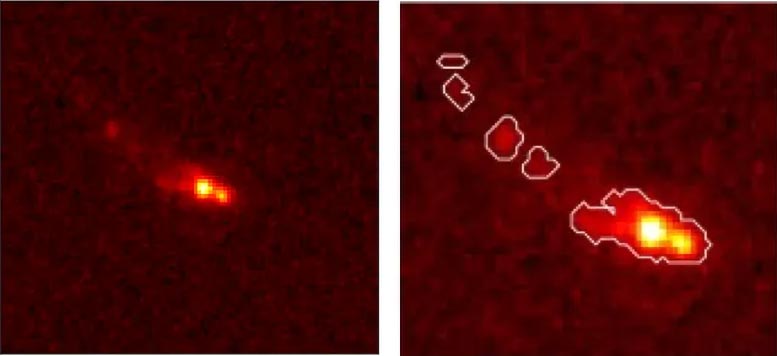
Just a couple of years ago, Gz9p3 appeared as a single point of light through the Hubble Space Telescope. But by using the James Webb Space Telescope we could observe this object as it was 510 million years after the Big Bang, around 13 billion years ago.
We found Gz9p3 was far more massive and mature than expected for such a young Universe, already containing several billion stars.
By far the most massive object confirmed from this time, it was calculated as 10 times more massive than any other galaxy found that early in the Universe.
Combined, these results suggest that for the galaxy to reach this size, stars must have developed much faster and more efficiently than we first thought.
Most Distant Galaxy Merger in the Early Universe
Not only is this Gz9p3 massive, but its complex shape immediately identifies it as one of the earliest galaxy mergers ever witnessed.
The JWST imaging of the galaxy shows a morphology typically associated with two interacting galaxies. And the merger hasn’t finished because we still see two components.
When two massive objects join like this, they effectively throw away some of the matter in the process. So, this discarded matter suggests what we observed is one of the most distant mergers ever seen.

Next, our study looked deeper, to describe the population of stars that make up the merging galaxies. Using JWST, we were able to examine the spectrum of the galaxy, splitting the light in the same way a prism splits white light into a rainbow.
When using imaging alone, most studies of these very distant objects show only very young stars because the younger stars are brighter and so their light dominates the imaging data.
For example, a young bright population sparked by the galaxy merger, less than a few million years old, outshines an older population already over 100 million years old.
Using the spectroscopy technique we can produce such detailed observations, that the two populations can be distinguished.
New Models of the Early Universe
Such a mature older population was not anticipated considering how early stars would have to have formed to have aged sufficiently by this cosmic time. The spectroscopy is so detailed, we can see the subtle features of the old stars that tell us there’s more there than you think.
Specific elements detected in the spectrum (including silicon, carbon, and iron) reveal this older population must exist to enrich the galaxy with an abundance of chemicals.
It is not only the size of the galaxies that is surprising but also the speed with which they grew to such a chemically mature state.
These observations provide evidence of a rapid, efficient build-up of stars and metals in the immediate aftermath of the Big Bang, tied to ongoing galaxy mergers, demonstrating that massive galaxies with several billion stars existed earlier than expected.
Isolated galaxies build up their population of stars in situ from their finite reservoirs of gas, however, this can be a slow way for galaxies to grow.
Interactions between galaxies can draw in fresh inflows of pristine gas, providing fuel for rapid star formation, and mergers provide an even more accelerated channel for mass accumulation and growth.
The largest galaxies in our modern Universe all carry a history of mergers, including our own Milky Way which has grown to its current size through successive mergers with smaller galaxies.
These observations of Gz9p3 show that galaxies were able to accumulate mass quickly in the early Universe through mergers, with star formation efficiencies higher than we expected.
This and other observations using the JWST are causing astrophysicists to adjust their modeling of the early years of the Universe.
Our cosmology isn’t necessarily wrong, but our understanding of how quickly galaxies formed probably is, because they are more massive than we ever believed could be possible.
These new results are well-timed as we approach the two-year mark for scientific observations made using the JWST.
As the total number of galaxies observed grows, astronomers studying the early Universe are transitioning from the discovery phase to a period when we have large enough samples to start building and refining new models.
There has never been a more exciting time to make sense of the mysteries of the early Universe.
Reference: “A massive interacting galaxy 510 million years after the Big Bang” by Kristan Boyett, Michele Trenti, Nicha Leethochawalit, Antonello Calabró, Benjamin Metha, Guido Roberts-Borsani, Nicoló Dalmasso, Lilan Yang, Paola Santini, Tommaso Treu, Tucker Jones, Alaina Henry, Charlotte A. Mason, Takahiro Morishita, Themiya Nanayakkara, Namrata Roy, Xin Wang, Adriano Fontana, Emiliano Merlin, Marco Castellano, Diego Paris, Maruša Bradač, Matt Malkan, Danilo Marchesini, Sara Mascia, Karl Glazebrook, Laura Pentericci, Eros Vanzella and Benedetta Vulcani, 7 March 2024, Nature Astronomy.
DOI: 10.1038/s41550-024-02218-7
The study was led by Dr. Kit Boyett with a team including Professor Michele Trenti, Benjamin Metha and Nicoló Dalmasso also from the University of Melbourne and the ARC Centre of Excellence for All Sky Astrophysics in 3 Dimensions (ASTRO 3D). The international research team comprised 27 authors from 19 institutions in Australia, Thailand, Italy, the USA, Japan, Denmark, and China.
Never miss a breakthrough: Join the SciTechDaily newsletter.
Follow us on Google and Google News.
2 Comments
Adding to the Webb observations of early active galaxies (quasars with early supermassive black holes).
“The largest galaxies in our modern Universe all carry a history of mergers, including our own Milky Way which has grown to its current size through successive mergers with smaller galaxies.”
There is now two more candidates to early Milky Way merger events, perhaps as old as 12 billion years ago: “Shiva and Shakti: Presumed Proto-Galactic Fragments in the Inner Milky Way”, Khyati Malhan and Hans-Walter Rix 2024 ApJ 964 104.