
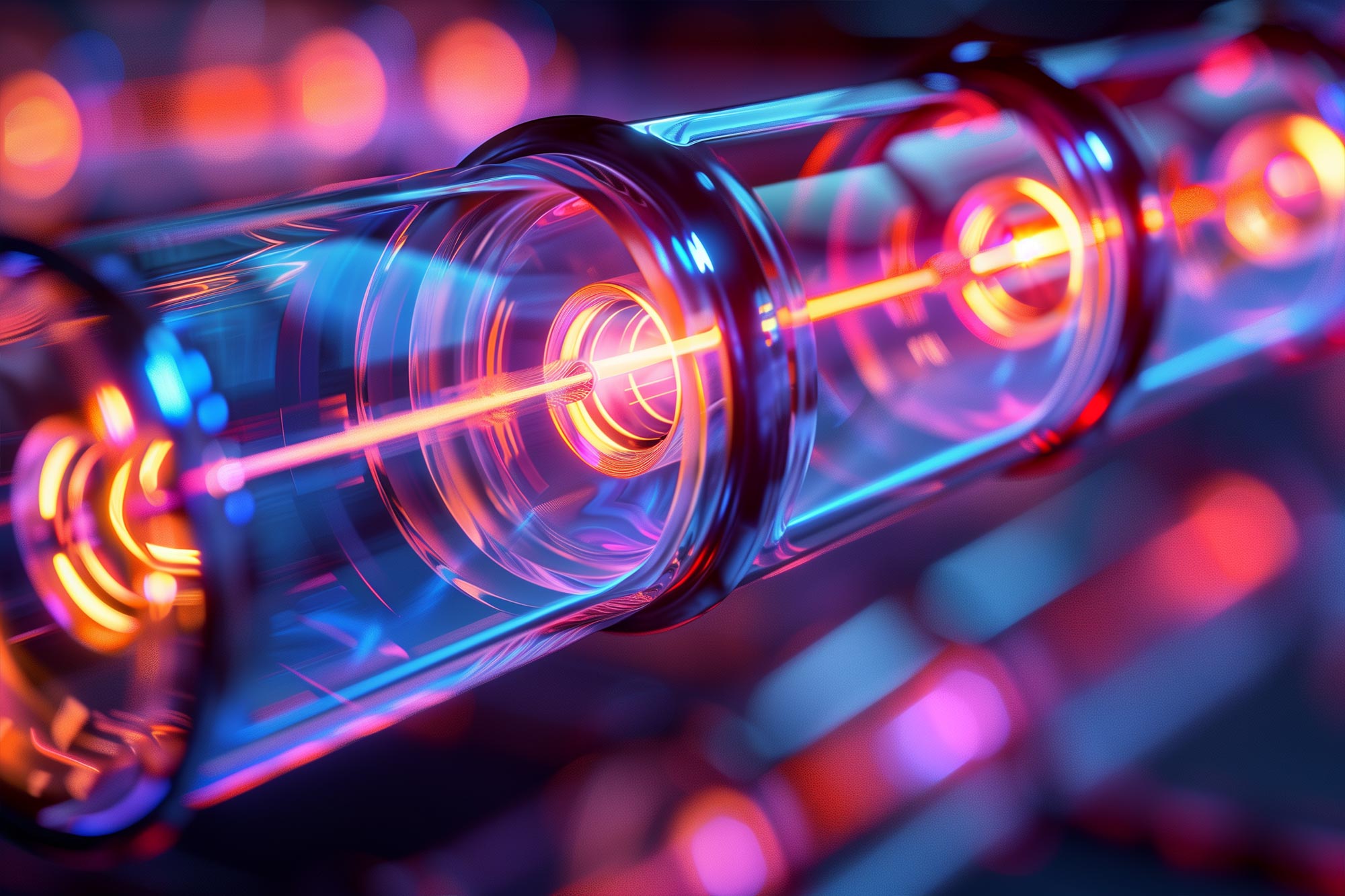
A new approach for quantum networks involves using vacuum sealed tubes with spaced-out lenses to transport quantum data via photons over long distances. This method, developed by scientists at the University of Chicago and collaborators, aims to enable secure, high-capacity quantum communication across vast distances.
Quantum computers offer powerful ways to improve cybersecurity, communications, and data processing, among other fields. To realize these full benefits, however, multiple quantum computers need to be connected to build quantum networks or a quantum internet. Scientists have struggled to come up with practical methods of building such networks, which must transmit quantum information over long distances.
Innovating Quantum Communication
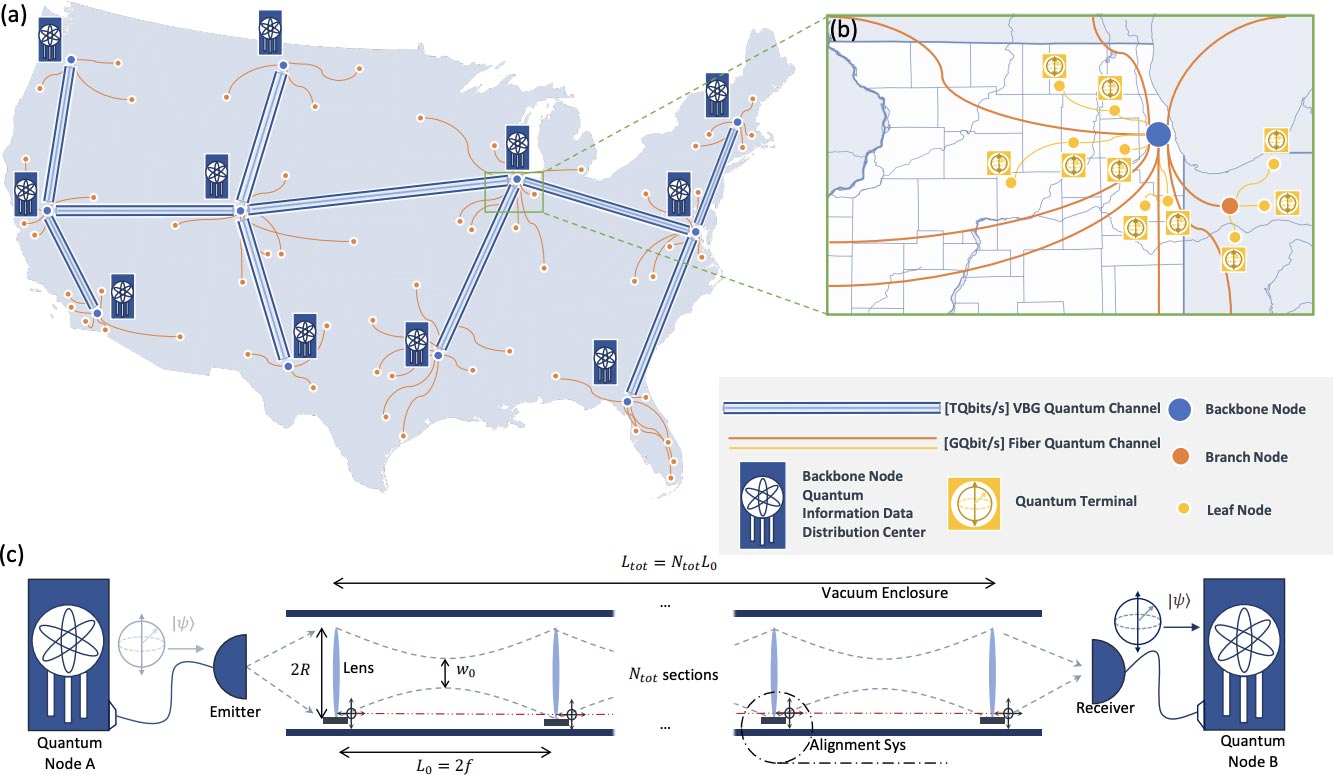
Now, researchers at the University of Chicago Pritzker School of Molecular Engineering (PME) have proposed a new approach — building long quantum channels using vacuum sealed tubes with an array of spaced-out lenses. These vacuum beam guides, about 20 centimeters in diameter, would have ranges of thousands of kilometers and capacities of 10 trillion qubits per second, better than any existing quantum communication approach. Photons of light encoding quantum data would move through the vacuum tubes and remain focused thanks to the lenses.
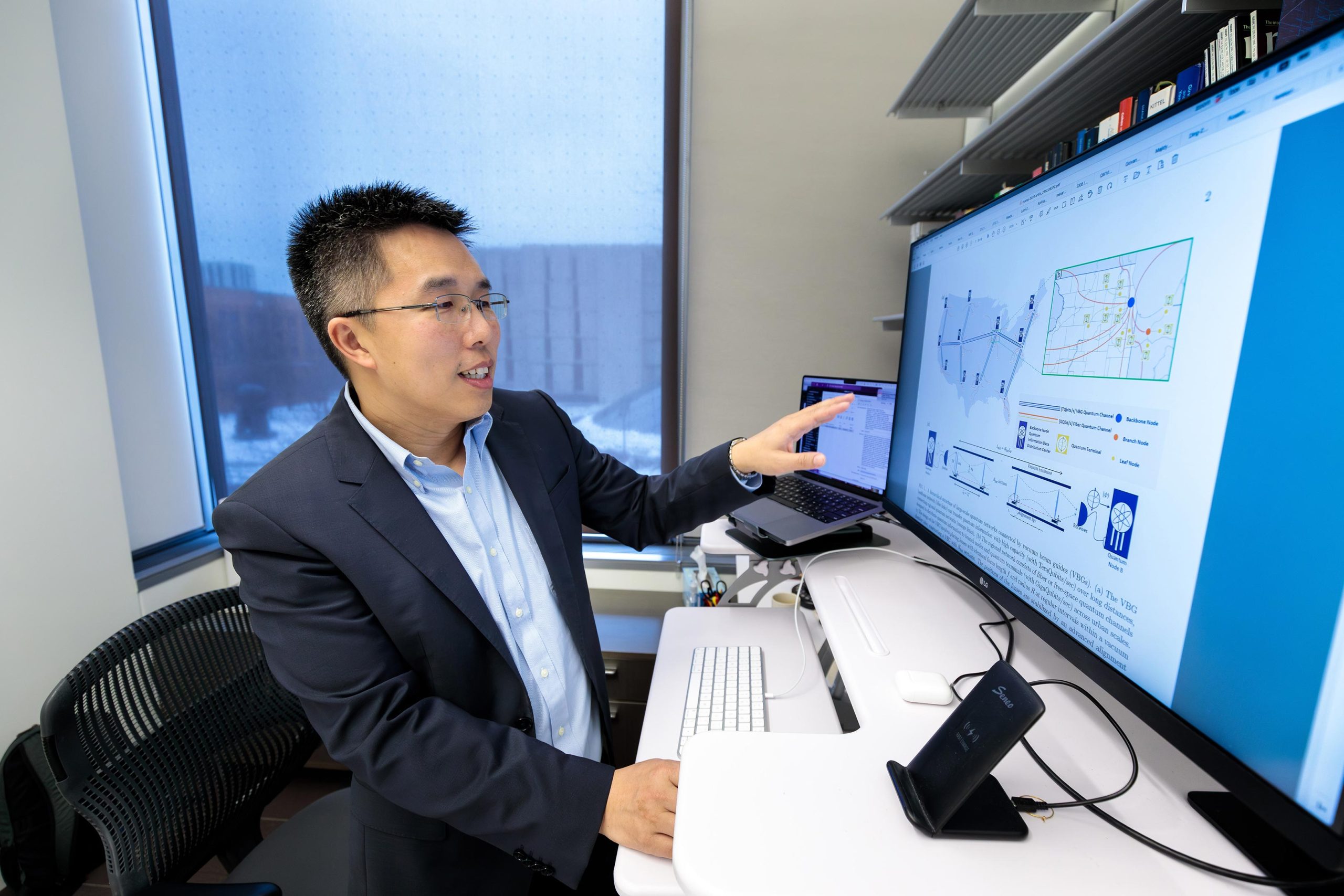
“We believe this kind of network is feasible and has a lot of potential,” said Liang Jiang, professor of molecular engineering and senior author of the new work. “It could not only be used for secure communication, but also for building distributed quantum computing networks, distributed quantum sensing technologies, new kinds of telescopes, and synchronized clocks.”
Jiang collaborated with scientists at Stanford University and the California Institute of Technology on the new work, which was published on July 9 in Physical Review Letters.
Quantum Properties and Data Transmission
While classical computers encode data in conventional bits — represented as a 0 or 1 — quantum computers rely on qubits, which can exhibit quantum phenomena. These phenomena include superposition — a kind of ambiguous combination of states — as well as entanglement, which allows two quantum particles to be correlated with each other even across vast distances.
These properties give quantum computers the ability to analyze new types of data and store and pass along information in new, secure ways. Connecting multiple quantum computers can them even more powerful, as their data processing abilities can be pooled. However, networks typically used to connect computers are not ideal because they cannot maintain the quantum properties of qubits.
“You can’t send a quantum state over a classical network,” explained Jiang. “You might send a piece of data classically, a quantum computer can process it, but the result is then sent back classically again.”
Some researchers have tested ways of using fiber-optic cables and satellites to transmit optical photons, which can act as qubits. Photons can travel a short distance through existing fiber-optic cables but generally lose their information quickly as photons are absorbed. Photons bounced to satellites and back to the ground in a new location are absorbed less because of the vacuum of space, but their transmission is limited by the atmosphere absorption and availability of the satellites.
“What we wanted to do was to combine the advantages of each of those previous approaches,” said PME graduate student Yuexun Huang, the first author of the new work. “In a vacuum, you can send a lot of information without attenuation. But being able to do that on the ground would be ideal.”
“We believe this kind of network is feasible and has a lot of potential.”
Prof. Liang Jiang
Ground-Based Vacuum Tubes and Quantum Information
Scientists working at the Laser Interferometer Gravitational-Wave Observatory (LIGO) the California Institute of Technology (Caltech) have built huge ground-based vacuum tubes to contain moving photons of light that can detect gravitational waves. Experiments at LIGO have shown that inside a nearly-molecule-free vacuum, photons can travel for thousands of kilometers.
Inspired by this technology, Jiang, Huang, and their colleagues began to sketch out how smaller vacuum tubes could be used to transport photons between quantum computers. In their new theoretical work, they showed that these tubes, if designed and arranged properly, could carry photons across the country. Moreover, they would only need medium vacuum (10^-4 atmosphere pressure), which is much easier to maintain than the ultra-high vacuum (10^-11 atmosphere pressure) required for LIGO.
“The main challenge is that as a photon moves through a vacuum, it spreads out a bit,” explained Jiang. “To overcome that, we propose putting lenses every few kilometers that can focus the beam over long distances without diffraction loss.”
In collaboration with researchers at Caltech, the group is planning tabletop experiments to test the practicality of the idea, and then plans to use larger vacuum tubes such as those at LIGO to work on how to align the lenses and stabilize the photon beams over long distances.
“To implement this technology on a larger scale certain poses some civil engineering challenges that we need to figure out as well,” said Jiang. “But the ultimate benefit is that we have large quantum networks that can communicate tens of terabytes of data per second.”
Reference: “Vacuum Beam Guide for Large Scale Quantum Networks” by Yuexun Huang, Francisco Salces–Carcoba, Rana X. Adhikari, Amir H. Safavi-Naeini and Liang Jiang, 9 July 2024, Physical Review Letters.
DOI: 10.1103/PhysRevLett.133.020801
Funding: This work was supported by the Army Research Laboratory, Air Force Research Laboratory, National Science Foundation, NTT Research, Packard Foundation, the Marshall and Arlene Bennett Family Research Program, and the U.S. Department of Energy.
Never miss a breakthrough: Join the SciTechDaily newsletter.
Follow us on Google and Google News.
1 Comment
Could… but won’t.