

Scientists have fabricated a transistor from a single carbon nanotube by applying heat and strain to rearrange its atomic structure.
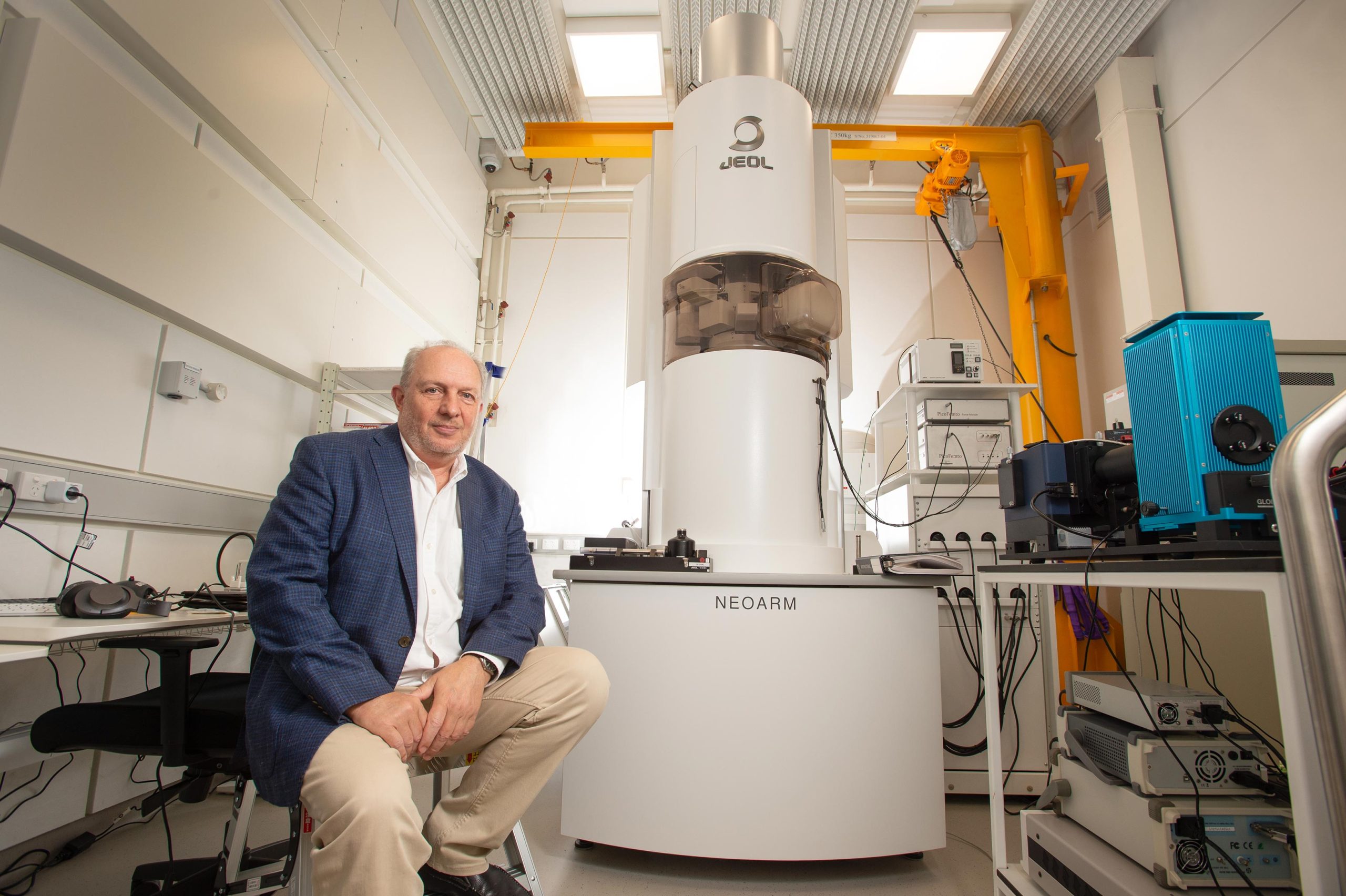
An international team of researchers has used a unique tool inserted into an electron microscope to create a transistor that’s 25,000 times smaller than the width of a human hair.
The research, published in the journal Science, involves researchers from Japan, China, Russia, and Australia who have worked on the project that began five years ago.
QUT Center for Materials Science co-director Professor Dmitri Golberg, who led the research project, said the result was a “very interesting fundamental discovery” which could lead a way for the future development of tiny transistors for future generations of advanced computing devices.
“In this work, we have shown it is possible to control the electronic properties of an individual carbon nanotube,” Professor Golberg said.
How Heat and Strain Reshaped a Nanotube Into a Transistor
The researchers created the tiny transistor by simultaneously applying a force and low voltage which heated a carbon nanotube made up of a few layers until outer tube shells separate, leaving just a single-layer nanotube.
The heat and strain then changed the “chilarity” of the nanotube, meaning the pattern in which the carbon atoms joined together to form the single-atomic layer of the nanotube wall was rearranged.
The result of the new structure connecting the carbon atoms was that the nanotube was transformed into a transistor.
Professor Golberg’s team members from the National University of Science and Technology in Moscow created a theory explaining the changes in the atomic structure and properties observed in the transistor.
Manipulating Chirality to Build Nanoscale Devices
Lead author Dr. Dai-Ming Tang, from the International Center for Materials Nanoarchitectonics in Japan, said the research had demonstrated the ability to manipulate the molecular properties of the nanotube to fabricate nanoscale electrical devices.
Dr. Tang began working on the project five years ago when Professor Golberg headed up the research group at this center.
“Semiconducting carbon nanotubes are promising for fabricating energy-efficient nanotransistors to build beyond-silicon microprocessors,” Dr. Tang said.
“However, it remains a great challenge to control the chirality of individual carbon nanotubes, which uniquely determines the atomic geometry and electronic structure.
“In this work, we designed and fabricated carbon nanotube intramolecular transistors by altering the local chirality of a metallic nanotube segment by heating and mechanical strain.”
Professor Golberg said the research in demonstrating the fundamental science in creating the tiny transistor was a promising step towards building beyond-silicon microprocessors.
Transistors, which are used to switch and amplify electronic signals, are often called the “building blocks” of all electronic devices, including computers. For example, Apple says the chip which powers the future iPhones contains 15 billion transistors.
The computer industry has been focused on developing smaller and smaller transistors for decades, but faces the limitations of silicon.
Nanotransistors Push the Limits of Silicon Technology
In recent years, researchers have made significant steps in developing nanotransistors, which are so small that millions of them could fit onto the head of a pin.
“Miniaturization of transistors down to nanometer scale is a great challenge of the modern semiconducting industry and nanotechnology,” Professor Golberg said.
“The present discovery, although not practical for a mass-production of tiny transistors, shows a novel fabrication principle and opens up a new horizon of using thermomechanical treatments of nanotubes for obtaining the smallest transistors with desired characteristics.”
Reference: “Semiconductor nanochannels in metallic carbon nanotubes by thermomechanical chirality alteration” by Dai-Ming Tang, Sergey V. Erohin, Dmitry G. Kvashnin, Victor A. Demin, Ovidiu Cretu, Song Jiang, Lili Zhang, Peng-Xiang Hou, Guohai Chen, Don N. Futaba, Yongjia Zheng, Rong Xiang, Xin Zhou, Feng-Chun Hsia, Naoyuki Kawamoto, Masanori Mitome, Yoshihiro Nemoto, Fumihiko Uesugi, Masaki Takeguchi, Shigeo Maruyama, Hui-Ming Cheng, Yoshio Bando, Chang Liu, Pavel B. Sorokin and Dmitri Golberg, 23 December 2021, Science.
DOI: 10.1126/science.abi8884
Never miss a breakthrough: Join the SciTechDaily newsletter.
Follow us on Google and Google News.
3 Comments
“chilarity”! lol
Hella chill semiconductors, dude
Chilarity or chirality?
C hilarity.
Proofread much?
Interesting
Some thoughts about Quantum Computing practical difficulties to be overcome. Some Way out ideas.
1. What would a quantum microprocessors look like? How do we build one with four dimensionsal computing to maximise the benefit of Quantum capability of Zero, One, And (Zero OR One) AND (Zero AND One) reality in the quantum space.
2. Are Nano transistors and Microprocessor built with carbon nanotubes the only option? Can we explore other elements of the periodic table to replace these and include superconducting materials in the mix? Can we explore some other workarounds of Silion limitation without further miniturization?Can Computing Power be Paired together to handle the four dimensions reolacing two dimensions?
Views expressed are personal and not binding on anyone.