
Close Menu
    Facebook X (Twitter) Instagram
    SciTechDaily
    • Biology
    • Chemistry
    • Earth
    • Health
    • Physics
    • Science
    • Space
    • Technology
    Facebook X (Twitter) Pinterest YouTube RSS
    SciTechDaily
    Home»Space»Galactic Misconceptions Unveiled: The Truth Behind “Late-Type” Galaxies in Hubble’s Latest Snapshot
    Space

    Galactic Misconceptions Unveiled: The Truth Behind “Late-Type” Galaxies in Hubble’s Latest Snapshot

    By ESA/HubbleNovember 19, 20231 Comment2 Mins Read
    Facebook Twitter Pinterest Telegram LinkedIn WhatsApp Email Reddit
    Share
    Facebook Twitter LinkedIn Pinterest Telegram Email Reddit
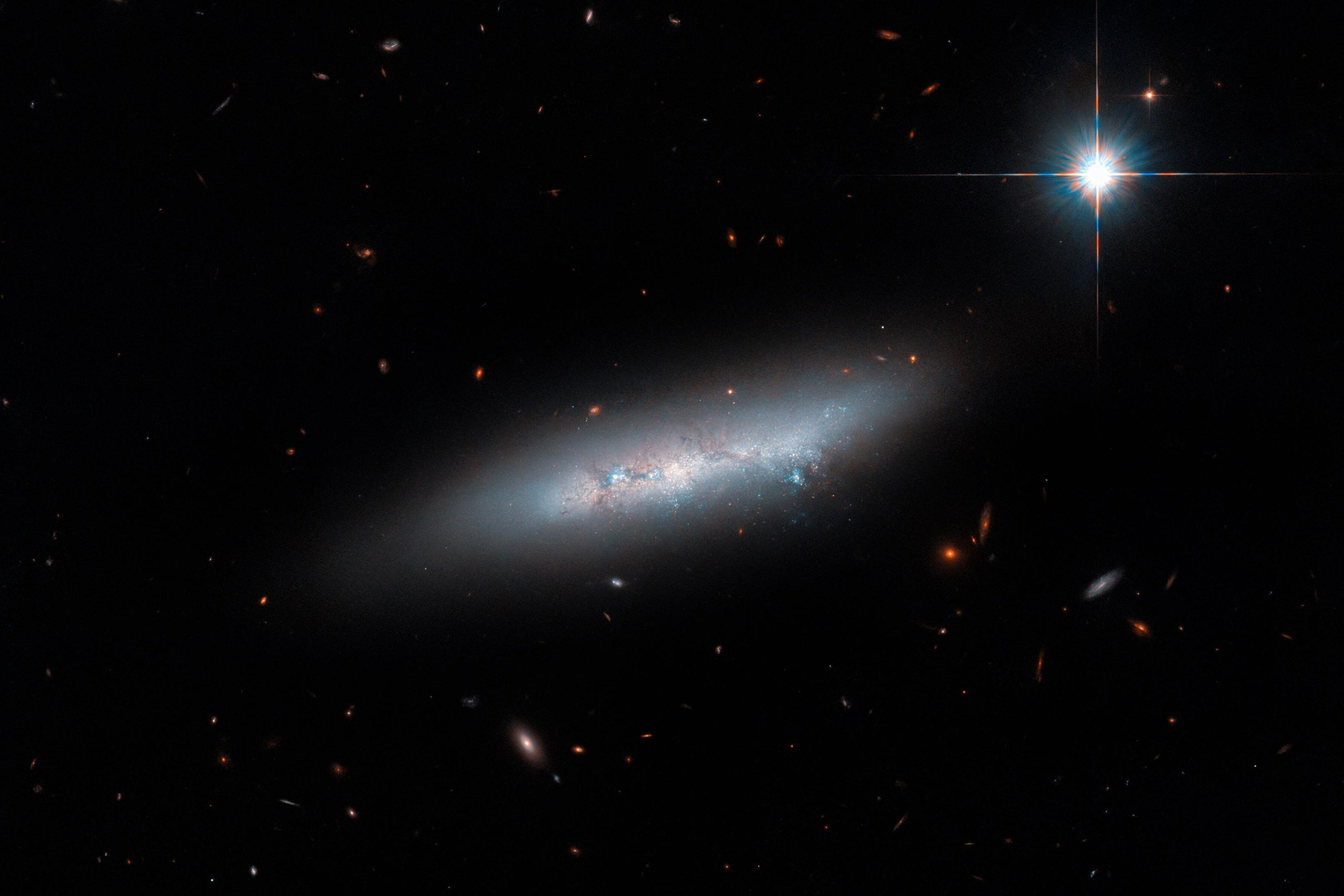
    Galaxy NGC 2814
    This image features NGC 2814, an irregular galaxy in the Holmberg 124 group, captured by the Hubble Telescope. Credit: ESA/Hubble & NASA, C. Kilpatrick

    Hubble Captures the Isolated Beauty of NGC 2814

    This Hubble Picture of the Week features NGC 2814, an irregular galaxy that is located approximately 85 million light-years from Earth. In this image, which was captured using Hubble’s Advanced Camera for Surveys (ACS), the galaxy appears to be quite isolated: visually, it looks a little like a loose stroke of bright paint across a dark background.

    However, looks can be deceiving. NGC 2814 actually has three close (in astronomical terms) galactic neighbors: a side-on spiral galaxy known as NGC 2820; an irregular galaxy named IC 2458; and a face-on non-barred spiral galaxy called NGC 2805. Collectively, the four galaxies make up a galaxy group known as Holmberg 124. In some literature, these galaxies are referred to as a group of ‘late-type galaxies’.

    Clarifying Galactic Classifications

    The terminology ‘late-type’ refers to spiral and irregular galaxies, while ‘early-type’ refers to elliptical galaxies. This rather confusing terminology has led to a common misconception within the astronomy community. It is still quite widely believed that Edwin Hubble inaccurately thought that elliptical galaxies were the evolutionary precursors to spiral and irregular galaxies, and that that is the reason why ellipticals are classed as ‘early-type’ and spirals and irregulars are classed as ‘late-type’.

    This misconception is due to the Hubble ‘tuning fork’ of galactic classification, which visually shows galaxy types proceeding from elliptical to spiral, in a sequence that could easily be interpreted as a temporal evolution.

    However, Hubble actually adopted the terms ‘early-type’ and ‘late-type’ from much older astronomical terminology for stellar classifications, and did not mean to state that ellipticals were literally evolutionary precursors to spiral and irregular galaxies. In fact, he explicitly said in his 1927 paper that “the nomenclature … [early and late] … refers to position in the sequence, and temporal connotations are made at one’s peri’.”

    Despite Hubble himself being quite emphatic on this topic, the misunderstanding persists almost a hundred years later, and perhaps provides an instructive example of why it is helpful to classify things with easy-to-interpret terminology from the get-go!

    Never miss a breakthrough: Join the SciTechDaily newsletter.
    Follow us on Google and Google News.

    Astronomy Astrophysics European Space Agency Hubble Space Telescope
    Share. Facebook Twitter Pinterest LinkedIn Email Reddit

    Related Articles

    Hubble Captures a Dangerous Dance Over 100 Million Light-Years From Earth

    Hubble Captures the Final Acts of a Monster Star

    Hubble Find Surprises Astronomers: White Dwarfs Can Still Undergo Stable Thermonuclear Activity

    First Evidence of Water Vapor at Jupiter’s Moon Ganymede – May Hold More Water Than All of Earth’s Oceans

    Our Giant Universe: Hubble Spots Massive Galaxy Cluster With a Wealth of Exciting Possibilities

    Tantrums of a Baby Star: Herbig-Haro Objects

    Unexpected Discovery: Hubble Space Telescope Uncovers Concentration of Small Black Holes

    “Unprecedented” – Unusual Planetary Nebula Fades Mere Decades After It Arrived

    Hubble Captures Unprecedented Fading of Stingray Nebula – “This Is Very, Very Dramatic, and Very Weird”

    1 Comment

    1. Peter Jackson FRAS on November 20, 2023 7:27 am

      A new cyclic TEMPORAL evolutionary sequence of galaxy types was well received by the AAS Pasadena conference. This DFM sequence identifies a ‘missing link’ between re-ionised quasar jet outflow material and new young open spiral galaxies. Central galaxy bars etc. are thus explained. These then evolved to discs, lenticulars and ‘ring’ galaxies (from AGN accretion). The original paper identifying this new sequence was here; https://www.researchgate.net/publication/275970919_A_CYCLIC_MODEL_OF_GALAXY_EVOLUTION_WITH_BARS_Published_HJ_2014

      Reply
    Leave A Reply Cancel Reply

    • Facebook
    • Twitter
    • Pinterest
    • YouTube

    Don't Miss a Discovery

    Subscribe for the Latest in Science & Tech!

    Trending News

    Scientists May Have Found the Key to Jupiter and Saturn’s Moon Mystery

    Scientists Uncover Brain Changes That Link Pain to Depression

    Saunas May Do More Than Raise Body Temperature – They Activate Your Immune System

    Exercise in a Pill? Metformin Shows Surprising Effects in Cancer Patients

    Hidden Oceans of Magma Could Be Protecting Alien Life

    New Study Challenges Alzheimer’s Theories: It’s Not Just About Plaques

    Artificial Sweeteners May Harm Future Generations, Study Suggests

    Splashdown! NASA Artemis II Returns From Record-Breaking Moon Mission

    Follow SciTechDaily
    • Facebook
    • Twitter
    • YouTube
    • Pinterest
    • Newsletter
    • RSS
    SciTech News
    • Biology News
    • Chemistry News
    • Earth News
    • Health News
    • Physics News
    • Science News
    • Space News
    • Technology News
    Recent Posts
    • Ancient DNA Reveals Irish Goats Have a 3,000-Year-Old Lineage Still Alive Today
    • Historians Reveal Secrets of the Strange Hat Wars That Shook Early Modern England
    • “A Plague Is Upon Us”: The Mass Death That Changed an Ancient City Forever
    • This Strange Material Can Turn Superconductivity on and off Like a Switch
    • Scientists Discover Game-Changing New Way To Treat High Cholesterol
    Copyright © 1998 - 2026 SciTechDaily. All Rights Reserved.
    • Science News
    • About
    • Contact
    • Editorial Board
    • Privacy Policy
    • Terms of Use

    Type above and press Enter to search. Press Esc to cancel.