

Close Menu
    Facebook X (Twitter) Instagram
    SciTechDaily
    • Biology
    • Chemistry
    • Earth
    • Health
    • Physics
    • Science
    • Space
    • Technology
    Facebook X (Twitter) Pinterest YouTube RSS
    SciTechDaily
    Home»Biology»Game-Changing AI Tool Rewrites the Rules of Protein Engineering
    Biology

    Game-Changing AI Tool Rewrites the Rules of Protein Engineering

    By Chinese Academy of Sciences HeadquartersJuly 15, 20251 Comment3 Mins Read
    Facebook Twitter Pinterest Telegram LinkedIn WhatsApp Email Reddit
    Share
    Facebook Twitter LinkedIn Pinterest Telegram Email Reddit
    Advancing Protein Evolution With Inverse Folding Models Integrating Structural and Evolutionary Constraints
    Advancing protein evolution with inverse folding models integrating structural and evolutionary constraints. Credit: IGDB

    Chinese scientists have developed a novel AI-guided protein engineering strategy that enables faster, cost-effective, and highly accurate protein design.

    A group of scientists in China, led by Professor Caixia Gao from the Institute of Genetics and Developmental Biology (IGDB) at the Chinese Academy of Sciences, has introduced an innovative method that may significantly advance protein engineering. This new technique, known as AI-informed Constraints for protein Engineering (AiCE), accelerates the evolution of proteins by combining structural and evolutionary insights within a standard inverse folding model. Remarkably, it does so without requiring the development or training of dedicated artificial intelligence (AI) systems.

    The research, published in Cell on July 7, takes aim at several long-standing limitations in conventional protein engineering practices.

    Ideally, protein engineering would achieve high-performance results with minimal complexity. However, most current methods struggle with high costs, low efficiency, and limited scalability. Even though AI-based approaches offer improvements, they typically demand significant computational resources. This has created a need for solutions that are both powerful and practical, allowing for more widespread use without sacrificing accuracy.

    Introducing AiCEsingle: Precision Through Structural Constraints

    In this study, the researchers first developed AiCEsingle, a module designed to predict high-fitness (HF) single amino acid substitutions. It enhances prediction accuracy by extensively sampling inverse folding models—AI models that generate compatible amino acid sequences based on protein 3D structures—while incorporating structural constraints.
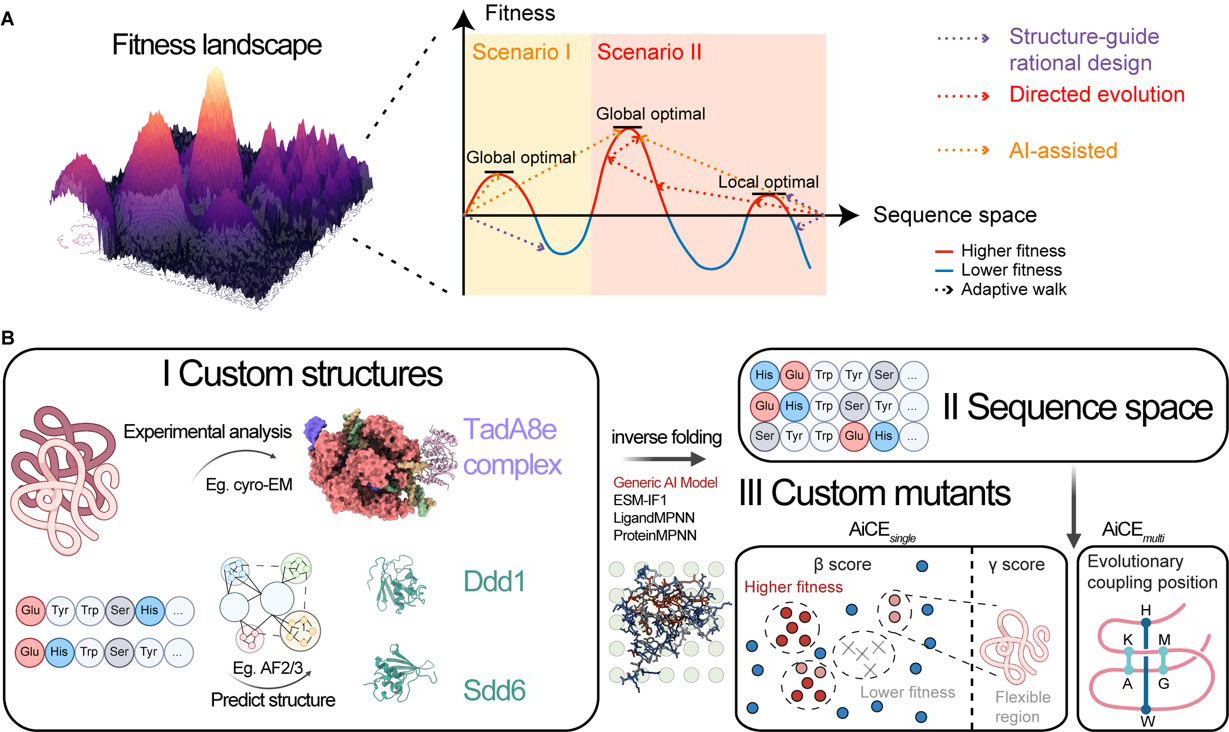
    AiCE AI Informed Approach for Protein Engineering
    AiCE as an AI-informed approach for protein engineering. Credit: IGDB

    Benchmarking against 60 deep mutational scanning (DMS) datasets demonstrated that AiCEsingle outperforms other AI-based methods by 36–90%. Its effectiveness for complex proteins and protein–nucleic acid complexes was also validated. Notably, incorporating structural constraints alone yielded a 37% improvement in accuracy.

    To address the challenge of negative epistatic interactions in combinatorial mutations, the researchers developed the AiCEmulti module, which integrates evolutionary coupling constraints. This allows for accurate prediction of multiple high-fitness mutations at minimal computational cost, expanding the tool’s versatility and practical utility.

    Engineering a New Generation of Functional Proteins

    Using the AiCE framework, the researchers successfully evolved eight proteins with diverse structures and functions, including deaminases, nuclear localization sequences, nucleases, and reverse transcriptases. These engineered proteins have enabled the creation of several next-generation base editors for applications in precision medicine and molecular breeding. These include: enABE8e, a cytosine base editor with a ~50% narrower editing window; enSdd6-CBE, an adenine base editor with 1.3× higher fidelity; and enDdd1-DdCBE, a mitochondrial base editor showing a 13× increase in activity.

    AiCE represents a simple, efficient, and broadly applicable strategy for protein engineering. By unlocking the potential of existing AI models, it offers a promising new direction for the field and enhances the interpretability of AI-driven protein redesign.

    Reference: “Advancing protein evolution with inverse folding models integrating structural and evolutionary constraints” by Hongyuan Fei, Yunjia Li, Yijing Liu, Jingjing Wei, Aojie Chen and Caixia Gao, 7 July 2025, Cell.
    DOI: 10.1016/j.cell.2025.06.014

    Never miss a breakthrough: Join the SciTechDaily newsletter.
    Follow us on Google and Google News.

    Bioinformatics Biotechnology Chinese Academy of Sciences Computational Biology Genetics
    Share. Facebook Twitter Pinterest LinkedIn Email Reddit

    Related Articles

    New Tool Reads DNA and RNA in a Single Cell, Unlocking Secrets of Disease

    First Major Discoveries Reported From Project to Read Complete Genetic Sequences of All 70,000 Vertebrate Species

    Heart Recovery After Heart Attack Mapped in Great Detail

    New Genetic Engineering Tool Unlocks Biochemical Treasure Chest Within Microbes

    Researchers Create a Molecular Map of Every Cell in a Developing Animal Embryo

    New Technology for Gene-Editing Mutations in Live Organisms

    Improved Technique Provides Major Lift to Biomedical Genomics Research

    Scientists Engineer First Living Organism with an Expanded Genetic Alphabet

    MIT Researchers Reverse a Rare Liver Disorder in Mice

    1 Comment

    1. Robert on July 15, 2025 8:22 am

      Anyone ever heard of Prions?

      Reply
    Leave A Reply Cancel Reply

    • Facebook
    • Twitter
    • Pinterest
    • YouTube

    Don't Miss a Discovery

    Subscribe for the Latest in Science & Tech!

    Trending News

    Collapsing Plasma May Hold the Key to Cosmic Magnetism

    This Breakthrough Solar Panel Generates Power From Both Sunlight and Raindrops

    Scientists Uncover New Metabolic Effects Beyond Weight Loss of Mounjaro

    Scientists Discover Cancer Tumors Are “Addicted” to This Common Antioxidant

    1,800 Miles Down: Scientists Uncover Mysterious Movements at the Edge of Earth’s Core

    Scientists Discover Hidden “Good Fats” in Green Rice That Could Transform Nutrition

    Your Child’s Clothes Could Contain Toxic Lead, Study Finds

    Researchers Break a 150-Year-Old Math Law With a Surprising Donut Discovery

    Follow SciTechDaily
    • Facebook
    • Twitter
    • YouTube
    • Pinterest
    • Newsletter
    • RSS
    SciTech News
    • Biology News
    • Chemistry News
    • Earth News
    • Health News
    • Physics News
    • Science News
    • Space News
    • Technology News
    Recent Posts
    • The Mystery of the Notes: Why No One Knows How This 120-Year-Old Song Should Sound
    • Scientists Discover 132-Million-Year-Old Dinosaur Tracks on South Africa’s Coast
    • Scientists Uncover the Secret Ingredient Behind the Spark That May Have Started Life on Earth
    • Natural Oils vs. Antibiotics: The Swine Study That Could Change Farming
    • The Biggest Volcanic Event in Earth’s History Transformed an Entire Oceanic Plate
    Copyright © 1998 - 2026 SciTechDaily. All Rights Reserved.
    • Science News
    • About
    • Contact
    • Editorial Board
    • Privacy Policy
    • Terms of Use

    Type above and press Enter to search. Press Esc to cancel.