
Close Menu
    Facebook X (Twitter) Instagram
    SciTechDaily
    • Biology
    • Chemistry
    • Earth
    • Health
    • Physics
    • Science
    • Space
    • Technology
    Facebook X (Twitter) Pinterest YouTube RSS
    SciTechDaily
    Home»Space»Gemini Observatory Image of the Lagoon Nebula
    Space

    Gemini Observatory Image of the Lagoon Nebula

    By Gemini ObservatoryApril 9, 2013No Comments3 Mins Read
    Facebook Twitter Pinterest Telegram LinkedIn WhatsApp Email Reddit
    Share
    Facebook Twitter LinkedIn Pinterest Telegram Email Reddit
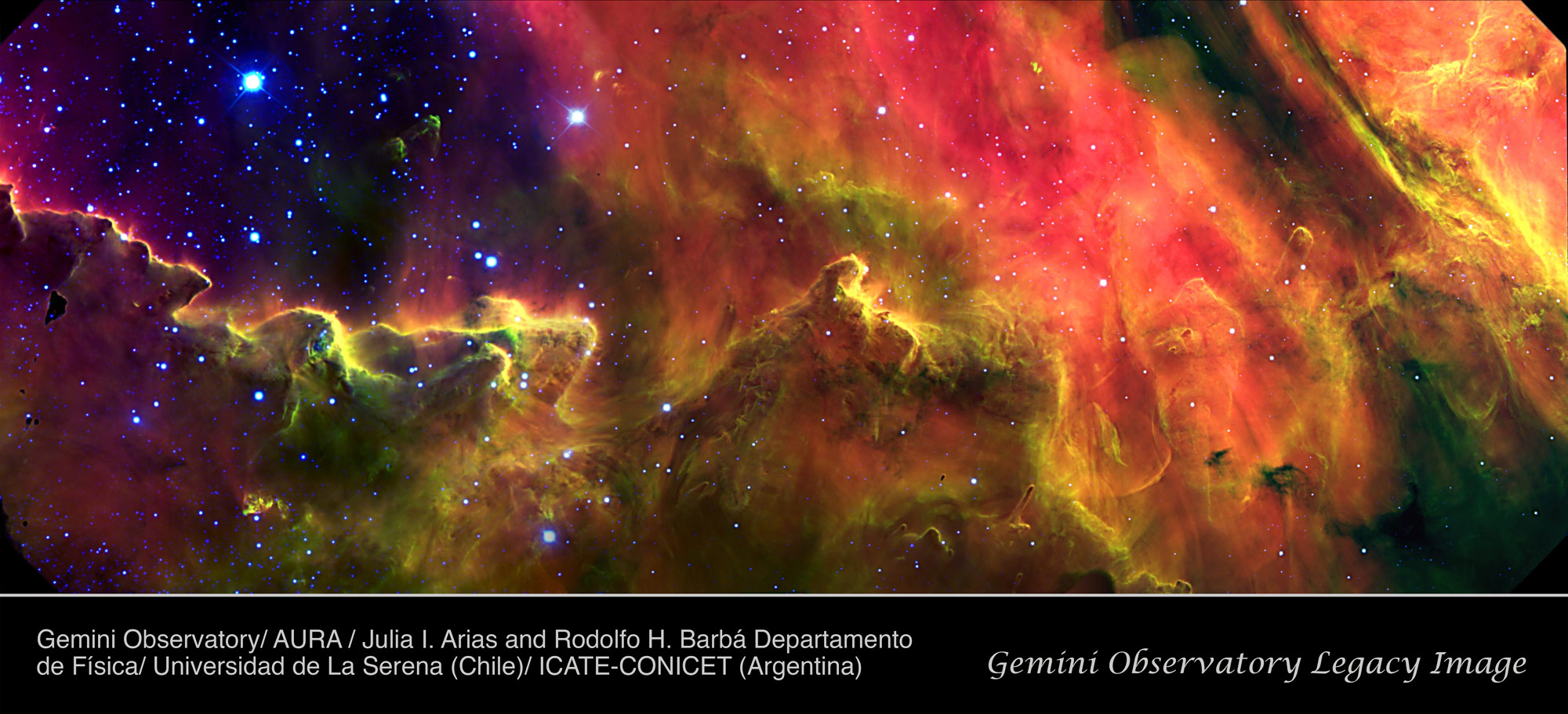
    Gemini South Telescope Image of the Lagoon Nebula
    A portion of the Lagoon nebula imaged by Argentinean astronomers Julia Arias and Rodolfo Barbá using the Gemini South telescope with the Gemini Multi-Object Spectrograph. Credit: Julia I. Arias and Rodolfo H. Barbá Departamento de Física, Universidad de La Serena (Chile), and ICATE-CONICET (Argentina)

    Released two years ago, this partial image of the Lagoon Nebula still remains an all-time favorite of astronomers and sky-watchers.

    The Lagoon Nebula (Messier 8, or M8) is among the most striking examples of a stellar nursery in our neighborhood of the Milky Way galaxy. Visible in small telescopes and binoculars its fuzzy glow reveals the type of chaotic environment where new stars are born.

    Argentinean astronomers Julia Arias (Universidad de La Serena) and Rodolfo Barbá (Universidad de La Serena and ICATE-CONICET) have used the Gemini South telescope in Chile, to obtain a dramatic new image of the nursery that could be described as psychedelic. Actually, since M8 is located some 5,000 lightyears away, the multi-hued scene is truly a psychedelic “flashback” as its photons had to travel through space for that same number of years before they reached the gigantic Gemini 8-meter mirror. Astronomers sometimes call the region imaged the “Southern Cliff” because it resembles a sharp drop-off. Beyond the “cliff,” light from a spattering of young background stars in the upper left of the image shines through the cloudscape.

    Arias and Barbá obtained the imaging data to explore the evolutionary relationship between the newborn stars and what are known as Herbig-Haro (HH) objects. HH objects form when young stars eject large amounts of fast-moving gas as they grow. This gas plows into the surrounding nebula, producing bright shock fronts that glow as the gas is heated by friction and surrounding gas is excited by the high-energy radiation of nearby hot stars. The researchers found a dozen of these HH objects in the image, spanning sizes that range from a few thousand astronomical units (about a trillion kilometers) to 1.4 parsecs (4.6 light-years), i.e. a little greater than the distance from the Sun to its nearest neighbor Proxima Centauri.

    The picture – a composite of individual images obtained with two narrow-band optical filters sensitive to hydrogen (red) and ionized sulfur (green) emission, and another that transmits far red light (blue) – reveals in dramatic detail a glorious cloudscape of dust and gas surrounding this nursery of intermediate- and low-mass stars. Most of the newborn stars are imbedded in the tips of thick dusty clouds, which have the appearance of bright-rimmed pillars.

    The Lagoon nebula is located in the direction of the constellation Sagittarius in the southern Milky Way. Viewed through large amateur telescopes, it appears as a pale ghostly glow with a touch of pink. In this image, the use of selective filters to reveal characteristics of the gas clouds and the assignment of red, green, and blue to represent each of the three data sets results in myriad and strong color differentiation. Thus, the colors shown are not representative of the light’s actual color. For example, light from the far-red end of the spectrum, beyond what the eye can see, appears blue in this image.

    The Gemini Multi-Object Spectrograph (GMOS) on Gemini South captured the light for the spectacular new image from its perch on Cerro Pachón in the Chilean Andes.

    Never miss a breakthrough: Join the SciTechDaily newsletter.
    Follow us on Google and Google News.

    Astronomy Gemini Observatory
    Share. Facebook Twitter Pinterest LinkedIn Email Reddit

    Related Articles

    After Many Years of Searching – Potential First Traces of the Universe’s Earliest Stars Discovered

    Atlas of Peculiar Galaxies: Strong-Arming a Galaxy

    New Discovery Reveals Why Uranus and Neptune Are Different Colors

    Crystal-Clear Images of Sidewinding Young Stellar Jets Captured by Gemini South Telescope’s Adaptive Optics System

    Gemini Catches a Glowing One-Winged Butterfly

    Ruins of Ancient Star Cluster Discovered at the Fringes of Our Galaxy

    Astronomers Discover Surprising Cause of a “Fizzled” Gamma-Ray Burst

    By Jove! Stunning New Images Show Jupiter’s Great Red Spot, Superstorms, and Gargantuan Cyclones

    Are We Missing Other Earths? Dramatic New Evidence Uncovered by Astronomers

    Leave A Reply Cancel Reply

    • Facebook
    • Twitter
    • Pinterest
    • YouTube

    Don't Miss a Discovery

    Subscribe for the Latest in Science & Tech!

    Trending News

    Massive Study Warns Marijuana Use in Teens Is Linked to Serious Mental Illness

    Scientists Discover a Completely Unexpected Way T Cells Kill Cancer

    Scientists Just Found the Solar System’s Original “Planet Factory”

    Study Warns Widely Used Food Preservatives Linked to High Blood Pressure and Heart Disease

    New Treatment Could Reverse Osteoarthritis Within Weeks

    Physicists Have Measured “Negative Time” in Bizarre Quantum Experiment

    The Deadly Tapeworm Spreading Across America Has Reached the Pacific Northwest

    Could Low Vitamin D Be Making Your Pain Worse?

    Follow SciTechDaily
    • Facebook
    • Twitter
    • YouTube
    • Pinterest
    • Newsletter
    • RSS
    SciTech News
    • Biology News
    • Chemistry News
    • Earth News
    • Health News
    • Physics News
    • Science News
    • Space News
    • Technology News
    Recent Posts
    • Scientists Discover Mysterious Creature Living in the Great Salt Lake – and It Exists Nowhere Else on Earth
    • It’s Alive? Surprising Discovery Changes What We Know About Fog
    • Simple Family Routines May Be the Secret to a Smoother Start at School
    • Brain Study Overturns Long-Held Beliefs About How Humans Learn Speech
    • Ancient Goose Fossil Challenges Long-Held Theories About New Zealand Birds
    Copyright © 1998 - 2026 SciTechDaily. All Rights Reserved.
    • Science News
    • About
    • Contact
    • Editorial Board
    • Privacy Policy
    • Terms of Use

    Type above and press Enter to search. Press Esc to cancel.