
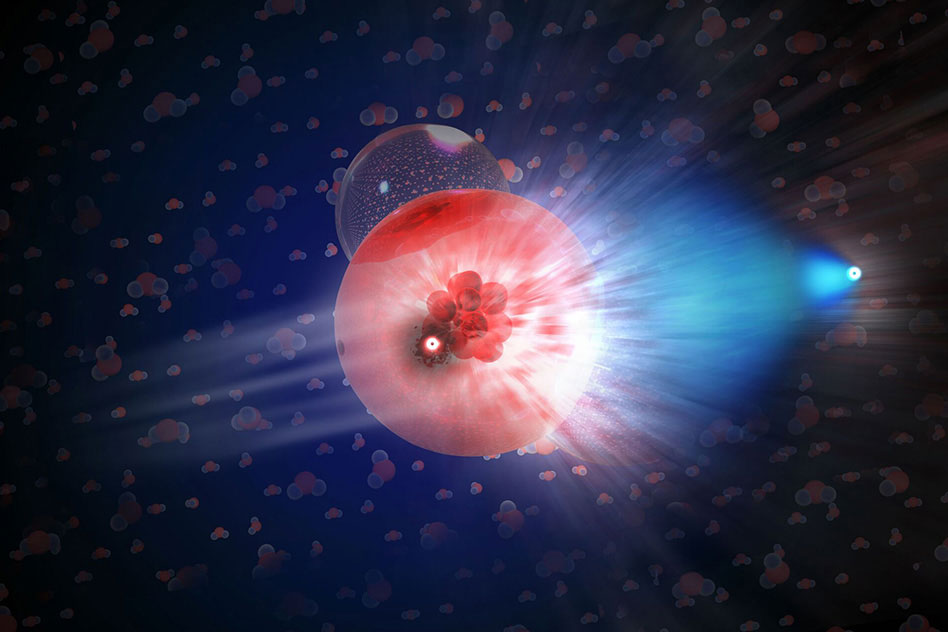
The “ghostly particle” is confirmed to have originated from a blazar, nearly 4 billion light years from Earth.
For the first time, scientists from around the world have detected a source of high-energy cosmic neutrinos — subatomic particles, produced in the aftermath of explosive astrophysical phenoma, that streak across the universe by the billions, leaving very little trace of their presence.
Neutrinos, Italian for “little neutral ones,” are often described as “ghost particles,” for their extremely weak interactions with ordinary matter. Indeed, billions of neutrinos stream through our fingernails every second, without ruffling so much as a molecule of matter. And yet, on September 22, 2017, the IceCube Neutrino Observatory, based at the Amundsen-Scott South Pole Station, detected a neutrino in signals picked up by its detectors buried deep in the Antarctic ice. Researchers there quickly sent out alerts to ground- and space-based telescopes in hopes of finding the neutrino’s cosmic source.
An answer was soon confirmed: The neutrino originated from a blazar — an active galaxy with a black hole at its center — about 3.7 billion light years away. The blazar, known to astronomers as TXS 0506+056, can be seen in the night sky just off the shoulder of the Orion constellation.
The findings, published today in two papers in Science, help to resolve a longstanding debate over the kinds of processes that send neutrinos speeding through the universe. Based on the results, researchers now know that blazars can produce neutrinos energetic enough to reach Earth from billions of light years across the universe.
Because blazars produce neutrinos, they also likely generate cosmic rays. The sources of cosmic rays, which continually rain down on Earth, have been a mystery. Unlike neutrinos, which interact weakly, and therefore stream blithely and directly through space, cosmic rays are charged particles whose paths can easily veer in response to magnetic fields. Cosmic ray sources, therefore, can be difficult to track. The new findings provide evidence that blazars are not only sources but also powerful accelerators of both neutrinos and cosmic rays.
Janet Conrad, professor of physics at MIT, is a member of the IceCube Collaboration, which encompasses more than 300 scientists around the world, and is a co-author of both papers. Conrad spoke with MIT News about the race to trace the neutrino to its distant, powerful source.
Q: Give us an idea of what it took to find these neutrinos and their very specific source. How did IceCube do this?
A: This discovery could only have happened with a monumental detector like IceCube. It is literally gigatons of ice instrumented with detectors that can observe light. These detectors are located about a mile below the ice. The prototype was constructed in the 1990s. IceCube began in 2005 and took five years to construct. It took us about five years to learn how to analyze the data quickly enough to be able to send alerts to other telescopes that look for electromagnetic signals. We can now do this in about one minute.
The neutrino event that happened on September 22, 2017, lit up a straight line of light collectors that is half a mile in length. Because it formed such a straight line, we could point backward into the sky to know its direction of origin. We have had high-energy, very linear events like this. Each time they arrive, we send out a notice to the community called an “astronomer’s telegram” saying “Look this way!” And this time, it worked! They saw something!
The Fermi gamma-ray telescope, based in space, followed up within about a day looking in the direction the track pointed. They sent an astronomer’s telegram that followed ours, saying that the neutrino event position coincided with a blazar. Other telescopes on Earth, including MAGIC, then responded. So while it took only a minute to see and announce our event, this was built on years of work by us and by the telescopes that joined us in this discovery.
Q: Tell us a bit about what kind of journey these neutrinos must have taken from their source and finally to Earth?
A: A blazar is an active galaxy that contains a black hole. The black hole is spinning quickly, powering jets of particles and photons that spurt out the bottom and top. This particular blazar is 3.7 billion light-years away from us. A light-year is about 6 trillion miles. So this source is very far away! Between us and the blazar, there are strong magnetic fields that will bend away charged particles, and there is dust that will absorb photons. But neutrinos interact only weakly. They are not deflected by a magnetic field. They are very unlikely to interact in the dust, and so the neutrinos produced in the jet come directly to us.
In fact, even on Earth, neutrinos will interact rarely, so this neutrino probably came with companions that we did not detect. This blazar has flared before! So we looked in our data, and we found that in 2014 there were multiple events coming from the direction of this blazar. Since we have seen neutrinos in coincidence with this blazar more than once, this result is especially compelling.
Q: What to you makes this particular discovery so exciting?
A: Neutrinos do very interesting things along their path. Neutrinos are produced in one of three types or “flavors,” and then they will change flavors as they travel due to a quantum mechanical effect called neutrino oscillations. So, though we observe a neutrino of the “muon” type, we don’t know what flavor it began with. Also, we do not know if neutrinos have extra interactions or properties beyond those we describe in our “Standard Model” — the theory of particle physics. A neutrino that has traveled for such a long distance and at this high energy provides a very interesting test of our model. We had seen astrophysical neutrinos before but did not know where they came from. This extra information about the position of its origin makes the event very exciting to particle physicists like those of us in the MIT neutrino group, as well as to astrophysicists.
Conrad’s group members who are also members of the IceCube Collaboration include graduate students Marjon Moulai, Spencer Axani, and Gabriel Collin, and postdoc Carlos Arguelles.
Publications:
“Multimessenger observations of a flaring blazar coincident with high-energy neutrino IceCube-170922A” by The IceCube Collaboration, et al., 13 July 2018, Science.
DOI: 10.1126/science.aat1378
“Neutrino emission from the direction of the blazar TXS 0506+056 prior to the IceCube-170922A alert” IceCube Collaboration, Science, 13 July 2018, Science.
DOI: 10.1126/science.aat2890
Never miss a breakthrough: Join the SciTechDaily newsletter.
Follow us on Google and Google News.
2 Comments
Ok, so you’ve seen IceCube detecting a blazar. But have you ever seen IceCube wearing a blazar? I have. https://www.spott.tv/en/jackets/jackets?f=celebrity:ice-cube
Pent up consciousness to collective epiphany rewarding the source with a lightsaber ZAP … Looking forward to seeing this multiply and intensify as we al get focused back on all that truly matters…the nature of things and this space in time @thelondonerssf #borncreative #designhumanityforward