
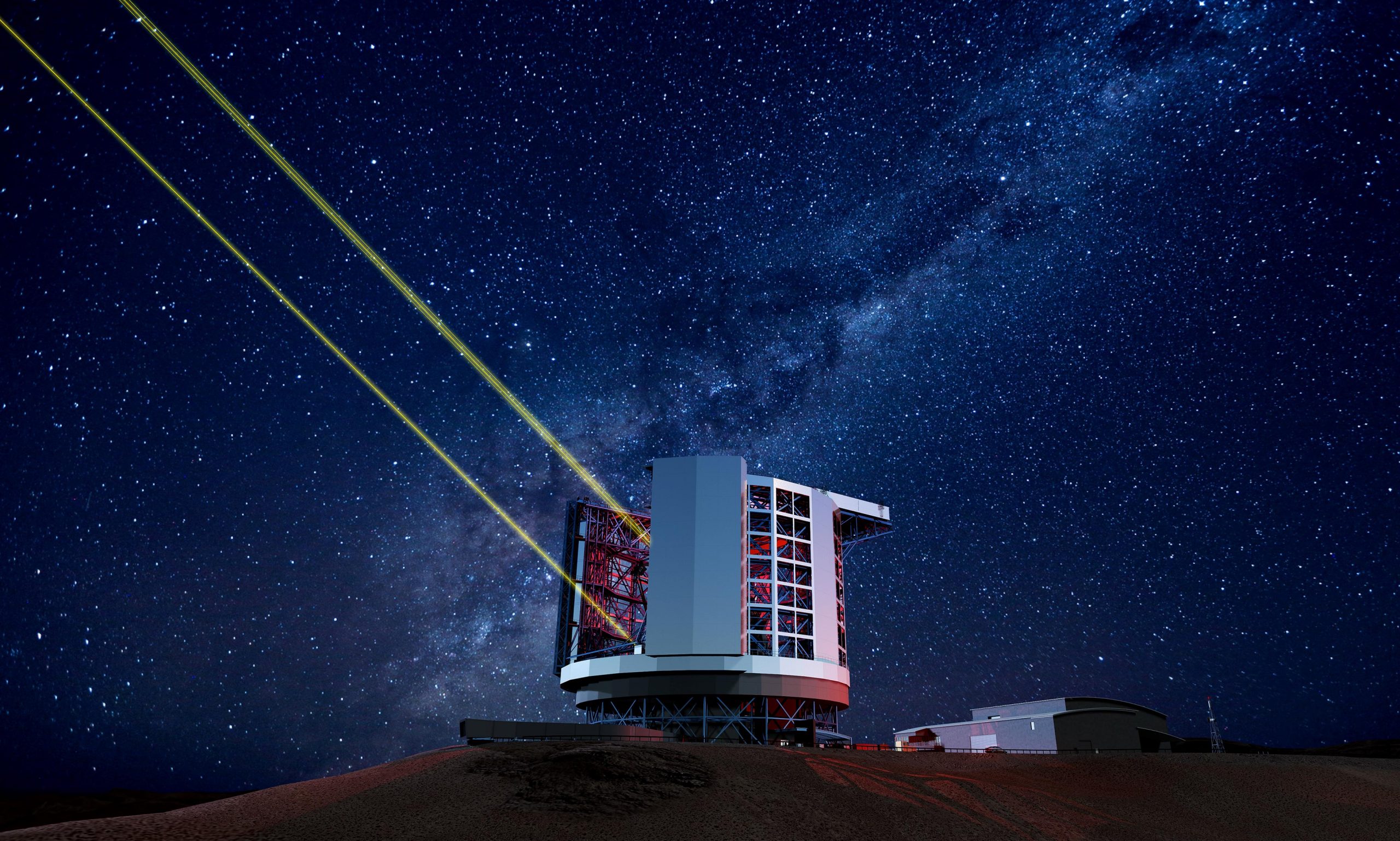
The world’s largest optical mirror was successfully installed on a support system prototype for the first time to validate the telescope’s extraordinary performance.
The Giant Magellan Telescope has integrated its first primary mirror into a complex support system, beginning testing to validate its performance. This milestone brings the telescope closer to delivering unprecedented image resolution, aided by advanced actuators and sensors.
The Giant Magellan Telescope has successfully installed one of its completed 8.4-meter primary mirrors into a prototype support system at the University of Arizona’s Richard F. Caris Mirror Lab. This complex support system—comparable in size to half a basketball court and containing three times as many parts as a typical car—is essential for the telescope’s optical precision and stability.
This installation marks the beginning of a six-month optical testing phase to confirm that the support system can precisely control the mirror, validating the telescope’s advanced light-collecting capabilities.

Unique Design of the Primary Mirror Array
The Giant Magellan’s light-collecting surface spans 368 square meters and is made up of seven of the largest optical mirrors in the world, arranged in a unique flower pattern. Together, these mirrors will offer the highest image resolution and widest field of view ever achieved for astronomical exploration, delivering up to 200 times the power of today’s leading telescopes. Each mirror weighs 16 metric tons and is supported by a specialized pneumatic system housed in a steel framework, or “cell.” This support system, with nanometer-level precision, adjusts the mirror’s position, regulates its temperature, protects it from seismic shifts, and maintains its shape against gravitational sag as the telescope moves. In tandem, the seven mirrors function as a single light-collecting surface, creating the ideal conditions for the telescope’s peak optical performance during scientific observations.
“This work is funded by a National Science Foundation award,” said Barbara Fischer, Primary Mirror Subsystem Manager for the Giant Magellan Telescope. “We began integrating the active support prototype system more than three years ago, and we first used a steel mirror mass simulator to demonstrate that our design was able to safely support and control the completed primary mirror segments. I am honored to work with an extraordinary team, and it is exciting to finally see a completed mirror segment integrated with the cell.”

Complex Assembly and Transport
As a key part of the integration process, Giant Magellan worked closely with Texas A&M University to clean, assemble, and test the support actuators that are being used in the cell. While the actual installation of the mirror into the cell took only one day, the process began with four weeks of disassembly to prepare the cell and support system for transport. The system was then moved 20 miles from the University of Arizona’s Tech Park to the Richard F. Caris Mirror Lab for reassembly. This logistically complex operation occurred a few hours after midnight to minimize traffic disruptions, as the wide-load cell required two road lanes for transport.

Precision Control With Innovative Actuators
“The Giant Magellan Telescope’s primary mirror active support system is the first of its kind,” said Trupti Ranka, Principal Opto-Mechanical Control Systems Engineer for the Giant Magellan Telescope. “The active support system contains an array of approximately 200 actuators and sensors to control the position and shape of the 16-metric tons, 8.4-meter mirror within a fraction of a micron. The control system allows a harmonious operation between the sensor data and actuators to achieve this precision.”

Rigorous Testing for Performance Assurance
Now that one of the primary mirrors has been successfully integrated with the support system prototype, it will undergo rigorous testing under a metrology tower at the Richard F. Caris Mirror Lab to confirm that the mirror can maintain its shape and performance under various operational conditions. Once testing is complete, the design for the production active support systems will undergo a final design review, and production will commence in 2027.
“This intricate system took years of designing, building, and testing by a team of specialized engineers and technicians,” said Tomas Krasuski, Principal Software and System Test Engineer for the Giant Magellan Telescope. “Every single component was thoroughly tested before integrating it into the system. Now that we’ve installed the mirror segment, we are excited to validate its performance. It has been a challenging yet rewarding process to get here.”
Progress and Future Production Plans
The milestone highlights the next stage of advancement for the Giant Magellan Telescope’s seven primary mirror segments and their support systems. Three of the primary mirror segments are complete, while the remaining four are in various stages of polishing. The seventh and final primary mirror was cast in October 2023 and is now being prepared for polishing. This latest milestone also follows the August 2024 start of the Giant Magellan’s 39-meter-tall telescope mount structure assembly at Ingersoll Machine Tools in Rockford, Illinois, which will support the seven primary mirrors and their cells, adaptive optics, and scientific instruments.
“For the first time, a completed primary mirror segment has been integrated into its support system — this is a giant step in our journey toward first light,” said William Burgett, Project Manager for the Giant Magellan Telescope. “Once its performance is validated, we will begin manufacturing all seven mirror cells at Ingersoll Machine Tools, which will be one of the most exciting advancements to date.”
The Giant Magellan Telescope is now 40% under construction across 36 states and on track to be operational in Chile by the early 2030s.
Never miss a breakthrough: Join the SciTechDaily newsletter.
Follow us on Google and Google News.