
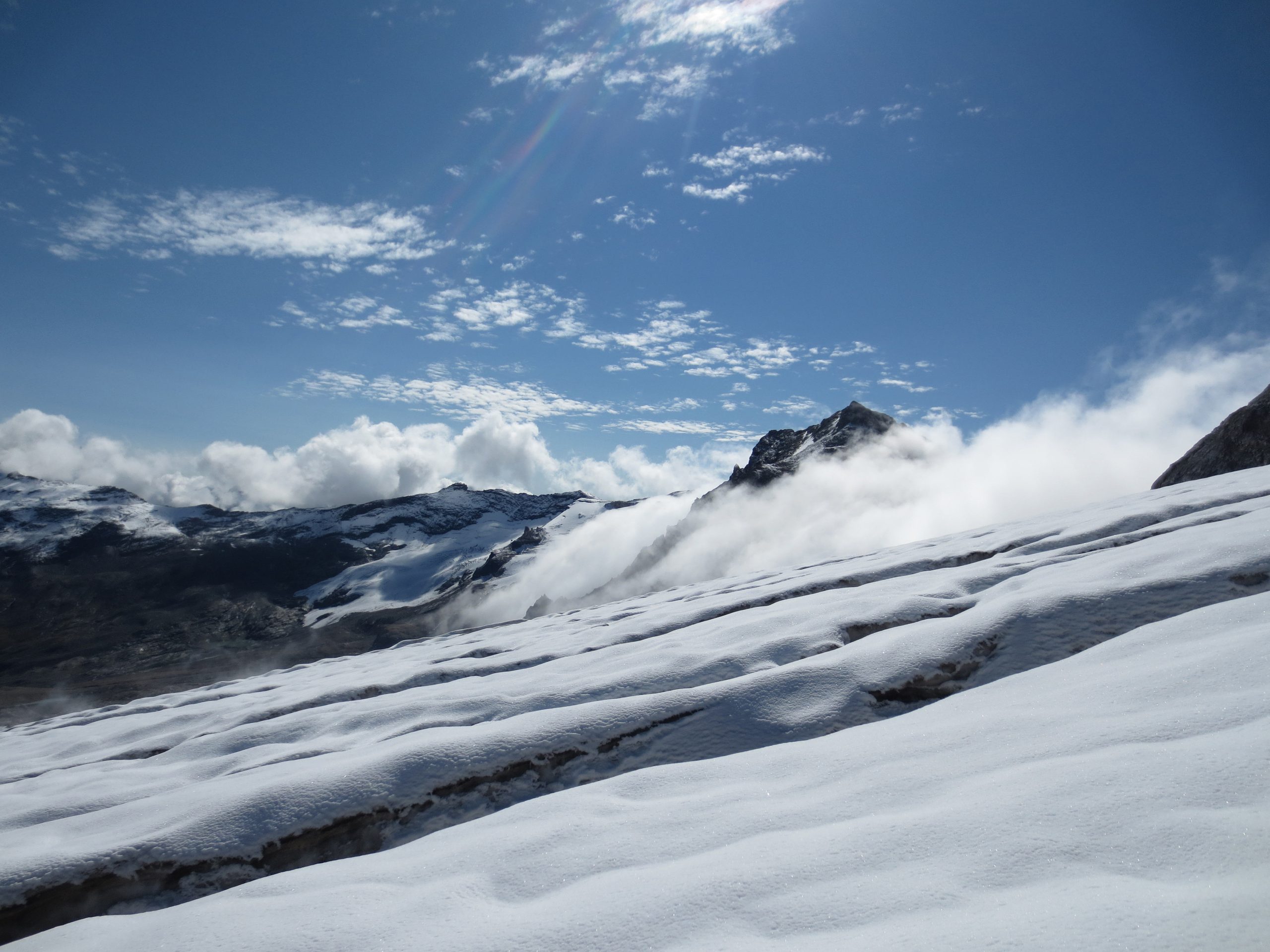
New research reveals glaciers are steadily losing their battle against the impacts of climate change.
Glaciers appear to be resisting the effects of climate change by cooling the air that comes into contact with their icy surfaces. But this natural defense may not last much longer. Researchers from the Pellicciotti group at the Institute of Science and Technology Austria (ISTA) have assembled and reanalyzed an extensive global dataset of glacier observations, offering new insight into this temporary phenomenon.
According to their study, published in Nature Climate Change, glaciers are expected to reach the height of their self-cooling ability within the next decade. After that point, near-surface temperatures are projected to climb more rapidly, leading to faster melting and retreat.
Postdoctoral researcher Thomas Shaw vividly recalls a summer day in August 2022 that marked one of his key field experiences. Working under Francesca Pellicciotti at ISTA, Shaw stood atop Switzerland’s Glacier de Corbassière, 2,600 meters above sea level, gathering crucial data about the glacier’s condition. The weather was deceptively mild, with clear skies and a temperature of 17 degrees Celsius, unusual for someone standing on a glacier.
So, are glaciers “keeping their cool” a little too well? While average global temperatures continue to rise, glacier surfaces appear to warm more slowly. In the Himalayas, some of the world’s largest glaciers even send frigid air cascading down their slopes, forming cold winds that help protect their ecosystems. Yet scientists caution that this self-cooling process does not signal long-term resilience. Instead, it may be a fleeting response to a warming world.
A new study led by Shaw demonstrates that this reaction of glaciers is likely to reach its peak in the 2030s. “The more the climate warms, the more it will trigger the glaciers to cool their own microclimate and local environments down-valley,” says Shaw. “But this effect will not last long, and a trend shift will ensue before the middle of the century.” From then on, the glaciers’ melting and fragmentation due to human-caused climate change will intensify, and their near-surface temperatures will rise more rapidly, hastening their decline.
Large glaciers and cold winds
It takes a tremendous effort to understand local climate effects in some of the world’s remotest areas and map their evolution on a global scale. Often, on-site data is simply lacking.
This poses a challenge to the precision of computational models which simulate the climate’s detailed evolution. When Pellicciotti and her collaborators first saw the data collected at a 5000-meter-high climate station on the slopes of Mount Everest, they could hardly believe their eyes.
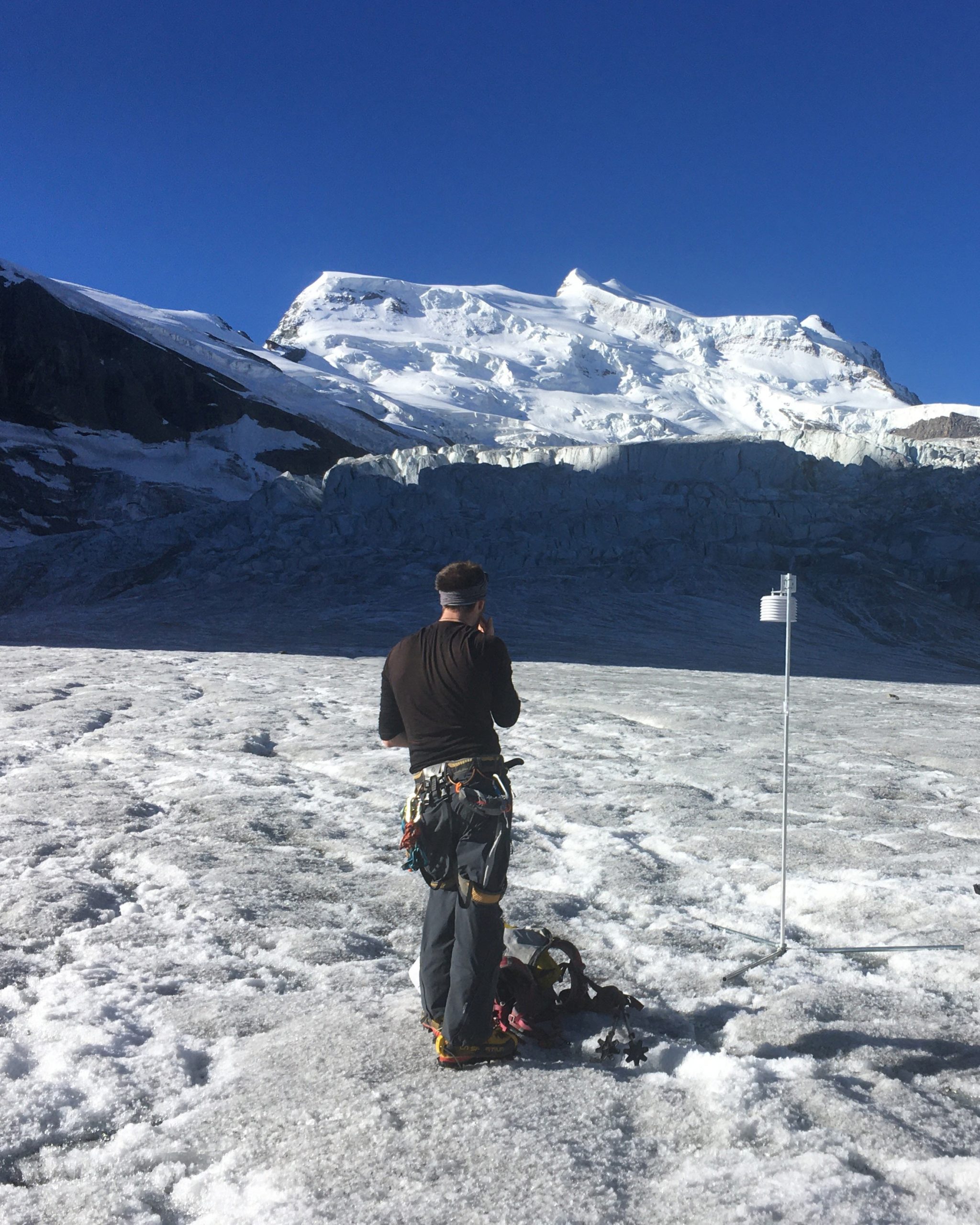
“Upon examining the data thoroughly, we understood that the glaciers were reacting to the warming air in summer by intensifying their temperature exchange at the surface,” Pellicciotti says.
Due to the sheer size of the Himalayan glaciers, this results in the cooling of large air masses in direct contact with the glacier surfaces. “These large, dense cold air masses then flow down the slopes with the effect of gravity in a phenomenon called ‘katabatic winds.’” Other large glaciers around the world behave similarly.
Scientists going out of their way
Now, Shaw sought to develop a robust global model that overcomes the limitations of data scarcity. He developed a new method to estimate how long glaciers would continue to absorb the climate shock worldwide.
“We compiled data from past and recent projects across our research group, pooled them with all published data, and reached out to other researchers to request that they share with us their unpublished data,” says Shaw. “Using this unprecedented dataset, we reassessed the physical processes to find generalizable aspects and developed a statistical framework that can give us a glimpse into the evolution of glacier cooling worldwide.”
Peak cooling
Shaw and the team compiled an inventory of hourly data from 350 weather stations located on 62 glaciers worldwide, representing a total of 169 summer-long measurement campaigns. They specifically examined the ratio of near-surface temperature to ambient, non-glacier temperature right above each station and analyzed it over space and time.
The melting Pasterze Glacier, Austria. Drone footage over the glacier. Research on katabatic winds was conducted there in the 1990s. Credit: Thomas Shaw | ISTA
“We call the difference in temperature ‘decoupling,’ because it seems at odds with the warming of ambient temperatures,” says Shaw. They showed that, on average, the near-surface temperature on mountain glaciers worldwide warmed 0.83 degrees Celsius for every degree rise in ambient temperature.
They also investigated the glacier properties most likely to limit the decoupling effect, such as the presence of a debris mantle on the lower part of a glacier, and refined their model with this information. By modeling future projections, they demonstrated that this cooling effect will peak between the 2020s and 2040s, before the glaciers’ steady mass loss leads to their large-scale retreat, reversing the cooling trend. “By then, the worn-out and considerably degraded glaciers will ‘recouple’ to the steadily warming atmosphere, sealing their fate,” says Shaw.
Accepting the loss and coordinating future actions
While the projection paints a bleak future for the world’s majestic water towers, there are pragmatic consequences if the current trend continues. “Knowing that the glaciers’ self-cooling will continue a little longer could buy us some extra time to optimize our water management plans over the next decades,” says Shaw.
However, the team is fully aware that they can neither salvage nor recover the world’s mountain glaciers. “We must accept the committed ice loss and put our full efforts into limiting further climatic warming rather than into ineffective geo-engineering strategies such as seeding clouds and covering glaciers. These are like putting an expensive Band-Aid on a bullet wound. The coming decades are a time for reflection, effective water management, and action to change public consciousness about human-caused climate change.”
The researchers further underline the need for coordinated global climate policies to drastically reduce emissions and safeguard human life on Earth from the unforeseeable effects of global warming. “Every bit of a degree counts,” says Shaw, echoing the words that scientists have been stressing for decades.
Reference: “Mountain glaciers recouple to atmospheric warming over the twenty-first century” by Thomas E. Shaw, Evan S. Miles, Michael McCarthy, Pascal Buri, Nicolas Guyennon, Franco Salerno, Luca Carturan, Benjamin Brock and Francesca Pellicciotti, 10 October 2025, Nature Climate Change.
DOI: 10.1038/s41558-025-02449-0
Funding: Horizon 2020 Framework Programme
Never miss a breakthrough: Join the SciTechDaily newsletter.
Follow us on Google and Google News.
6 Comments
They should’ve trained harder.
“While average global temperatures continue to rise, glacier surfaces appear to warm more slowly.”
Of course! Water and ice have a specific heat capacity — the amount of heat required to raise a one gram mass one degree Celcius — that is much higher than air. Also, to change ice to water (phase change) the energy of the latent heat of fusion has to be absorbed. That is what makes a cooler with ice useful in keeping food cold. Thus, ice temperature will lag the air temperature when it is warming. It is simple physical chemistry.
Let’s be clear: Melting during interglacials is normal. Prior to the current Holocene interglacial, the Greenland ice sheets were reduced to small alpine glaciers during the Eemian interglacial. Man had nothing to do with that. Climate, just like weather, changes. The concern for the availability of water is because of the burgeoning population at the base of the Himalayas. But what if, instead of warming, the Himalayas were to cool? The glaciers would stop retreating. That means meltwater would decrease. Either way, people will be confronted with a reduced availability of water. It is unlikely that precipitation will exactly match the melting of glaciers for any extended period of time. And, even if it did, the runoff would be less than what it is today where the current flow is augmented by melting happening at a greater rate than snow accumulation, meaning problems for those depending on today’s runoff. It is a social and political problem, not one of climate change.
Everything you say is absurd. To compare today’s human civilization to what it was during the Eemian interglacial is to beg the question, how did the bond market react back then? I think you’ve been watching too many Flintstone cartoons.
You aren’t making sense. My point was that the current warming is blamed commonly on anthropogenic CO2, which was non-existent during the Eemian. What do bonds or cartoons have to do with that?
How about addressing why you disagree with something I specifically said such as cooling of the climate reducing availability of water needed by those living at the foot of the Himalayas?
Katabatic winds are very common; we get one down the hill behind our house in a temperate climate. What is being described is a katabatic wind flowing down a glacier; I knew bloke who got frostbite of the armpits because he ran back to camp without his shirt as the ridge above the katabatic wind was in still warm air but the 200m back to camp in a shallow valley the wind air very chilly irrespective of the wind-chill factor of a 20knot kataabatic wind at minus20deg. So katabatic winds keep the glaciers cool ….. and then as Anthropogenic heating warms up the air down-stream of the glaciers the winds first strengthen but when the glaciers melt/become covered in dark rock moraine those may be lessen.
But then again as the air in the Anthropogenically heated plains gets hotter and even though the mountains may also get warmer they will still be cooler than the plains as air up there is cooler than the air down there and we will still get those katabatic winds: the fascinating interplay between densities of air masses and the temperatures thereof.