
Himalayan glaciers react, blow cold winds down their slopes.
Himalayan Glaciers fight back to preserve themselves, but for how long? An international team of researchers, co-led by Professor Francesca Pellicciotti of the Institute of Science and Technology Austria (ISTA), explains a stunning phenomenon: rising global temperatures have led Himalayan glaciers to increasingly cool the air in contact with the ice surface. The ensuing cold winds might help cool the glaciers and preserve the surrounding ecosystems. The results, found across the Himalayan range, were published in Nature Geoscience.
Is global warming causing Himalayan glaciers to melt like ice cream on a hot summer day? Previously, scientists documented an elevation-dependent warming effect: they showed that mountain tops “felt” the effect of global warming stronger and warmed up faster. Yet, a high-altitude climate station at the base of Mount Everest in Nepal showed an unexpected phenomenon: the measured surface air temperature averages remained suspiciously stable instead of increasing. How could this data be interpreted?
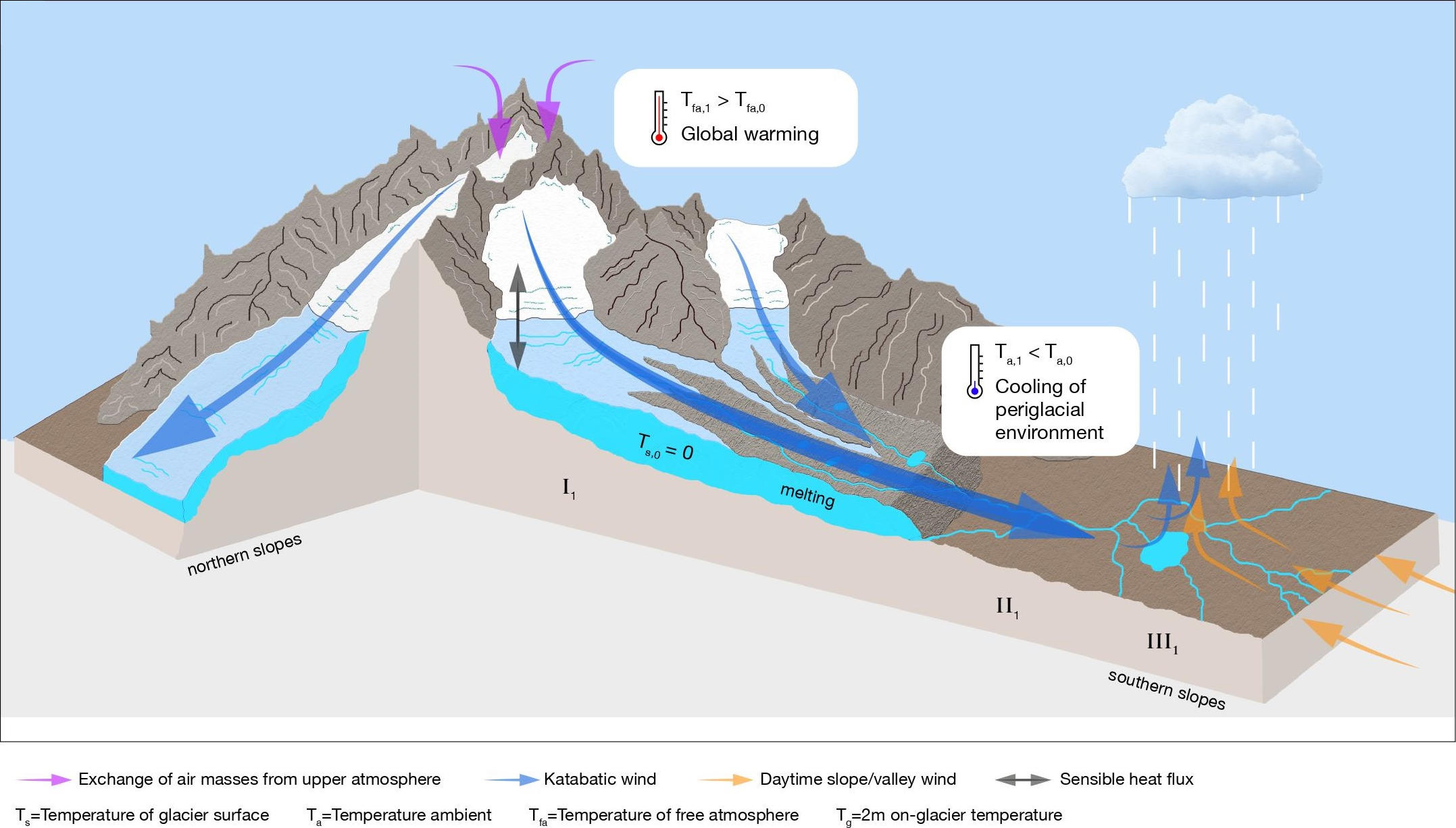
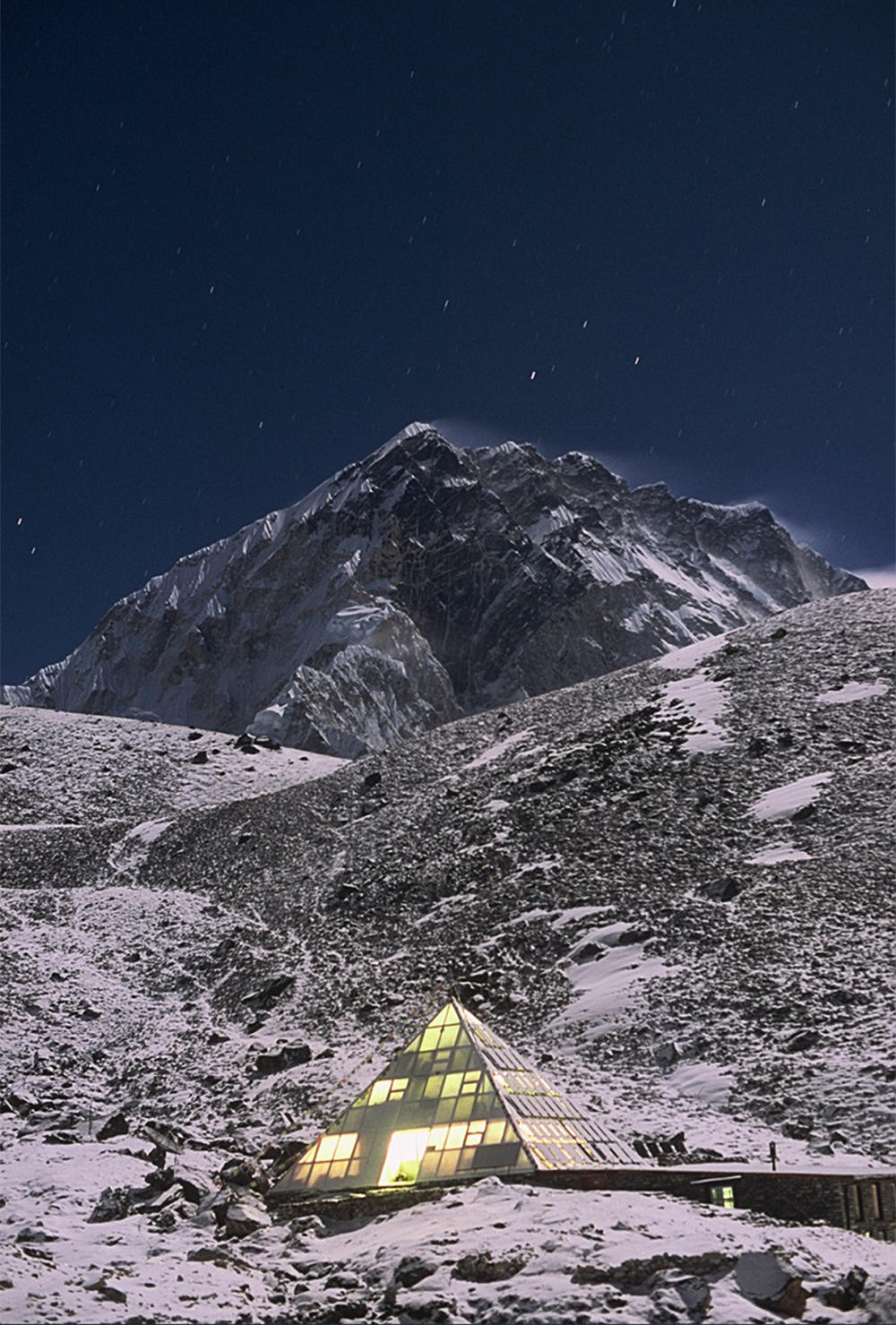
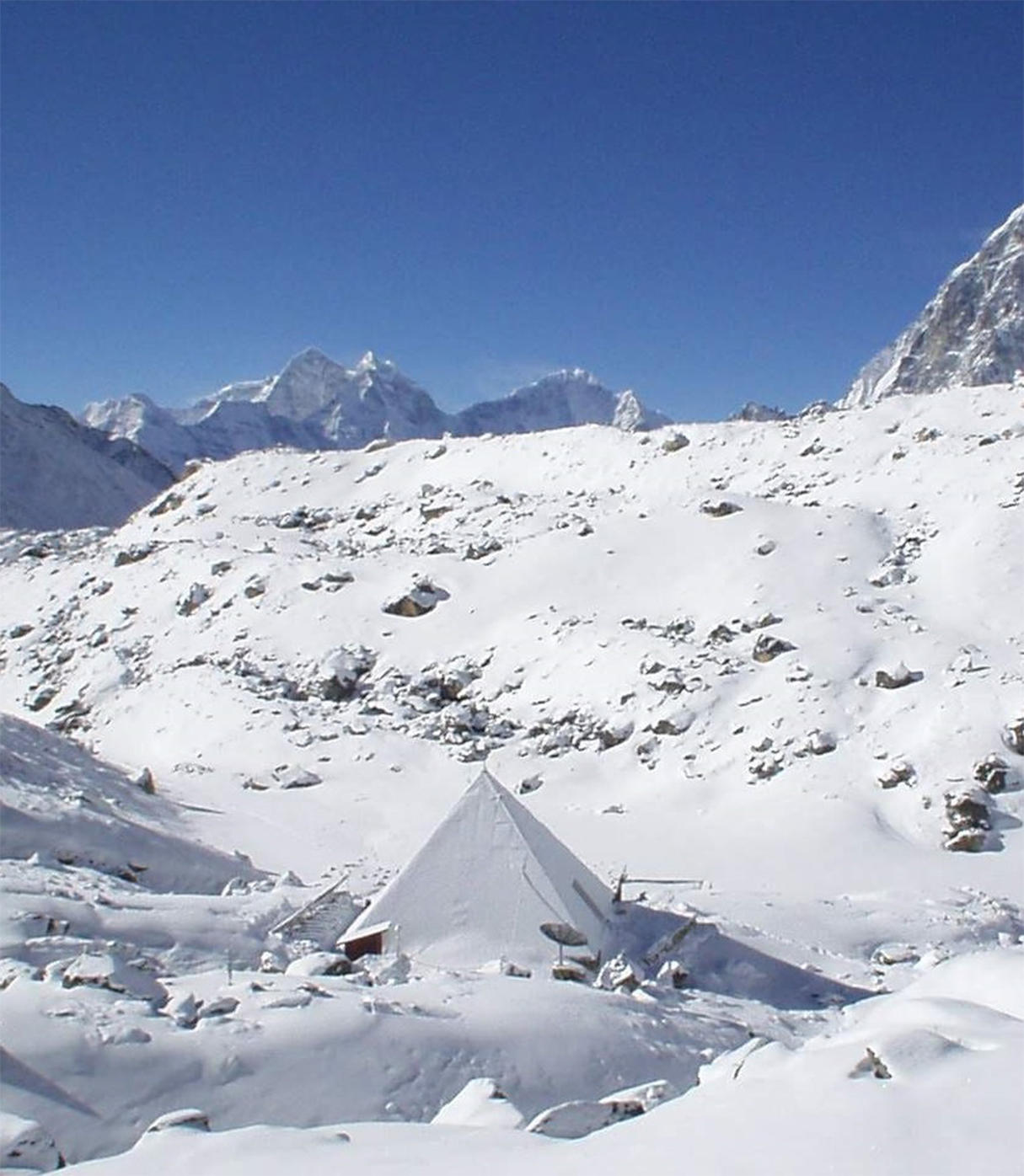
The Pyramid International Laboratory/Observatory climate station, located at a glacierized elevation (5050 m) on the southern slopes of Mount Everest, alongside the Khumbu and Lobuche glaciers, has continuously recorded hourly meteorological data for nearly three decades. Now, an international team of researchers led by new ISTA Professor Francesca Pellicciotti and National Research Council of Italy (CNR) researchers Franco Salerno and Nicolas Guyennon cracked the code.
The warming climate is triggering a cooling reaction in the glaciers: it is causing cold winds—katabatic winds—to flow down the slopes. But how long can the glaciers locally counterbalance the effects of global warming by cooling themselves? And which characteristics allow the glaciers to do so?
The Devil Is in the Detail
To explain the observed phenomenon, the team had to examine the data thoroughly. “We found that the overall temperature averages seemed stable for a simple reason. While the minimum temperatures have been steadily on the rise, the surface temperature maxima in summer were consistently dropping,” says Salerno.
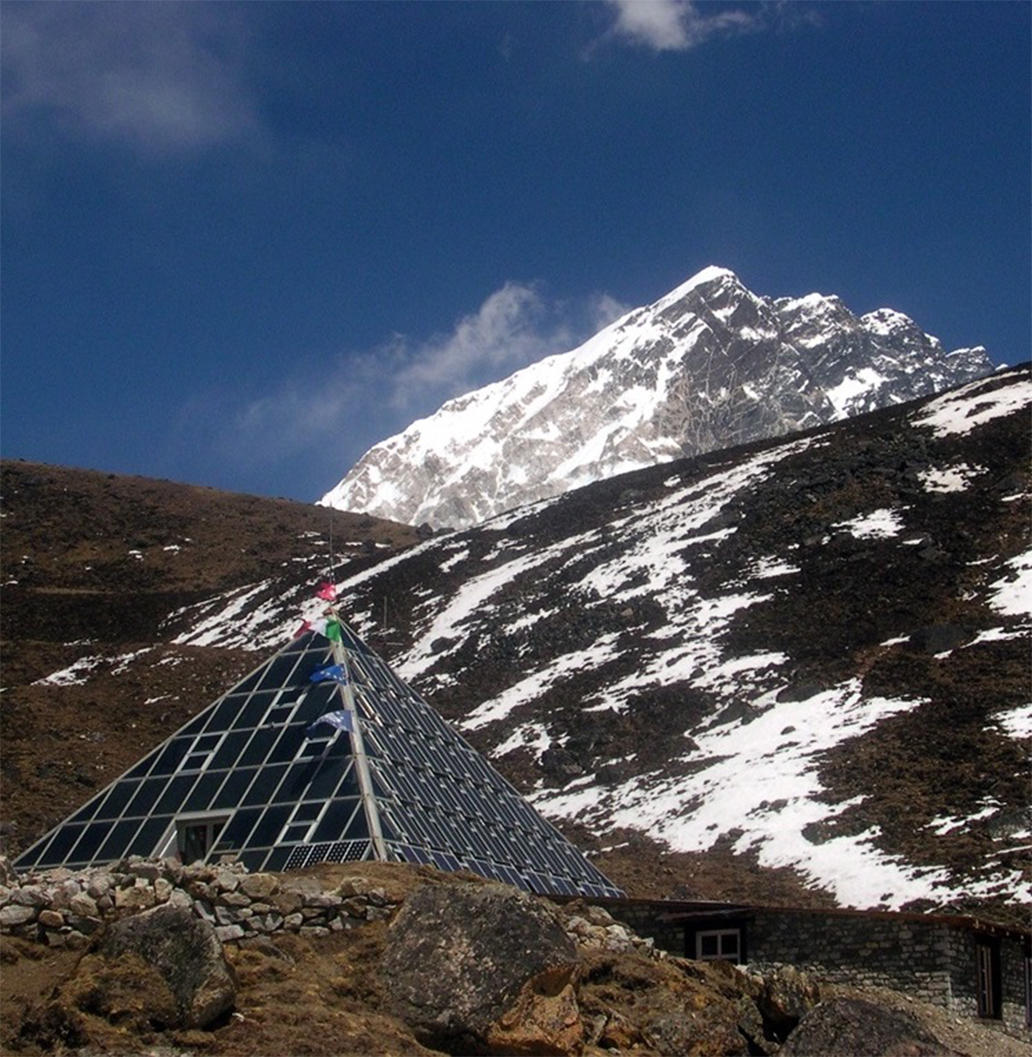
The glaciers are reacting to the warming climate by increasing their temperature exchange with the surface, Pellicciotti explains. Global warming causes an increased temperature difference between the warmer environmental air over the glacier and the air mass in direct contact with the glacier’s surface.
“This leads to an increase in turbulent heat exchange at the glacier’s surface and stronger cooling of the surface air mass,” says Pellicciotti. As a result, the cool and dry surface air masses become denser and flow down the slopes into the valleys, cooling the lower parts of the glaciers and the surrounding ecosystems.
What Makes Glaciers Fight Back?
Going beyond the ground observations uniquely available at Pyramid, the team drew on the latest scientific advances in climate models: the global climate and weather reanalysis called ERA5-Land. ERA5-Land reanalysis combines model data with observations from across the world into a globally complete and consistent dataset using the laws of physics. Interpreting this data allowed the team to demonstrate that the global warming-induced katabatic winds occurred not only on Mount Everest but in the entire Himalayan range. “This phenomenon is the outcome of 30 years of steadily increasing global temperatures. The next step is to find out which key glacier characteristics favor such a reaction,” says Pellicciotti.

Ultimately, the researchers seek to understand which glaciers can react this way to global warming, and for how long. “While other glaciers are experiencing dramatic changes right now, the glaciers in High-Mountain Asia—the Third Pole—are very large, hold more ice masses, and have longer response times. Thus, we might still have a chance to ‘save’ these glaciers.”
Thus, Pellicciotti and her team will soon investigate whether the world’s only stable or growing glaciers in the Pamir and Karakoram mountains, to the north-west of the Himalayas, are also reacting to global warming by blowing cold winds down their slopes. “The slopes of the Pamir and Karakoram glaciers are generally flatter than in the Himalayas. Thus, we hypothesize that the cold winds might act to cool the glaciers themselves rather than reaching lower down into the surrounding environments. We will be able to tell in the next couple of years,” says Pellicciotti.
Glacier Tipping Point?
“We believe that the katabatic winds are the response of healthy glaciers to rising global temperatures and that this phenomenon could help preserve the permafrost and surrounding vegetation,” says Guyennon. Glaciers are indeed essential in maintaining the water security in their ecosystems.
But how long can healthy glaciers fight back? The glaciers on the southern Himalayan slopes are classical examples of “accumulation-ablation glaciers”: they accumulate mass at high altitudes from the Indian subcontinent’s summer monsoons and, at the same time, lose mass from the continuous melting.
However, the katabatic winds are now shifting this balance: the colder air masses flowing down from the glaciers are lowering the altitude at which precipitation takes place. This leads to the glaciers missing a key mass input while they continue to melt. Thus, perceived cool temperatures flowing down from glaciers are an emergency reaction to global warming rather than an indicator of glacier long-term stability.
Does this mean that the glaciers are approaching their preservation tipping point? “They are in some places, but we do not know where and how,” says Pellicciotti. Yet, she does not lose heart easily: “Even if the glaciers can’t preserve themselves forever, they might still preserve the environment around them for some time. Thus, we call for more multidisciplinary research approaches to converge efforts toward explaining the effects of global warming,” she concludes. These efforts could prove instrumental in changing the course of human-caused climate change.
Reference: “Local cooling and drying induced by Himalayan glaciers under global warming” by Franco Salerno, Nicolas Guyennon, Kun Yang, Thomas E. Shaw, Changgui Lin, Nicola Colombo, Emanuele Romano, Stephan Gruber, Tobias Bolch, Andrea Alessandri, Paolo Cristofanelli, Davide Putero, Guglielmina Diolaiuti, Gianni Tartari, Gianpietro Verza, Sudeep Thakuri, Gianpaolo Balsamo, Evan S. Miles and Francesca Pellicciotti, 4 December 2023, Nature Geoscience.
DOI: 10.1038/s41561-023-01331-y
The study was funded by the H2020 Marie Skłodowska-Curie Actions, the Second Tibetan Plateau Scientific Expedition and Research Program, PNRR, Horizon 2020 Framework Programme, and SNSF.
Never miss a breakthrough: Join the SciTechDaily newsletter.
Follow us on Google and Google News.
1 Comment
“How Himalayan Glaciers Are Fighting Back”
—
Personifying glaciers? [lol]