
Close Menu
    Facebook X (Twitter) Instagram
    SciTechDaily
    • Biology
    • Chemistry
    • Earth
    • Health
    • Physics
    • Science
    • Space
    • Technology
    Facebook X (Twitter) Pinterest YouTube RSS
    SciTechDaily
    Home»Space»Globular Cluster NGC 6362 Shows Its Blue Stragglers
    Space

    Globular Cluster NGC 6362 Shows Its Blue Stragglers

    By European Southern ObservatoryOctober 31, 2012No Comments3 Mins Read
    Facebook Twitter Pinterest Telegram LinkedIn WhatsApp Email Reddit
    Share
    Facebook Twitter LinkedIn Pinterest Telegram Email Reddit
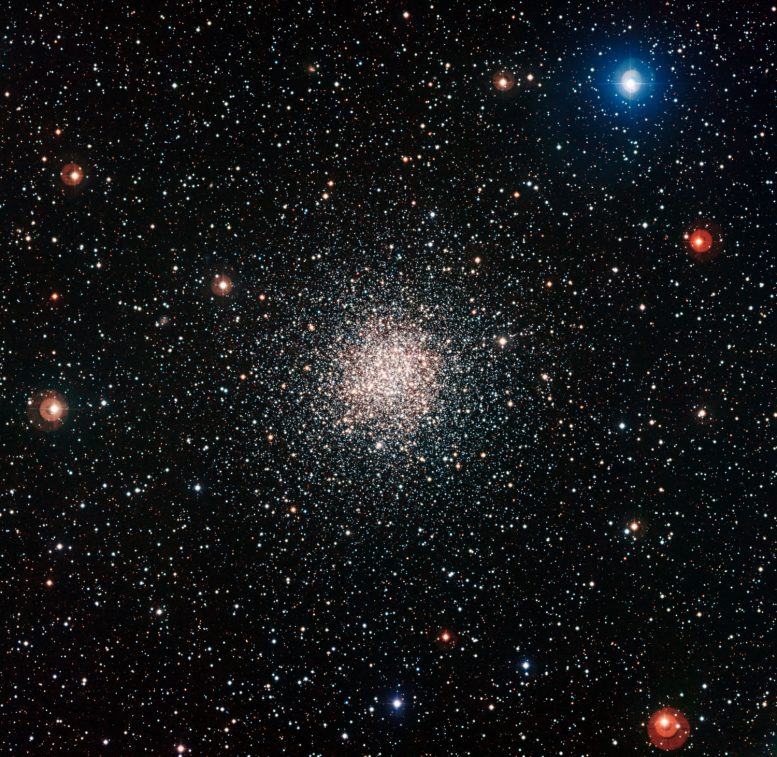
    globular star cluster NGC 6362
    This colorful view of the globular cluster NGC 6362 was captured by the Wide Field Imager attached to the MPG/ESO 2.2-meter telescope at ESO’s La Silla Observatory in Chile. This brilliant ball of ancient stars lies in the southern constellation of Ara (The Altar). Credit: ESO

    Located about 25,000 light-years from Earth in the constellation of Ara, globular cluster NGC 6362 contains many blue stragglers, stars that appear younger and bluer than their companions.

    This new picture (above), along with a new image of the central region from the NASA/ESA Hubble Space Telescope (below), provide the best view of this little-known cluster ever obtained. Globular clusters are mainly composed of tens of thousands of very ancient stars, but they also contain some stars that look suspiciously young.

    Globular star clusters are among the oldest objects in the Universe, and NGC 6362 cannot hide its age in this picture. The many yellowish stars in the cluster have already run through much of their lives and become red giant stars. But globular clusters are not static relics from the past — some curious stellar activities are still going on in these dense star cities.

    For instance, NGC 6362 is home to many blue stragglers — old stars that really do succeed in passing for a younger age. All of the stars in a globular cluster formed over a fairly short period of time, typically about 10 billion years ago for most globulars. Yet blue stragglers are bluer and more luminous — and hence more massive — than they should be after ten billion years of stellar evolution. Blue stars are hot and consume their fuel quickly, so if these stars had formed about ten billion years ago, then they should have fizzled out long ago. How did they survive?

    Astronomers are keen to understand the secret of the youthful appearance of blue stragglers. Currently, there are two main theories: stars colliding and merging, and a transfer of material between two companion stars. The basic idea behind both of these options is that the stars were not born as big as we see them today, but that they received an injection of extra material at some point during their lifetimes and this then gave them a new lease of life.
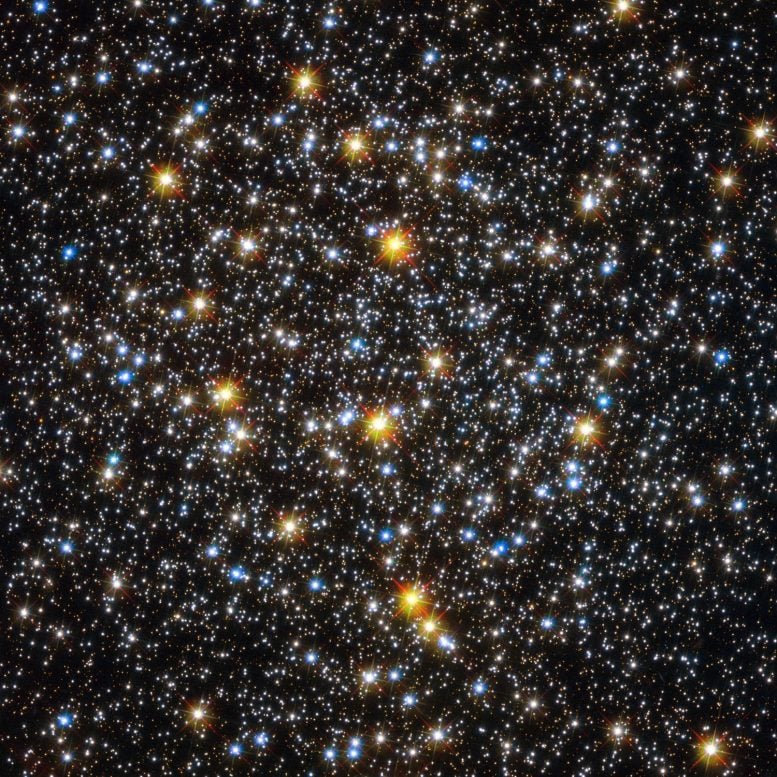
    hubble-views-globular-cluster-NGC-6362
    The NASA/ESA Hubble Space Telescope offers an impressive view of the center of globular cluster NGC 6362. Credit: British astronomer James Dunl

    Although less well known than some brighter globular clusters, NGC 6362 holds much that is of interest to astronomers and has been well studied over the years. It was selected as one of the 160 stellar fields for the Pre-FLAMES Survey — a preliminary survey conducted between 1999 and 2002 using the 2.2-meter telescope at La Silla to find suitable stars for follow-up observations with the VLT’s spectroscopic instrument FLAMES. The picture here comes from data collected as part of this survey.

    The new image shows the entire cluster against a rich background of the carpet of stars in the Milky Way. The central parts of NGC 6362 have also been studied in detail by the NASA/ESA Hubble Space Telescope. The Hubble view shows a much smaller area of sky in much greater detail. The two views — one wide-angle and one zoomed in — complement each other perfectly.

    This brilliant ball of stars lies in the southern constellation of Ara (The Altar). It can be easily seen in a small telescope. It was first spotted in 1826 by the Scottish astronomer James Dunlop using a 22-centimeter telescope in Australia.

    Never miss a breakthrough: Join the SciTechDaily newsletter.
    Follow us on Google and Google News.

    Astronomy Astrophysics European Southern Observatory Globular Cluster NASA
    Share. Facebook Twitter Pinterest LinkedIn Email Reddit

    Related Articles

    Perpendicular Planet: A 90° Orbit Over Twin Suns Leaves Scientists Stunned

    Astronomers Create First Full 3D Model of Eta Carinae Nebula

    ALMA Reveals Unexpected Gas Clump in Debris Disc Around Beta Pictoris

    Sombrero Galaxy Exhibits Dual Characteristics

    Hubble Captures New Image of Messier 9

    Astronomers Combine Hundreds of Images of Carina Nebula to Reveal Thousands of Stars in Stellar Nursery

    The Bolshoi Simulation: Boxing the Universe

    NASA’s Kepler Mission Discovers 11 New Extrasolar Systems with 26 Exoplanets

    Hubble Observes Rare Blue Stars in Andromeda’s Core

    Leave A Reply Cancel Reply

    • Facebook
    • Twitter
    • Pinterest
    • YouTube

    Don't Miss a Discovery

    Subscribe for the Latest in Science & Tech!

    Trending News

    Popular Sugar-Free Sweetener Linked to Liver Disease, Study Warns

    What Is Hantavirus? The Deadly Disease Raising Alarm Worldwide

    Scientists Just Discovered How the Universe Builds Monster Black Holes

    Scientists Unveil New Treatment Strategy That Could Outsmart Cancer

    A Simple Vitamin May Hold the Key to Treating Rare Genetic Diseases

    Scientists Think the Real Fountain of Youth May Be Hiding in Your Gut

    Ravens Don’t Follow Wolves, They Predict Them

    This Common Knee Surgery May Be Doing More Harm Than Good

    Follow SciTechDaily
    • Facebook
    • Twitter
    • YouTube
    • Pinterest
    • Newsletter
    • RSS
    SciTech News
    • Biology News
    • Chemistry News
    • Earth News
    • Health News
    • Physics News
    • Science News
    • Space News
    • Technology News
    Recent Posts
    • Why Are So Many New Fathers Dying? Scientists Say the U.S. Has a Dangerous Blind Spot
    • Scientists Identify Simple Supplement That Greatly Reduces Alzheimer’s Damage
    • You May Have a Dangerous Type of Cholesterol Even if Your Tests Look Normal
    • Study Reveals Dangerous Flaw in AI Symptom Checkers
    • New MRI Breakthrough Captures Stunningly Clear Images of the Eye and Brain
    Copyright © 1998 - 2026 SciTechDaily. All Rights Reserved.
    • Science News
    • About
    • Contact
    • Editorial Board
    • Privacy Policy
    • Terms of Use

    Type above and press Enter to search. Press Esc to cancel.