
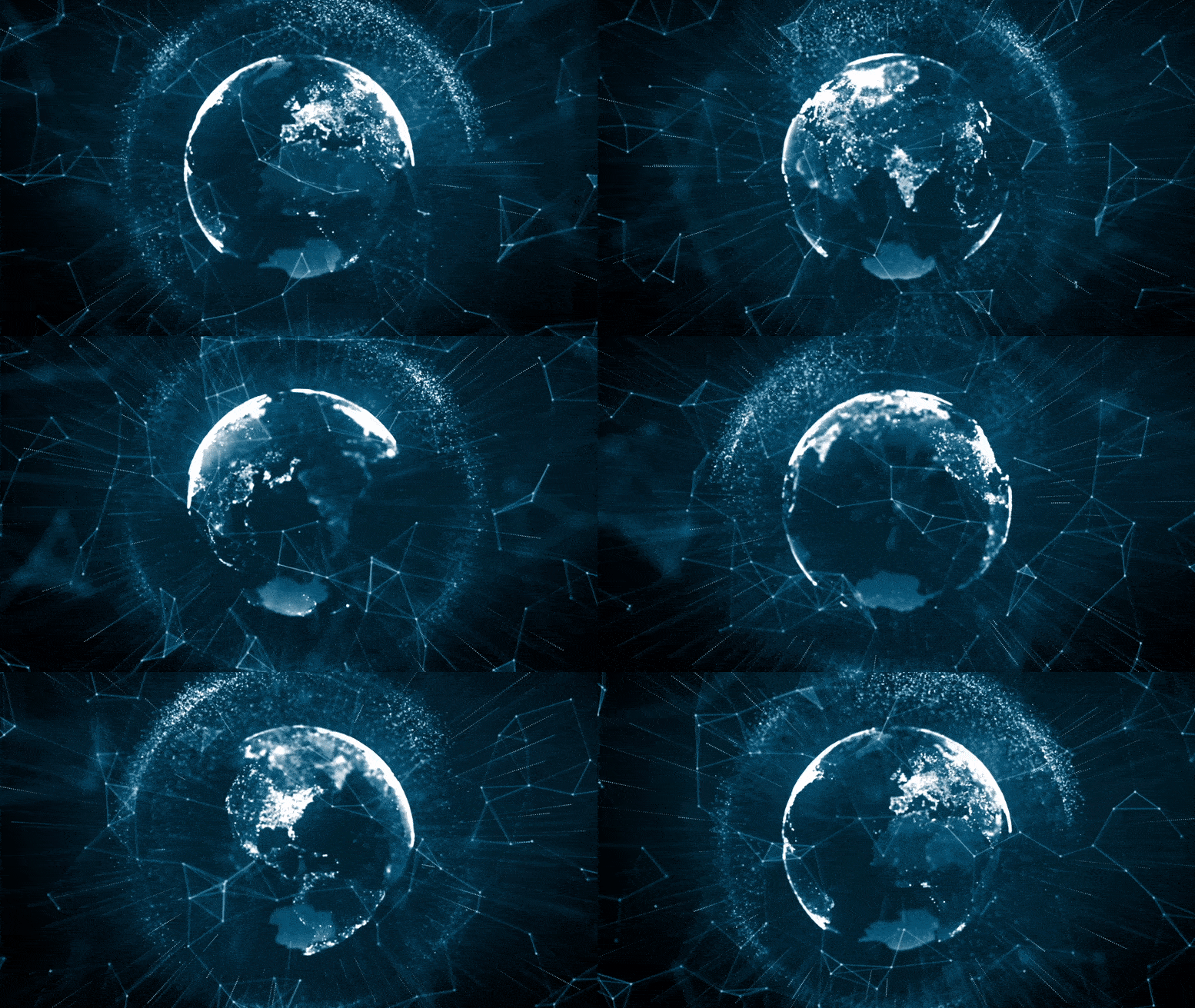
Sensor network GNOME publishes comprehensive data in Nature Physics for the first time — Nine stations in six countries involved.
An international team of researchers with key participation from the PRISMA+ Cluster of Excellence at Johannes Gutenberg University Mainz (JGU) and the Helmholtz Institute Mainz (HIM) has published for the first time comprehensive data on the search for dark matter using a worldwide network of optical magnetometers. According to the scientists, dark matter fields should produce a characteristic signal pattern that can be detected by correlated measurements at multiple stations of the GNOME network. Analysis of data from a one-month continuous GNOME operation has not yet yielded a corresponding indication. However, the measurement allows us to formulate constraints on the characteristics of dark matter, as the researchers report in the prestigious journal Nature Physics.
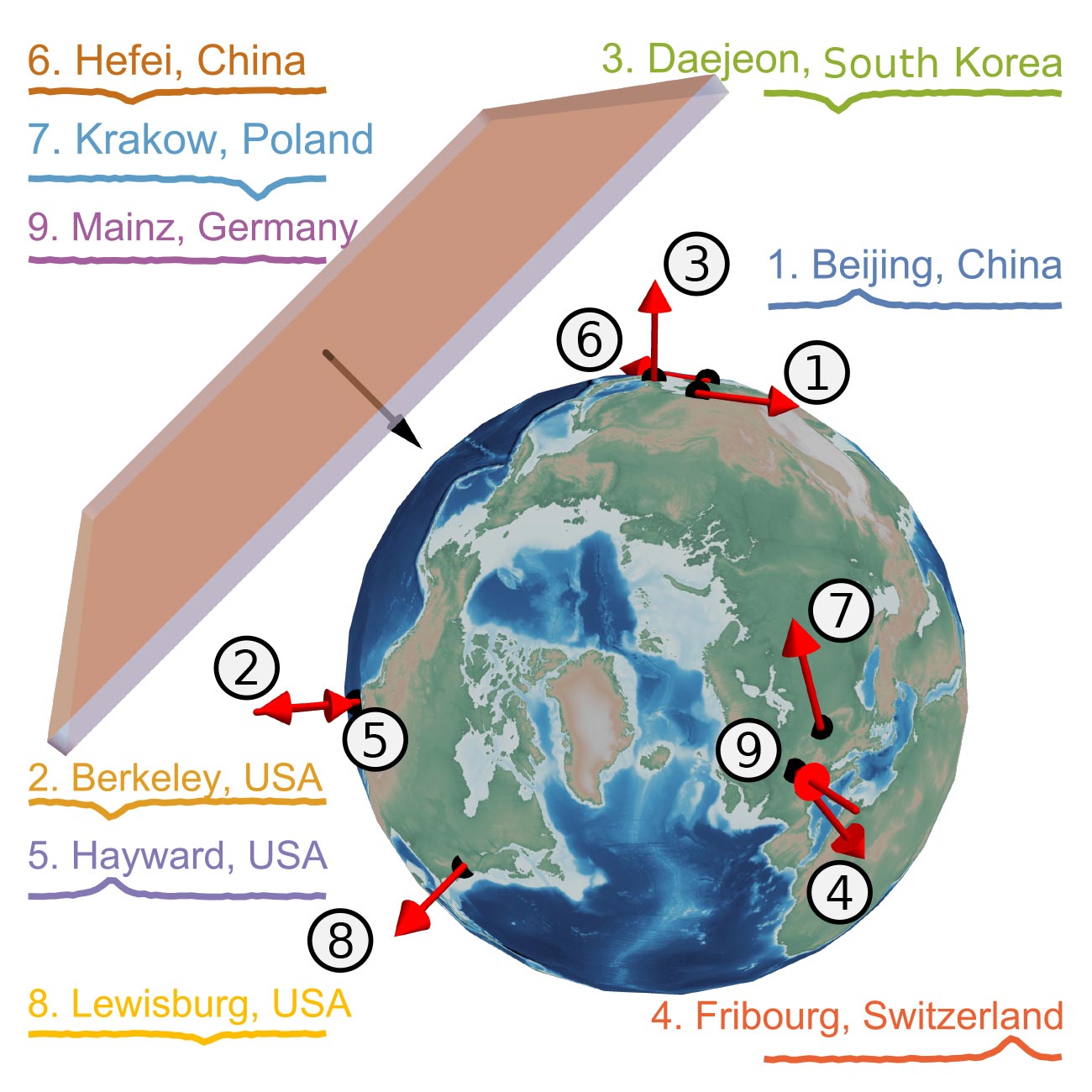
GNOME stands for Global Network of Optical Magnetometers for Exotic Physics Searches. Behind it are magnetometers distributed around the world in Germany, Serbia, Poland, Israel, South Korea, China, Australia, and the United States. With GNOME, the researchers particularly want to advance the search for dark matter – one of the most exciting challenges of fundamental physics in the 21st century. After all, it has long been known that many puzzling astronomical observations, such as the rotation speed of stars in galaxies or the spectrum of the cosmic background radiation, can best be explained by dark matter.
“Extremely light bosonic particles are considered one of the most promising candidates for dark matter today. These include so-called axion-like particles – ALPs for short,” said Professor Dr. Dmitry Budker, professor at PRISMA+ and at HIM, an institutional collaboration of Johannes Gutenberg University Mainz and the GSI Helmholtzzentrum für Schwerionenforschung in Darmstadt. “They can also be considered as a classical field oscillating with a certain frequency. A peculiarity of such bosonic fields is that – according to a possible theoretical scenario – they can form patterns and structures. As a result, the density of dark matter could be concentrated in many different regions – discrete domain walls smaller than a galaxy but much larger than Earth could form, for example.”
Detecting Dark Matter Signals
“If such a wall encounters the Earth, it is gradually detected by the GNOME network and can cause transient characteristic signal patterns in the magnetometers,” explained Dr. Arne Wickenbrock, one of the study’s co-authors. “Even more, the signals are correlated with each other in certain ways – depending on how fast the wall is moving and when it reaches each location.”
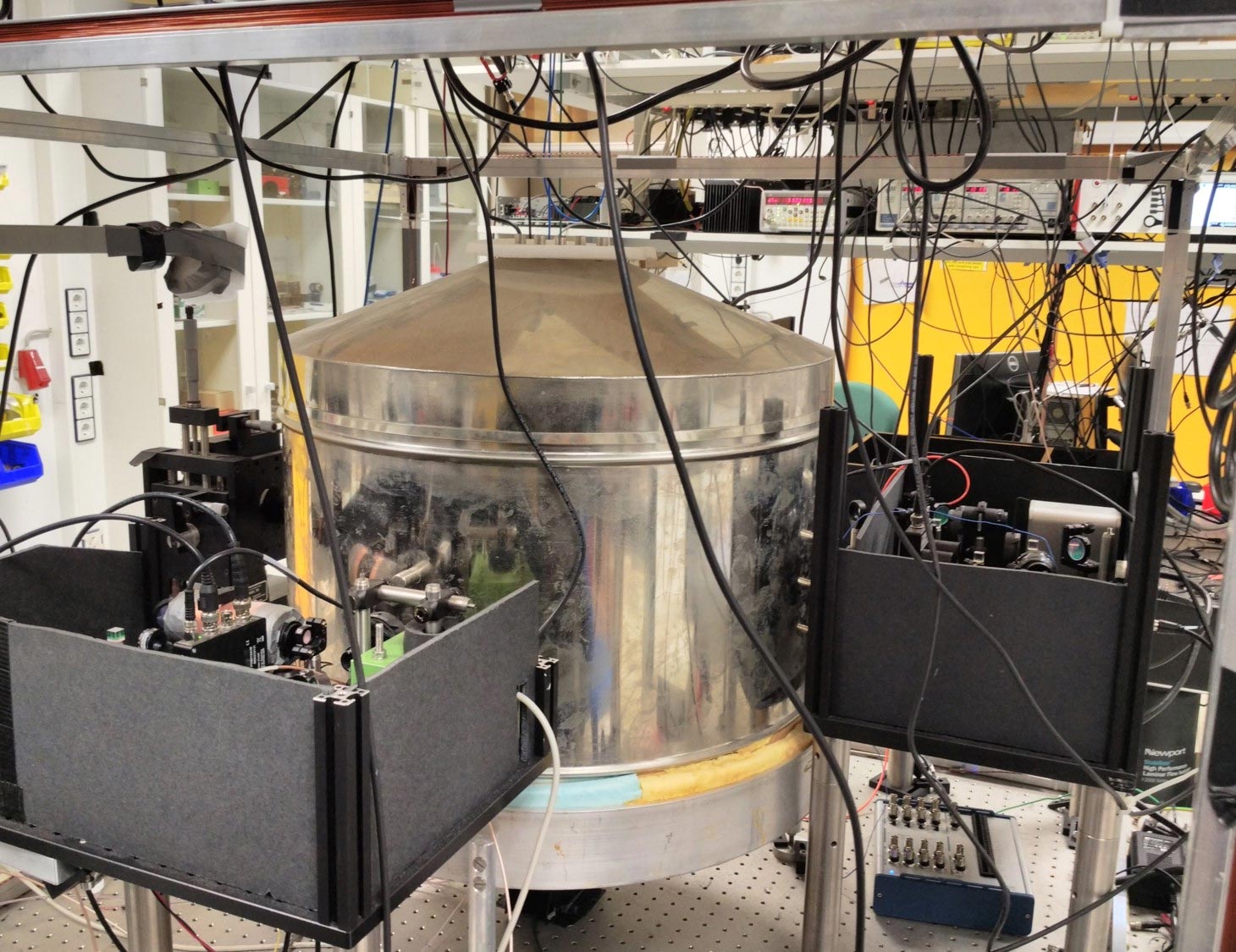
The network meanwhile consists of 14 magnetometers distributed over eight countries worldwide, nine of them provided data for the current analysis. The measurement principle is based on an interaction of dark matter with the nuclear spins of the atoms in the magnetometer. The atoms are excited with a laser at a specific frequency, orienting the nuclear spins in one direction. A potential dark matter field can disturb this direction, which is measurable.
Figuratively speaking, one can imagine that the atoms in the magnetometer initially dance around in confusion, as clarified by Hector Masia-Roig, a doctoral student in the Budker group and also an author of the current study. “When they ‘hear’ the right frequency of laser light, they all spin together. Dark matter particles can throw the dancing atoms out of balance. We can measure this perturbation very precisely.” Now the network of magnetometers becomes important: When the Earth moves through a spatially limited wall of dark matter, the dancing atoms in all stations are gradually disturbed. One of these stations is located in a laboratory at the Helmholtz Institute in Mainz. “Only when we match the signals from all the stations can we assess what triggered the disturbance,”said Masia-Roig. “Applied to the image of the dancing atoms, this means: If we compare the measurement results from all the stations, we can decide whether it was just one brave dancer dancing out of line or actually a global dark matter disturbance.”
One-Month Operation and Future Improvements
In the current study, the research team analyzes data from a one-month continuous operation of GNOME. The result: Statistically significant signals did not appear in the investigated mass range from one femtoelectronvolt (feV) to 100,000 feV. Conversely, this means that the researchers can narrow down the range in which such signals could theoretically be found even further than before. For scenarios that rely on discrete dark matter walls, this is an important result – “even though we have not yet been able to detect such a domain wall with our global ring search,” added Joseph Smiga, another PhD student in Mainz and author of the study.
Future work of the GNOME collaboration will focus on improving both the magnetometers themselves and the data analysis. In particular, continuous operation should be even more stable. This is important to reliably search for signals that last longer than an hour. In addition, the previous alkali atoms in the magnetometers are to be replaced by noble gases. Under the title Advanced GNOME, the researchers expect this to result in considerably better sensitivity for future measurements in the search for ALPs and dark matter.
Reference: “Search for topological defect dark matter with a global network of optical magnetometers” by Samer Afach, Ben C. Buchler, Dmitry Budker, Conner Dailey, Andrei Derevianko, Vincent Dumont, Nataniel L. Figueroa, Ilja Gerhardt, Zoran D. Grujic, Hong Guo, Chuanpeng Hao, Paul S. Hamilton, Morgan Hedges, Derek F. Jackson Kimball, Dongok Kim, Sami Khamis, Thomas Kornack, Victor Lebedev, Zheng-Tian Lu, Hector Masia-Roig, Madeline Monroy, Mikhail Padniuk, Christopher A. Palm, Sun Yool Park, Karun V. Paul, Alexander Penaflor, Xiang Peng, Maxim Pospelov, Rayshaun Preston, Szymon Pustelny, Theo Scholtes, Perrin C. Segura, Yannis K. Semertzidis, Dong Sheng, Yun Chang Shin, Joseph A. Smiga, Jason E. Stalnaker, Ibrahim Sulai, Dhruv Tandon, Tao Wang, Antoine Weis, Arne Wickenbrock, Tatum Wilson, Teng Wu, David Wurm, Wei Xiao, Yucheng Yang, Dongrui Yu and Jianwei Zhang, 7 December 2021, Nature Physics.
DOI: 10.1038/s41567-021-01393-y
Never miss a breakthrough: Join the SciTechDaily newsletter.
Follow us on Google and Google News.
1 Comment
Dark matter/energy is unlike to common matter has ño specific identification of existance,but a distinct connection with gravity has sole presence.