
Close Menu
    Facebook X (Twitter) Instagram
    SciTechDaily
    • Biology
    • Chemistry
    • Earth
    • Health
    • Physics
    • Science
    • Space
    • Technology
    Facebook X (Twitter) Pinterest YouTube RSS
    SciTechDaily
    Home»Health»Drug Resistant Gonorrhea on the Rise in North America
    Health

    Drug Resistant Gonorrhea on the Rise in North America

    By SciTechDailyJanuary 10, 2013No Comments3 Mins Read
    Facebook Twitter Pinterest Telegram LinkedIn WhatsApp Email Reddit
    Share
    Facebook Twitter LinkedIn Pinterest Telegram Email Reddit
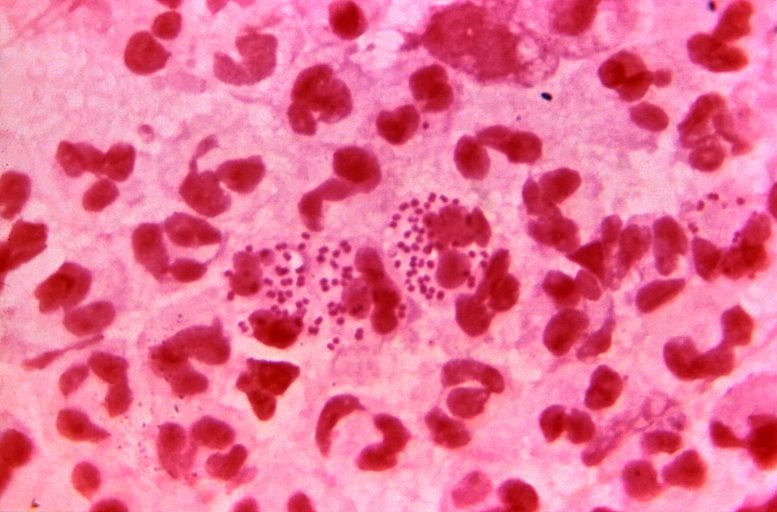
    Neisseria gonorrhoeae Diplococcal Bacteria
    This photomicrograph of a Gram-stained specimen, revealed the presence of intracellular, Gram-negative, Neisseria gonorrhoeae diplococcal bacteria, amongst numerous white blood cells (WBCs), known as polymorphonuclear leukocytes, or PMNs. Credit: CDC/Bill Schwartz

    The most common STIs in the USA, chlamydia and gonorrhea, are usually easy to eradicate thanks to doses of oral antibiotics, but now gonorrhea is getting more resistant to first-line defense drugs.

    The scientists published their findings in The Journal of the American Medical Association. There are more than 321,000 cases of gonorrhea reported each year in the USA and the actual number infected may be a lot higher because many people do not suffer from symptoms. The infection has also lost much of its social stigma, but left untreated it can cause pelvic inflammation, severe pregnancy complications, and female infertility. Its presence also increases the odds of HIV infection, and babies born to women with untreated gonorrhea risk blindness.

    Although antibiotics have reduced this infection to an inconvenience, Neisseria gonorrhoeae has been evolving steadily, becoming drug-resistant. Sulfonamides ceased to be effective in the 1940s. Penicillins and tetracyclines lost their effectiveness in the 1970s and 80s and fluoroquinolones were inadequate in 2007. And now the last treatment available, a class of antibiotics called cephalosporins, appears to be weakening against gonorrhea infections worldwide. According to the new study, this drug resistance has now reached North America in sizable numbers.

    A few years ago, in Japan, it was first noted that gonorrhea was becoming resistant to a cephalosporin antibiotic. Since then, the phenomenon has spread to Europe and North America.

    In this new study, patients were examined at a clinic in Toronto, Canada. The researchers were able to gather data on how often the drugs failed to work. Out of 133 patients who received the treatment and returned for their follow-up appointments for testing, 6.77%, or about 1 in 15, failed to respond to the treatment. There are no effective backup treatment options currently available.

    The CDC has recommended clinicians no longer prescribe a single antibiotic treatment. Instead, they should receive an injection of ceftriaxone as well as a week-long course of oral azithromycin or doxycycline.

    Reference: “Neisseria gonorrhoeae Treatment Failure and Susceptibility to Cefixime in Toronto, Canada” by Vanessa G. Allen, MD, MPH; Leo Mitterni; Christine Seah, MLT; Anuradha Rebbapragada, PhD; Irene E. Martin, BSc; Colin Lee, MD; Heather Siebert, MLT; Lynn Towns, MLT; Roberto G. Melano, PhD and Donald E. Low, MD, 9 January 2013, JAMA.
    DOI: 10.1001/jama.2012.176575

    Never miss a breakthrough: Join the SciTechDaily newsletter.
    Follow us on Google and Google News.

    Disease Epidemiology Gonorrhea Virology
    Share. Facebook Twitter Pinterest LinkedIn Email Reddit

    Related Articles

    Current State of Polio Eradication

    Drug Resistant Tuberculosis On The Rise

    H5N1 Work Will Probably Continue

    Cases of New Coronavirus Announced By WHO

    Whole-Genome Analysis Identifies the Source of a Recent MRSA Outbreak

    Hepatitis E Vaccine Debuts Thanks to Chinese Biotech Partnership

    FDA States Deadly Meningitis Outbreak Tied to More Drugs

    New Coronavirus Could Infect Millions During Hajj in Saudi Arabia

    West Nile Virus Might Be Linked to Kidney Problems

    Leave A Reply Cancel Reply

    • Facebook
    • Twitter
    • Pinterest
    • YouTube

    Don't Miss a Discovery

    Subscribe for the Latest in Science & Tech!

    Trending News

    AI Could Detect Early Signs of Alzheimer’s in Under a Minute – Far Before Traditional Tests

    What if Dark Matter Has Two Forms? Bold New Hypothesis Could Explain a Cosmic Mystery

    This Metal Melts in Your Hand – and Scientists Just Discovered Something Strange

    Beef vs. Chicken: Surprising Results From New Prediabetes Study

    Alzheimer’s Breakthrough: Scientists Discover Key Protein May Prevent Toxic Protein Clumps in the Brain

    Quantum Reality Gets Stranger: Physicists Put a Lump of Metal in Two Places at Once

    Scientists May Have Found the Key to Jupiter and Saturn’s Moon Mystery

    Scientists Uncover Brain Changes That Link Pain to Depression

    Follow SciTechDaily
    • Facebook
    • Twitter
    • YouTube
    • Pinterest
    • Newsletter
    • RSS
    SciTech News
    • Biology News
    • Chemistry News
    • Earth News
    • Health News
    • Physics News
    • Science News
    • Space News
    • Technology News
    Recent Posts
    • Ancient “Rock” Microbes May Reveal How Complex Life Began
    • Hidden “Trade Winds” Inside Cells Could Explain Cancer Spread
    • Humans Owe Their Eyes to a Tiny One-Eyed “Cyclops”
    • Researchers Capture Quantum Interference in One of Nature’s Rarest Atoms
    • Ancient DNA Reveals Irish Goats Have a 3,000-Year-Old Lineage Still Alive Today
    Copyright © 1998 - 2026 SciTechDaily. All Rights Reserved.
    • Science News
    • About
    • Contact
    • Editorial Board
    • Privacy Policy
    • Terms of Use

    Type above and press Enter to search. Press Esc to cancel.