
For the first time, scientists explain how rubbing a surface creates electrical current.
Researchers at Northwestern University have unraveled the long-standing mystery of why rubbing objects together generates static electricity. They discovered that different forces at the front and back of a sliding object cause varying electrical charges, which create a current. This insight, stemming from the ancient observations of Thales of Miletus, has significant implications, from preventing industrial accidents to enhancing pharmaceutical dosing.
Understanding Static Electricity: A Breakthrough Discovery
Anyone who has ever pet a cat or shuffled their feet across the carpet knows that rubbing objects together generates static electricity. But an explanation for this phenomenon has eluded researchers for more than two millennia.
Now, Northwestern University scientists have finally uncovered the mechanics at play.
When an object slides, the front and back parts of that object experience different forces, researchers found. This difference in forces causes different electrical charges to build up on the front and back parts of the object. And the difference in electrical charges creates a current, leading to a light zap.

Explaining an Age-Old Phenomenon
“For the first time, we are able to explain a mystery that nobody could before: why rubbing matters,” said Northwestern’s Laurence Marks, who led the study. “People have tried, but they could not explain experimental results without making assumptions that were not justified or justifiable. We now can, and the answer is surprisingly simple. Just having different deformations — and therefore different charges — at the front and back of something sliding leads to current.”
An expert in surface structures, Marks is a professor emeritus of materials science and engineering at Northwestern’s McCormick School of Engineering. Karl Olson, a Ph.D. student in Marks’ research group, is the paper’s first author.
The Historical Context of Static Studies
Greek philosopher Thales of Miletus first reported friction-induced static electricity in 600 B.C. After rubbing amber with fur, he noticed the fur attracted dust.
“Since then, it has become clear that rubbing induces static charging in all insulators — not just fur,” Marks said. “However, this is more or less where the scientific consensus ended.”
Shear: The Secret Behind Static
Marks and his team started to unravel the mystery in 2019. In a study published in Physical Review Letters, they reported that rubbing two materials together bends tiny protrusions on the surfaces of those materials. Those bent, deformed protrusions give rise to voltages, the researchers found.
“In 2019, we had the seed of what was going on. However, like all seeds, it needed time to grow,” Marks said. “Now, it has blossomed. We developed a new model that calculates electrical current. The values for the current for a range of different cases were in good agreement with experimental results.”
A concept called “elastic shear” lies at the heart of the new model. Elastic shear can occur when a material resists a sliding force. If a person pushes a plate across a table, the plate will resist sliding. As soon as the person stops pushing it, the plate stops moving. This added friction — caused by the resistance to sliding — causes electrical charges to move.
“Sliding and shear are intimately connected,” Marks said.
The Practical Implications of Static Electricity
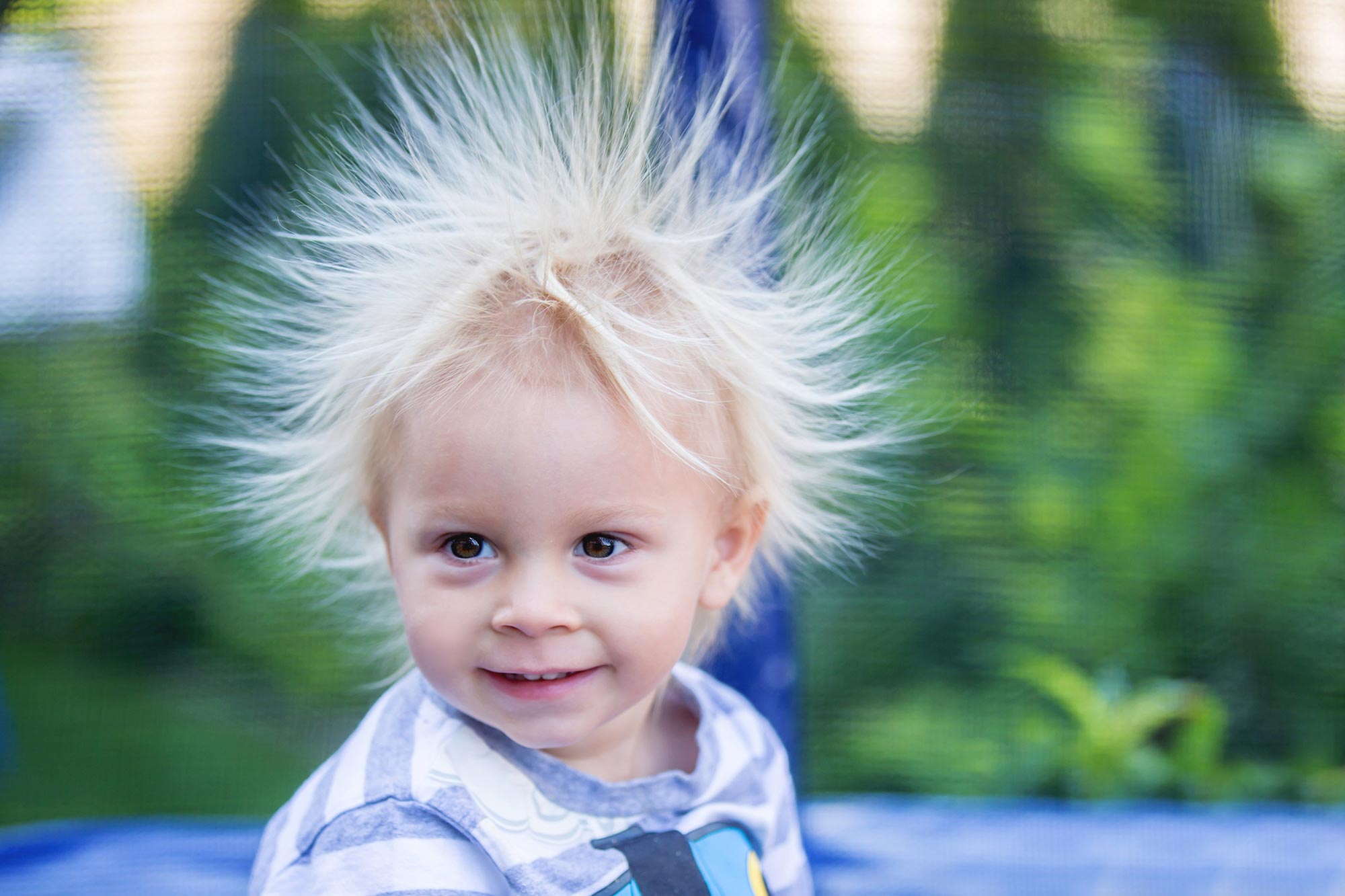
Although static electricity can cause funny mishaps, like hair standing on end after going down a playground slide, it also can lead to serious problems. For example, sparks from static electricity cause industrial fires and even explosions. It also can hinder consistent dosing for powdered pharmaceuticals. With a better understanding of the mechanisms at play, researchers potentially could introduce new solutions to these issues.
“Static electricity affects life in both simple and profound ways,” Marks said. “Charging grains with static electricity has a major influence on how coffee beans are ground and taste. The Earth would probably not be a planet without a key step in the clumping of particles that form planets, which occurs because of the static electricity generated by colliding grains. It’s amazing how much of our lives are touched by static electricity and how much of the universe depends on it.”
Reference: “What Puts the “Tribo” in Triboelectricity?” by Karl P. Olson and Laurence D. Marks, 17 September 2024, Nano Letters.
DOI: 10.1021/acs.nanolett.4c03656
Never miss a breakthrough: Join the SciTechDaily newsletter.
Follow us on Google and Google News.
6 Comments
This explains no more than what I was taught in school, and adds at least one more mystery: current flow in insulators. Current does not flow in insulators, and typically the better the insulator the better the static electrical phenomena. These phenomena aren’t just curiosities; computer memory and solid-state data storage for example depend on both lack of current flow as well as current flow.
Secondarily, the mechanisms involved–tiny protrusions and sheer-friction on surfaces is essentially descriptive and not explanatory. It is leaving no visual impression leading to the ultimate requirement of charge-segregation.
* Secondarily, the mechanisms involved—tiny protrusions and elastic shear on surfaces—is essentially…
“I’m a PhD and here’s my theory which I think is fact”. Unfortunately data and experiments are hidden behind paywalls and not worth $35 to me even though I found the phenomena interesting and have mitigated tribo effects in some of my past designs. A how and why explanation is needed rather than just pronouncements to make the assertions valid. I hope there’s a followup public posting.
Temperature variation either ambient or on the material surfaces should play a significant role in the discharge . By controlling the degree at different temperatures and measuring the output. If the voltage remains constant or fluctuates in either direction on the two “ controlled “ surfaces . Starting with the two most abundant elements in the universe , Hydrogen and Helium….. Measuring their atomic charge should be constant and proportionally equal in a controlled temperature environment. Then lobby to revise the nomenclature of the beginning of the universe from the Big Bang to the Super Spark.
The answer is surprisingly simple, it says. Having different deformations – and therefore different charges….
Um, for an entire article on a mystery, it sure as heck does a slick little pass to nothing. Explain how a different deformation = different charges!!! It acts like that’s a given! And Warp Drive is based on different uncertain heisenberg compensator settings being unequal…. Right.
They don t explain why bending protrusions creates voltage.
That is not an explanation of what creates static electricity.
We need to know what in those bent protrusions create electricity.
I am sorry but that is not an explanation at all.