
Most of the Earth’s surface is covered by oceans, which are teeming with a wide variety of life. Interestingly, these vast bodies of water also contain a dilute distribution of uranium ions. Extracting these ions could potentially offer a renewable source of fuel for nuclear power generation. A recent study in ACS Central Science introduces a new material designed for electrochemical extraction. This innovation is more effective at capturing the elusive uranium ions from seawater compared to previous techniques.
Nuclear power reactors release the energy naturally stored inside of an atom and turn it into heat and electricity by literally breaking the atom apart — a process known as fission. Uranium has become the favored element for this process as all its forms are unstable and radioactive, making it easy to split.
Currently, this metal is extracted from rocks, but uranium ore deposits are finite. Yet, the Nuclear Energy Agency estimates that 4.5 billion tons of uranium are floating around in our oceans as dissolved uranyl ions. This reserve is over 1,000 times more than what’s on land. Extracting these ions has proven to be challenging, though, as the materials for doing so don’t have enough surface area to trap ions effectively. So, Rui Zhao, Guangshan Zhu, and colleagues wanted to develop an electrode material with lots of microscopic nooks and crannies that could be used in the electrochemical capture of uranium ions from seawater.
Innovative Electrode Material Development
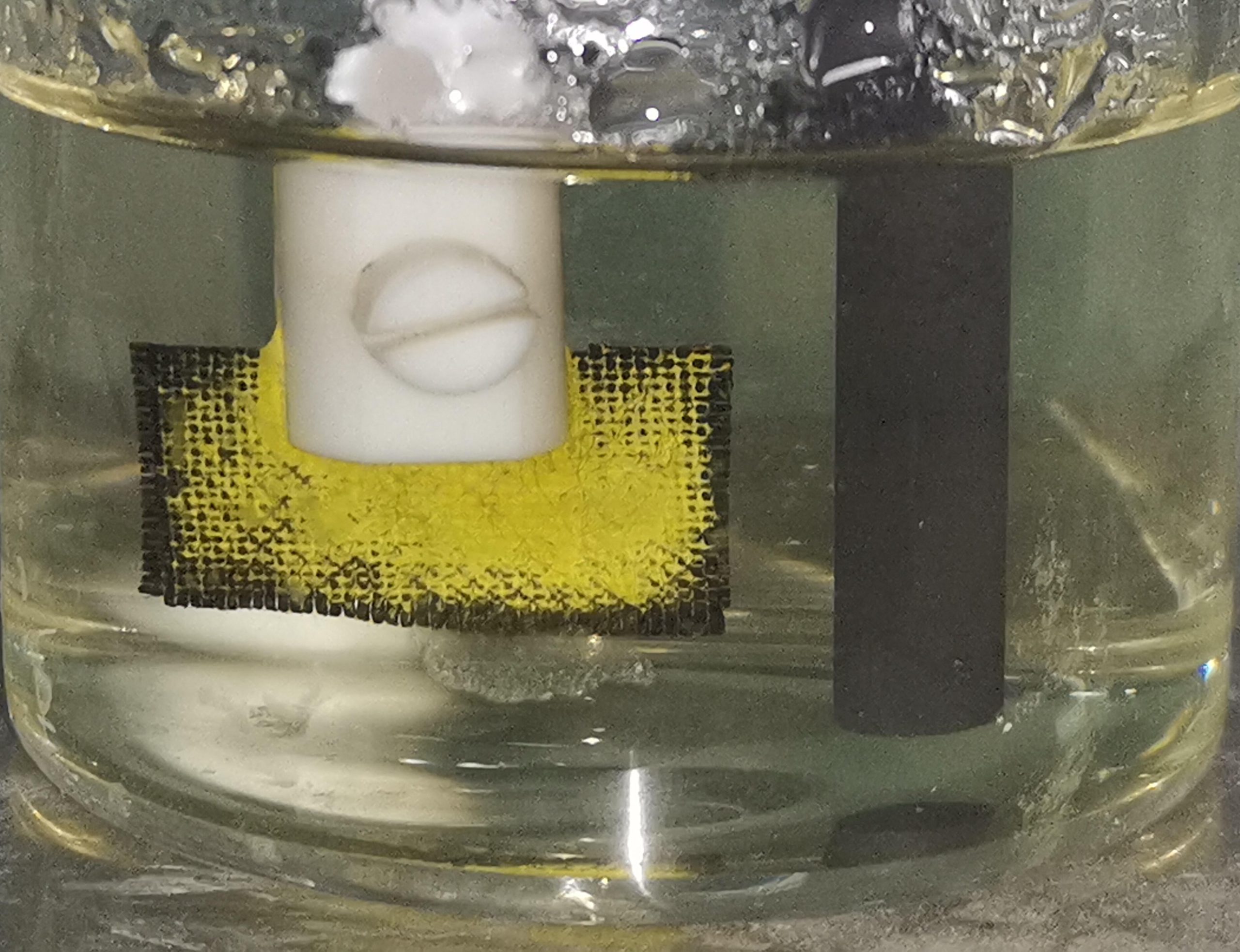
To create their electrodes, the team began with flexible cloth woven from carbon fibers. They coated the cloth with two specialized monomers that were then polymerized. Next, they treated the cloth with hydroxylamine hydrochloride to add amidoxime groups to the polymers. The natural, porous structure of the cloth created many tiny pockets for the amidoxime to nestle in and easily trap the uranyl ions.
In experiments, the researchers placed the coated cloth as a cathode in either naturally sourced or uranium-spiked seawater, added a graphite anode, and ran a cyclic current between the electrodes. Over time, bright yellow, uranium-based precipitates accumulated on the cathode cloth.
In the tests using seawater collected from the Bohai Sea, the electrodes extracted 12.6 milligrams of uranium per gram of coated, active material over 24 days. The coated material’s capacity was higher than most of the other uranium-extracting materials tested by the team. Additionally, using electrochemistry to trap the ions was around three times faster than simply allowing them to naturally accumulate on the cloths. The researchers say that this work offers an effective method to capture uranium from seawater, which could open up the oceans as new suppliers of nuclear fuel.
Reference: “Self-Standing Porous Aromatic Framework Electrodes for Efficient Electrochemical Uranium Extraction” by Dingyang Chen, Yue Li, Xinyue Zhao, Minsi Shi, Xiaoyuan Shi, Rui Zhao and Guangshan Zhu, 13 December 2023, ACS Central Science.
DOI: 10.1021/acscentsci.3c01291
The authors acknowledge funding from the National Key R&D Program of China, the National Natural Science Foundation of China, the Project of Education Department of Jilin Province, the Natural Science Foundation of Department of Science and Technology of Jilin Province, the Fundamental Research Funds for the Central Universities, and the “111” project.
Never miss a breakthrough: Join the SciTechDaily newsletter.
Follow us on Google and Google News.
4 Comments
Nice one; But, how did it get to be so selective that it discharges only the uranyl ions?
Good question. A rudimentary knowledge of electrolysis is requisite for understanding this completely. In electrolysis, there is a prefrential discharge of ions determined by a set of factors including: Concentration, relative positions of ions in the electro-chemical series and the nature of the electrodes…let me cut the chase. This time the third factor, being the decisive, is at play. The electrode used was specially tailor-made to fulfil its purpose of handpicking the uranyl ions. Hence, the selectivity.
“Currently, this metal is extracted from rocks, but uranium ore deposits are finite.”
More correctly, HIGH-GRADE ore deposits are finite. However, uranium is sufficiently abundant in low-grade black shales that calculations have shown that extracting uranium from the shales could be done with a net positive energy gain. Similarly, calculations have shown that even common granites could provide a net positive energy gain from the uranium and thorium found in them as trace elements because the splitting of atoms releases such a huge amount of energy. Although, I don’t favor the idea of chewing up the Sierra Nevada (actually mostly granodiorite) to supply energy to Los Angeles.
Ultimately, in a rational world, the source with the least environmental damage, and least expenditure of energy to mine it, will determine whether black shales, granitic rocks, or sea water will be the preferred source.
In a rational world, yes. Nuclearphobes would want it all outlawed–&, together with their unscientific pals, would try reducing the world to Paleolithic technology.