
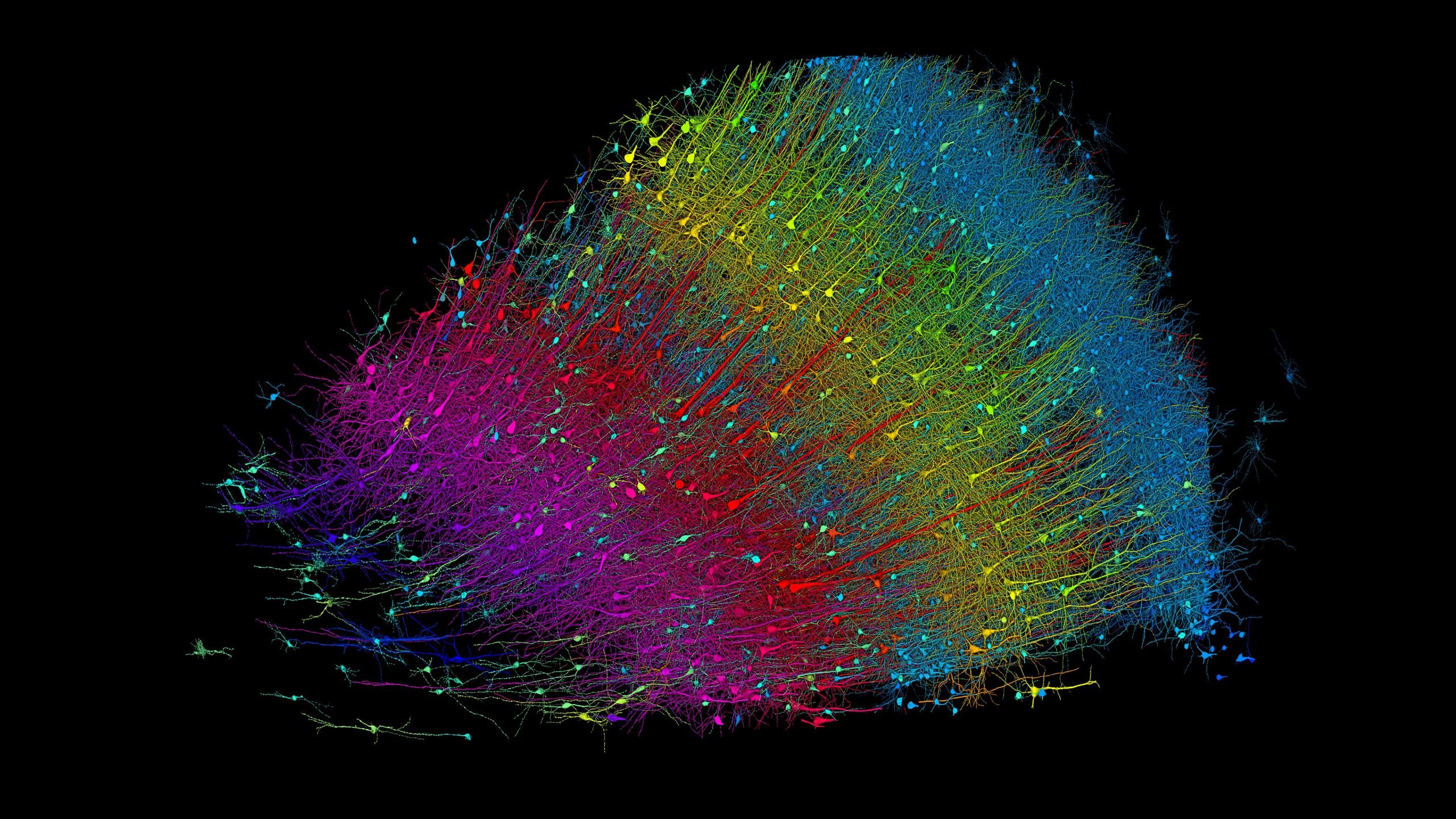
A collaborative effort between Harvard and Google has led to a breakthrough in brain science, producing an extensive 3D map of a tiny segment of human brain, revealing complex neural interactions and laying the groundwork for mapping an entire mouse brain.
A cubic millimeter of brain tissue may not sound like much. But considering that tiny square contains 57,000 cells, 230 millimeters of blood vessels, and 150 million synapses, all amounting to 1,400 terabytes of data, Harvard and Google researchers have just accomplished something enormous.
A Harvard team led by Jeff Lichtman, the Jeremy R. Knowles Professor of Molecular and Cellular Biology and newly appointed dean of science, has co-created with Google researchers the largest synaptic-resolution, 3D reconstruction of a piece of human brain to date, showing in vivid detail each cell and its web of neural connections in a piece of human temporal cortex about half the size of a rice grain.
Technological Advancements in Neuroscience
The impressive feat, published in the journal Science, is the latest in a nearly 10-year collaboration with scientists at Google Research, who combine Lichtman’s electron microscopy imaging with AI algorithms to color-code and reconstruct the extremely complex wiring of mammal brains. The paper’s three co-first authors are former Harvard postdoctoral researcher Alexander Shapson-Coe; Michał Januszewski of Google Research, and Harvard postdoctoral researcher Daniel Berger.
The collaboration’s ultimate goal, supported by the National Institutes of Health BRAIN Initiative, is to create a high-resolution map of a whole mouse brain’s neural wiring, which would entail about 1,000 times the amount of data they just produced from the 1-cubic-millimeter fragment of human cortex.
Insights From the Latest Brain Map
“The word ‘fragment’ is ironic,” Lichtman said. “A terabyte is, for most people, gigantic, yet a fragment of a human brain – just a minuscule, teeny-weeny little bit of human brain – is still thousands of terabytes.”
The latest map in Science contains never-before-seen details of brain structure, including a rare but powerful set of axons connected by up to 50 synapses. The team also noted oddities in the tissue, such as a small number of axons that formed extensive whorls. Since their sample was taken from a patient with epilepsy, they’re unsure if such unusual formations are pathological or simply rare.
The Field of Connectomics
Lichtman’s field is “connectomics,” which, analogous to genomics, seeks to create comprehensive catalogs of brain structure, down to individual cells and wiring. Such completed maps would light the way toward new insights into brain function and disease, about which scientists still know very little.
Google’s state-of-the-art AI algorithms allow for the reconstruction and mapping of brain tissue in three dimensions. The team has also developed a suite of publicly available tools researchers can use to examine and annotate the connectome.
Future Directions
“Given the enormous investment put into this project, it was important to present the results in a way that anybody else can now go and benefit from them,” said Google Research collaborator Viren Jain.
Next the team will tackle the mouse hippocampal formation, which is important to neuroscience for its role in memory and neurological disease.
Reference: “A petavoxel fragment of human cerebral cortex reconstructed at nanoscale resolution” by Alexander Shapson-Coe, Michał Januszewski, Daniel R. Berger, Art Pope, Yuelong Wu, Tim Blakely, Richard L. Schalek, Peter H. Li, Shuohong Wang, Jeremy Maitin-Shepard, Neha Karlupia, Sven Dorkenwald, Evelina Sjostedt, Laramie Leavitt, Dongil Lee, Jakob Troidl, Forrest Collman, Luke Bailey, Angerica Fitzmaurice, Rohin Kar, Benjamin Field, Hank Wu, Julian Wagner-Carena, David Aley, Joanna Lau, Zudi Lin, Donglai Wei, Hanspeter Pfister, Adi Peleg, Viren Jain and Jeff W. Lichtman, 10 May 2024, Science.
DOI: 10.1126/science.adk4858
Never miss a breakthrough: Join the SciTechDaily newsletter.
Follow us on Google and Google News.
1 Comment
Okay, so soon we will have the technology to scan and examine the connectome, but that’s the easy part. Teasing out the true functions of cortical columns and the fundamental architecture that is responsible for the truly wondrous abilities like our brains ways of conceptualizing a 3D representation from a 2D retinal array, or the plumbing behind consciousness and all the other abstract abilities of the human mind, we are a long way from daylight, that is for sure…