
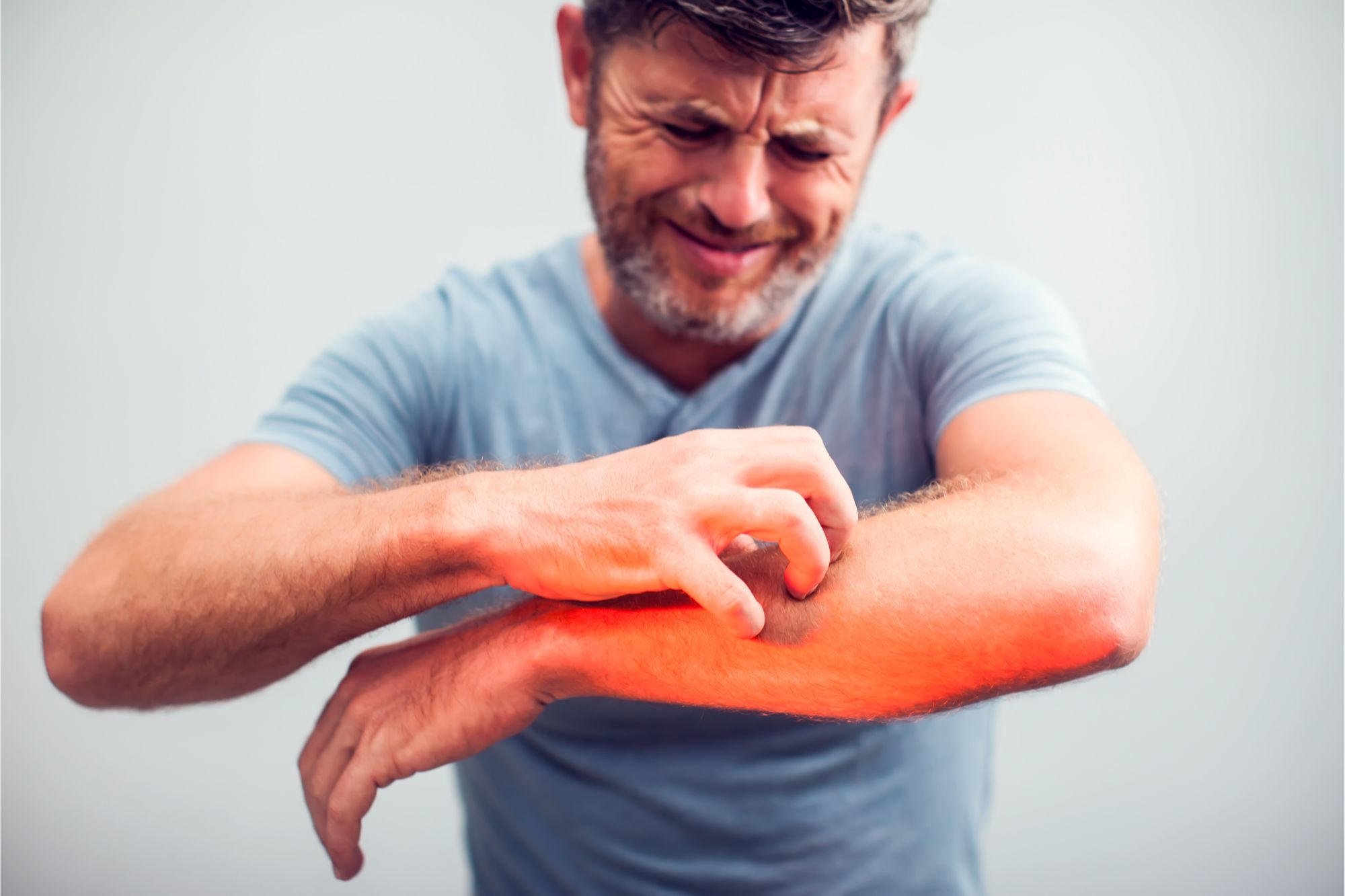
Researchers discover that a common microbe is an unrecognized cause of itching.
Researchers at Harvard Medical School have discovered that the bacterium Staphylococcus aureus, commonly found on the skin, can directly trigger itching by interacting with nerve cells.
The findings, based on research in mice and in human cells, was recently published in the journal Cell. This study provides a significant insight into the longstanding mystery of itching and sheds light on why skin disorders such as eczema and atopic dermatitis are often accompanied by persistent itch.
In such conditions, the equilibrium of microorganisms that keep our skin healthy is often thrown off balance, allowing S. aureus to flourish, the researchers said. Up until now, the itch that occurs with eczema and atopic dermatitis was believed to arise from the accompanying inflammation of the skin. But the new findings show that S. aureus single-handedly causes itch by instigating a molecular chain reaction that culminates in the urge to scratch.
“We’ve identified an entirely novel mechanism behind itch — the bacterium Staph aureus, which is found on almost every patient with the chronic condition atopic dermatitis. We show that itch can be caused by the microbe itself,” said senior author Isaac Chiu, associate professor of immunology in the Blavatnik Institute at HMS.
The study experiments showed that S. aureus releases a chemical that activates a protein on the nerve fibers that transmit signals from the skin to the brain. Treating animals with an FDA-approved anti-clotting medicine successfully blocked the activation of the protein to interrupt this key step in the itch-scratch cycle. The treatment relieved symptoms and minimized skin damage.
Credit: Harvard Medical School
The findings can inform the design of oral medicines and topical creams to treat persistent itch that occurs with various conditions linked to an imbalance in the skin microbiome, such as atopic dermatitis, prurigo nodularis, and psoriasis.
The repeated scratching that is a hallmark of these conditions can cause skin damage and amplify inflammation.
“Itch can be quite debilitating in patients who suffer from chronic skin conditions. Many of these patients carry on their skin the very microbe we’ve now shown for the first time can induce itch,” said study first author Liwen Deng, a postdoctoral research fellow in the Chiu Lab.
Identifying the molecular spark plug that ignites itch
Researchers exposed the skin of mice to S. aureus. The animals developed an intensifying itch over several days, and the repeated scratching caused worsening skin damage that spread beyond the original site of exposure.
Moreover, mice exposed to S. aureus became hypersensitive to innocuous stimuli that would not typically cause itch. The exposed mice were more likely than unexposed mice to develop abnormal itching in response to a light touch.
This hyperactive response, a condition called alloknesis, is common in patients with chronic conditions of the skin characterized by persistent itch. But it can also happen in people without any underlying conditions — think of that scratchy feeling you might get from a wool sweater.
To determine how the bacterium triggered itch, the researchers tested multiple modified versions of the S. aureus microbe that were engineered to lack specific pieces of the bug’s molecular makeup. The team focused on 10 enzymes known to be released by this microbe upon skin contact. One after another, the researchers eliminated nine suspects — showing that a bacterial enzyme called protease V8 was single-handedly responsible for initiating itch in mice. Human skin samples from patients with atopic dermatitis also had more S. aureus and higher V8 levels than healthy skin samples.
The analyses showed that V8 triggers itch by activating a protein called PAR1, which is found on skin neurons that originate in the spinal cord and carry various signals —touch, heat, pain, itch — from the skin to the brain. Normally, PAR1 lies dormant but upon contact with certain enzymes, including V8, it gets activated. The research showed that V8 snips one end of the PAR1 protein and awakens it. Experiments in mice showed that once activated, PAR1 initiates a signal that the brain eventually perceives as an itch. When researchers repeated the experiments in lab dishes containing human neurons, they also responded to V8.
Interestingly, various immune cells implicated in skin allergies and classically known to cause itch — mast cells and basophils — did not drive itch after bacterial exposure, the experiments showed. Nor did inflammatory chemicals called interleukins, or white cells, which are activated during allergic reactions and are also known to be elevated in skin diseases and even in certain neurologic disorders.
“When we started the study, it was unclear whether the itch was a result of inflammation or not,” Deng said. “We show that these things can be decoupled, that you don’t necessarily have to have inflammation for the microbe to cause itch, but that the itch exacerbates inflammation on the skin.”
Interrupting the itch-scratch cycle
Because PAR1 — the protein activated by S. aureus — is involved in blood clotting, researchers wanted to see whether an already approved anticlotting drug that blocks PAR1 would stop itch. It did.
The itchy mice whose skin was exposed to S. aureus experienced rapid improvement when treated with the drug. Their desire to scratch diminished dramatically, as did the skin damage caused by scratching.
Moreover, once treated with PAR1 blockers, the mice no longer experienced abnormal itch in response to innocuous stimuli.
The PAR1 blocker is already used in humans to prevent blood clots and could be repurposed as anti-itch medication. For example, the researchers noted, the active ingredient in the medicine could become the basis for anti-itch topical creams.
One immediate question that the researchers plan to explore in future work is whether other microbes besides S. aureus can trigger itch.
“We know that many microbes, including fungi, viruses, and bacteria, are accompanied by itch but how they cause itch is not clear,” Chiu said.
Beyond that, the findings raise a broader question: Why would a microbe cause itch? Evolutionarily speaking, what’s in it for the bacterium?
One possibility, the researchers said, is that pathogens may hijack itch and other neural reflexes to their advantage. For example, previous research has shown that the TB bacterium directly activates vagal neurons to cause cough, which might enable it to spread more easily from one host to another.
“It’s a speculation at this point, but the itch-scratch cycle could benefit the microbes and enable their spread to distant body sites and to uninfected hosts,” Deng said. “Why do we itch and scratch? Does it help us, or does it help the microbe? That’s something that we could follow up on in the future.”
Reference: “S. aureus drives itch and scratch-induced skin damage through a V8 protease-PAR1 axis” by Liwen Deng, Flavia Costa, Kimbria J. Blake, Samantha Choi, Arundhasa Chandrabalan, Muhammad Saad Yousuf, Stephanie Shiers, Daniel Dubreuil, Daniela Vega-Mendoza, Corinne Rolland, Celine Deraison, Tiphaine Voisin, Michelle D. Bagood, Lucia Wesemann, Abigail M Frey, Joseph S. Palumbo, Brian J. Wainger, Richard L. Gallo, Juan-Manuel Leyva-Castillo, Nathalie Vergnolle, Theodore J. Price, Rithwik Ramachandran, Alexander R. Horswill and Isaac M. Chiu, 22 November 2023, Cell.
DOI: 10.1016/j.cell.2023.10.019
The work was funded by the National Institutes of Health (grants R01AI168005, R01AI153185, R01NS065926, R01NS102161, R01NS111929, R37AI052453, R01AR076082, U01AI152038, UM1AI151958, R01AI153185, R01JL160582, F32AI172080, T32AI049928, 1R21AG075419), Food Allergy Science Initiative (FASI), Burroughs Wellcome Fund, Drako Family Fund, Jackson-Wijaya Research Fund, Canadian Institutes of Health Research (CIHR) (grants 376560 and 469411), and ANR-PARCURE (PRCE-CE18, 2020).
Chiu serves on the scientific advisory board of GSK Pharmaceuticals. Provisional patent application Serial No. 63/438,668, in which some coauthors are listed as inventors, was filed based on these findings.
Never miss a breakthrough: Join the SciTechDaily newsletter.
Follow us on Google and Google News.