
Close Menu
    Facebook X (Twitter) Instagram
    SciTechDaily
    • Biology
    • Chemistry
    • Earth
    • Health
    • Physics
    • Science
    • Space
    • Technology
    Facebook X (Twitter) Pinterest YouTube RSS
    SciTechDaily
    Home»Health»Harvard Study Links a Variety of Healthy Eating Patterns to a Lower Risk of Premature Death
    Health

    Harvard Study Links a Variety of Healthy Eating Patterns to a Lower Risk of Premature Death

    By Harvard T.H. Chan School of Public HealthFebruary 7, 20231 Comment3 Mins Read
    Facebook Twitter Pinterest Telegram LinkedIn WhatsApp Email Reddit
    Share
    Facebook Twitter LinkedIn Pinterest Telegram Email Reddit
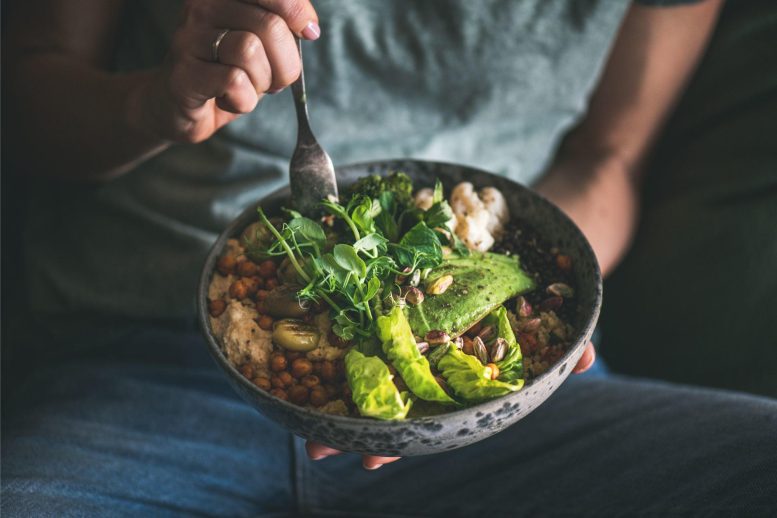
    Eating Healthy Vegan Food
    The Dietary Guidelines for Americans outlines four healthy eating patterns: Healthy Eating Index 2015, Alternate Mediterranean Diet, Healthful Plant-based Diet Index, and Alternate Healthy Eating Index. These patterns promote a balanced diet with emphasis on fruits, vegetables, whole grains, healthy fats, and moderation of saturated and trans fats, added sugars, and sodium.

    Adhering to Healthy Eating Patterns Reduces Risks of Death From Diseases Like Cancer and Heart Disease

    A Harvard study finds healthy eating patterns lower risk of premature death. Researchers discovered participants who followed at least one of four healthy eating patterns had reduced risk of death from any cause, including cardiovascular disease, cancer, and respiratory disease, compared to those with lower adherence. The study is consistent with the Dietary Guidelines for America, which recommends multiple healthy eating patterns.

    “The Dietary Guidelines for Americans are intended to provide science-based dietary advice that promotes good health and reduces major chronic diseases. Thus, it is critical to examine the associations between DGAs-recommended dietary patterns and long-term health outcomes, especially mortality,” said corresponding author Frank Hu, Fredrick J. Stare Professor of Nutrition and Epidemiology and chair of the Department of Nutrition.

    The was recently published in JAMA Internal Medicine.

    Few studies have evaluated whether greater adherence to the DGAs-recommended dietary patterns is associated with long-term risk of total and cause-specific mortality. The researchers used health data collected over 36 years from 75,230 women participating in the Nurses’ Health Study and 44,085 men in the Health Professionals Follow-up Study. All participants were free of cardiovascular disease or cancer at the beginning of the study and completed dietary questionnaires every four years. Their information was scored based on each of the four dietary pattern indexes (Healthy Eating Index 2015, Alternate Mediterranean Diet, Healthful Plant-based Diet Index, and Alternate Healthy Eating Index). All share key components including whole grains, fruits, vegetables, nuts, and legumes, although other components differ across different eating patterns.

    A higher score on at least one of the indexes was associated with a lower risk of premature death from all causes, and from cardiovascular disease, cancer, and respiratory disease. Higher scores on the AMED and the AHEI were associated with a lower risk of death from neurogenerative disease. The results were consistent for non-Hispanic white, non-Hispanic Black, and Hispanic people.

    Dietary Guidelines and Public Health

    The current DGAs (2015–2020) recommend multiple healthy eating patterns that can be adapted to individual food traditions and preferences. An updated version of the Guidelines is released every five years by the U.S. Departments of Health and Human Services (HHS) and Agriculture (USDA).

    “It is important to evaluate adherence to DGAs-recommended eating patterns and health outcomes, including mortality, so that timely updates can be made,” said Hu. “Our findings will be valuable for the 2025-2030 Dietary Guidelines Advisory Committee, which is being formed to evaluate current evidence surrounding different eating patterns and health outcomes.”

    Reference: “Healthy Eating Patterns and Risk of Total and Cause-Specific Mortality” by Zhilei Shan, MD, Ph.D., Fenglei Wang, Ph.D., Yanping Li, MD, Ph.D., Megu Y. Baden, MD, Ph.D., Shilpa N. Bhupathiraju, Ph.D., Dong D. Wang, MD, ScD, Qi Sun, MD, ScD, Kathryn M. Rexrode, MD, MPH, Eric B. Rimm, ScD, Lu Qi, MD, Ph.D., Fred K. Tabung, Ph.D., Edward L. Giovannucci, Ph.D., Walter C. Willett, MD, DrPH, JoAnn E. Manson, MD, DrPH, Qibin Qi, Ph.D. and Frank B. Hu, MD, Ph.D., 9 January 2022, JAMA Internal Medicine.
    DOI: 10.1001/jamainternmed.2022.6117

    The study was funded by the NHLBI Division of Intramural Research. 

    Never miss a breakthrough: Join the SciTechDaily newsletter.
    Follow us on Google and Google News.

    Death Diet Harvard University Mortality Nutrition Popular Public Health
    Share. Facebook Twitter Pinterest LinkedIn Email Reddit

    Related Articles

    This Special Diet May Slow Brain Aging, Harvard Study Reveals

    What a 30-Year Study Just Found About Your French Fries and Diabetes

    Hot Dogs, Soda, and a 540,000-Person Warning: Ultra-Processed Foods Shorten Life

    Harvard Study Reveals: Planetary Health Diet Can Extend Your Life and Save Earth Too

    Harvard Study: Sticking to a Mediterranean Lifestyle Can Reduce Your Risk of Death

    New Harvard Research Links Omega-3 Fatty Acid Consumption With Slower ALS Progression

    6 Scientifically Proven Health Benefits of a Plant-Based Diet

    We Cannot Cheat Aging and Death: New Insights Into “Invariant Rate of Aging Hypothesis”

    US Deaths Normally Change Less Than 2% Each Year – In 2020 With COVID, They Rose a Staggering 22.9%

    1 Comment

    1. PJ on December 7, 2025 8:19 pm

      What is the percentage of age regression when combining vitamins minerals and herbs supplements with AI and the human genome map??

      Reply
    Leave A Reply Cancel Reply

    • Facebook
    • Twitter
    • Pinterest
    • YouTube

    Don't Miss a Discovery

    Subscribe for the Latest in Science & Tech!

    Trending News

    First-of-Its-Kind Discovery: Homer’s Iliad Found Embedded in a 1,600-Year-Old Egyptian Mummy

    Beyond Inflammation: Scientists Uncover New Cause of Persistent Rheumatoid Arthritis

    A Simple Molecule Could Unlock Safer, Easier Weight Loss

    Scientists Just Built a Quantum Battery That Charges Almost Instantly

    Researchers Unveil Groundbreaking Sustainable Solution to Vitamin B12 Deficiency

    Millions of People Have Osteopenia Without Realizing It – Here’s What You Need To Know

    Researchers Discover Boosting a Single Protein Helps the Brain Fight Alzheimer’s

    World-First Study Reveals Human Hearts Can Regenerate After a Heart Attack

    Follow SciTechDaily
    • Facebook
    • Twitter
    • YouTube
    • Pinterest
    • Newsletter
    • RSS
    SciTech News
    • Biology News
    • Chemistry News
    • Earth News
    • Health News
    • Physics News
    • Science News
    • Space News
    • Technology News
    Recent Posts
    • After Decades, MIT Researchers Capture the First 3D Atomic View of a Mysterious Material
    • Your Favorite Fishing Spot Is Turning Brown – and the Fish Are Changing
    • 380-Million-Year-Old Fish Fossil Reveals Secrets of Life’s First Steps Onto Land
    • Mezcal “Worm” in a Bottle Mystery: DNA Testing Reveals a Surprise
    • Scientists Turn Red Lettuce Green, Unlocking Hidden Nutrients
    Copyright © 1998 - 2026 SciTechDaily. All Rights Reserved.
    • Science News
    • About
    • Contact
    • Editorial Board
    • Privacy Policy
    • Terms of Use

    Type above and press Enter to search. Press Esc to cancel.