
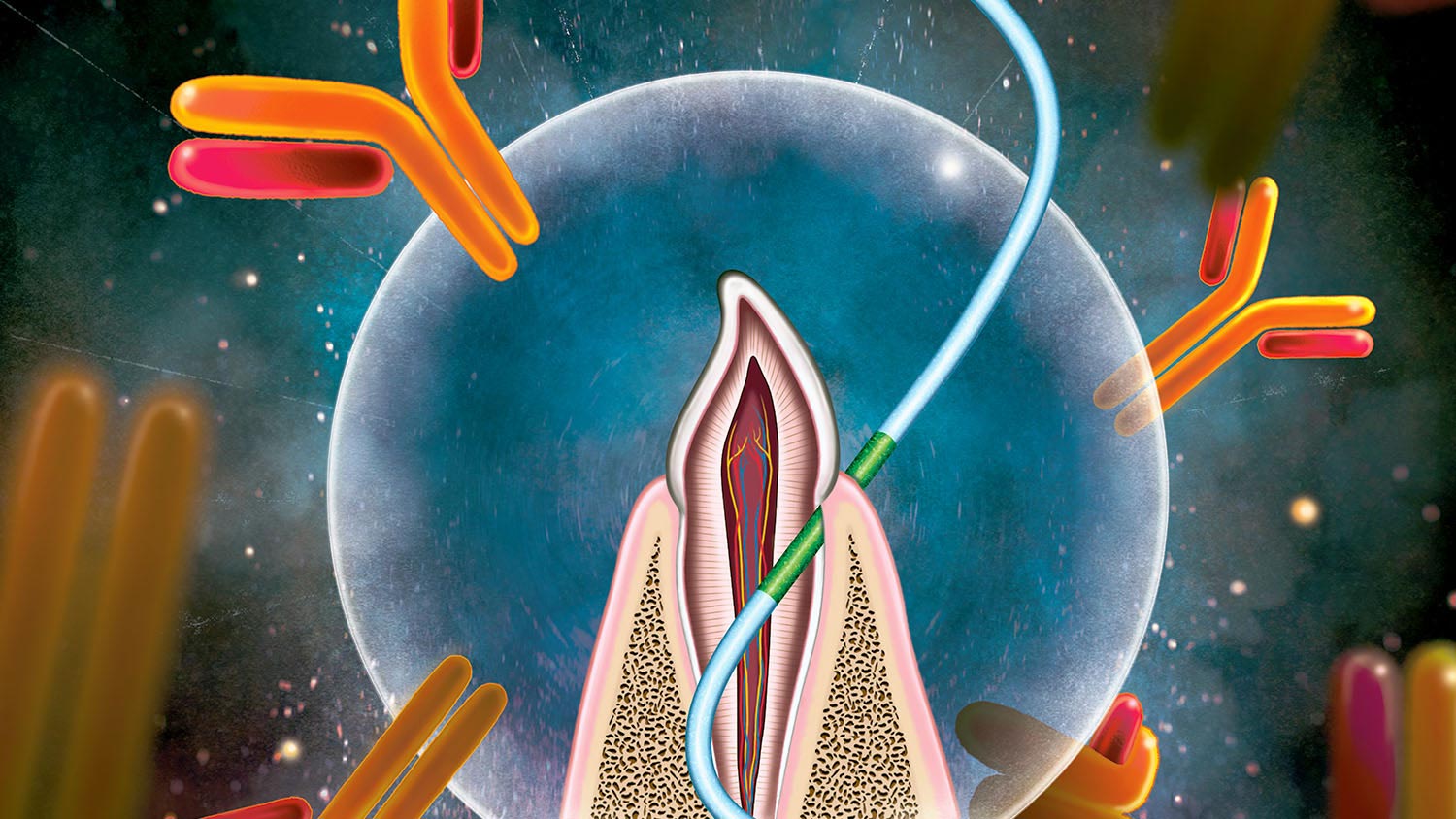
Scientists have discovered that flossing between your teeth could one day help vaccinate you.
By targeting a uniquely permeable gum tissue called the junctional epithelium, this new method stimulates immunity right where many infections enter: the mouth, nose, and lungs.
Floss-Based Vaccine Delivery Shows Promise
Researchers have tested an inventive way to deliver vaccines in animals, applying the vaccine to dental floss and introducing it through the tissue between the teeth and gums. This approach prompted the immune system to produce antibodies on mucosal surfaces, such as those lining the nose and lungs, which are often the first points of entry for viruses.
“Mucosal surfaces are important, because they are a source of entry for pathogens, such as influenza and COVID,” says Harvinder Singh Gill, corresponding author of a paper on the work. “However, if a vaccine is given by injection, antibodies are primarily produced in the bloodstream throughout the body, and relatively few antibodies are produced on mucosal surfaces.
“But we know that when a vaccine is given via the mucosal surface, antibodies are stimulated not only in the bloodstream, but also on mucosal surfaces,” says Gill, who is the Ronald B. and Cynthia J. McNeill Term Professor in Nanomedicine at North Carolina State University. “This improves the body’s ability to prevent infection, because there is an additional line of antibody defense before a pathogen enters the body.”
The Unique Advantage of the Junctional Epithelium
This is where the junctional epithelium becomes relevant. Epithelium refers to the tissue covering the surfaces of body structures, such as the lining of the lungs, stomach, and intestines. In most parts of the body, these layers form strong barriers that block harmful substances, from viruses to dirt, from entering the bloodstream. The junctional epithelium, however, is an exception.
This thin tissue lies at the deepest point of the gum pocket, where the tooth meets the gum, and lacks many of the barrier features found in other epithelial layers. Because of this, it can release immune cells to combat bacteria, which are present in saliva and in the space between the teeth and gums.
“Because the junctional epithelium is more permeable than other epithelial tissues – and is a mucosal layer – it presents a unique opportunity for introducing vaccines to the body in a way that will stimulate enhanced antibody production across the body’s mucosal layers,” says Gill.
Testing the Technique in Mice
To determine the viability of delivering vaccines via the junctional epithelium, the researchers applied vaccine to unwaxed dental floss and then flossed the teeth of lab mice. Specifically, the researchers compared antibody production in mice that received a peptide flu vaccine via flossing the junctional epithelium; via the nasal epithelium; or via placing vaccine on the mucosal tissue under the tongue.
“We found that applying vaccine via the junctional epithelium produces far superior antibody response on mucosal surfaces than the current gold standard for vaccinating via the oral cavity, which involves placing vaccine under the tongue,” says Rohan Ingrole, first author of the paper, who was a Ph.D. student under Gill at Texas Tech University. “The flossing technique also provides comparable protection against flu virus as compared to the vaccine being given via the nasal epithelium.”
Avoiding Brain Exposure and Other Risks
“This is extremely promising, because most vaccine formulations cannot be given via the nasal epithelium – the barrier features in that mucosal surface prevent efficient uptake of the vaccine,” Gill says. “Intranasal delivery also has the potential to cause the vaccine to reach the brain, which can pose safety concerns. However, vaccination via the junctional epithelium offers no such risk. For this experiment, we chose one of the few vaccine formulations that actually works for nasal delivery because we wanted to see how junctional epithelium delivery compared to the best-case scenario for nasal delivery.”
The researchers also tested whether the junctional epithelium delivery method worked for three other prominent classes of vaccines: proteins, inactivated viruses, and mRNA. In all three cases, the epithelial junction delivery technique produced robust antibody responses in the bloodstream and across mucosal surfaces.
Food and Drink Don’t Disrupt Immunity
The researchers also found that, at least in the animal model, it didn’t matter whether food and water were consumed immediately after flossing with the vaccine – the immune response was the same.
But while regular floss serves as an adequate vaccine delivery method for lab mice, the researchers know it’s not practical to ask people to hold vaccine-coated floss in their fingers. To address that challenge the researchers used a floss pick. A floss pick consists of a piece of floss stretched between two prongs that can be held by a handle.
Specifically, the researchers coated the floss in floss picks with fluorescent food dye. The researchers then recruited 27 study participants, explained the concept of applying vaccine via floss, and asked the participants to try to deposit the food dye in their epithelial junction with a floss pick.
“We found that approximately 60% of the dye was deposited in the gum pocket, which suggests that floss picks may be a practical vaccine delivery method to the epithelial junction,” Ingrole says.
Toward Clinical Trials and Broader Benefits
“We’re optimistic about that work and – depending on our findings – may then move toward clinical trials,” Gill says.
While there are still many questions that need to be answered before the floss technique can be considered for clinical use, the researchers think there could be significant advantages beyond the improved antibody response on mucosal surfaces.
“For example, it would be easy to administer, and it addresses concerns many people have about being vaccinated with needles,” Gill says. “And we think this technique should be comparable in price to other vaccine delivery techniques.
There are also some drawbacks. For example, this technique would not work on infants and toddlers who do not yet have teeth.
“In addition, we would need to know more about how or whether this approach would work for people who have gum disease or other oral infections,” Gill says.
The paper, “Floss-based vaccination targets the gingival sulcus for mucosal and systemic immunization,” is published in the journal Nature Biomedical Engineering.
Reference: “Floss-based vaccination targets the gingival sulcus for mucosal and systemic immunization” by Rohan S. J. Ingrole, Akhilesh Kumar Shakya, Gaurav Joshi, Chang Hyun Lee, Lazar D. Nesovic, Richard W. Compans and Harvinder Singh Gill, 22 July 2025, Nature Biomedical Engineering.
DOI: 10.1038/s41551-025-01451-3
Co-authors of the paper include Akhilesh Kumar Shakya, Chang Hyun Lee and Lazar Nesovic of Texas Tech; Gaurav Joshi of Texas Tech and NC State; and Richard Compans of Emory University.
The study was supported in part by the National Institutes of Health (NIH) under grants R01AI137846 and R01DE033759, and by funds from the Whitacre Endowed Chair in Science and Engineering at Texas Tech University.
Gill, Ingrole and Shakya are co-inventors on a patent related to targeting the junctional epithelium for vaccination.
Never miss a breakthrough: Join the SciTechDaily newsletter.
Follow us on Google and Google News.
1 Comment
Sneaky bio-weapon?