
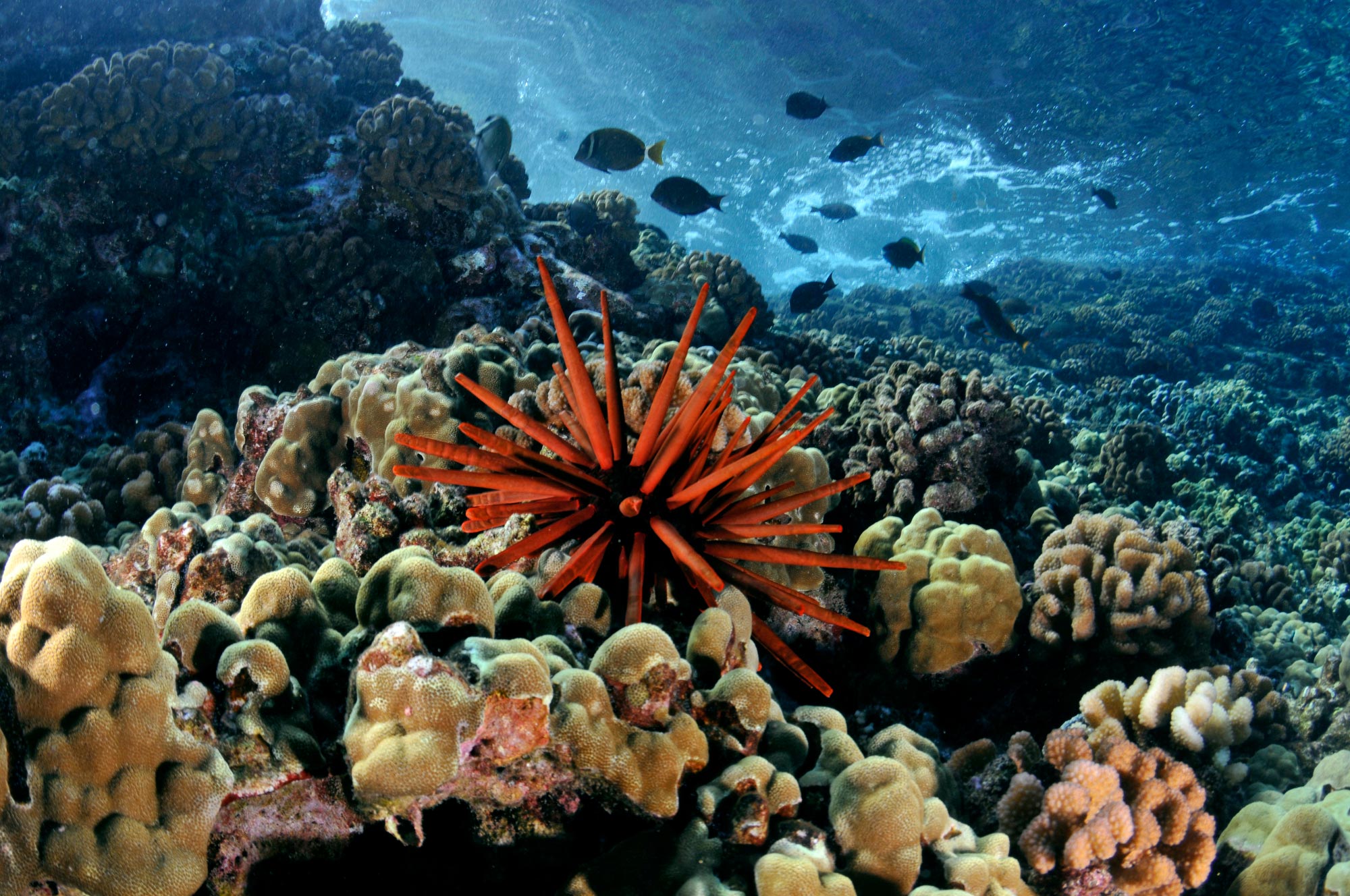
A startling new study shows that the waters surrounding Hawai‘i are heading toward levels of ocean acidification not seen in thousands of years—and fast.
Even under the most optimistic emissions scenarios, coral reefs around the islands are projected to experience chemical changes that could outpace their ability to adapt. Using fine-scale modeling, scientists reveal that the reefs may soon enter an entirely new oceanic environment, with windward coasts hit hardest. While some corals have shown signs of resilience, the clock is ticking, and researchers stress that continued emissions could reshape Hawai‘i’s underwater ecosystems forever.
Ocean Acidification Threatens Hawaiian Waters
Around the world, oceans are becoming more acidic as they absorb carbon dioxide from the atmosphere, posing serious risks to coral reefs and a wide range of marine life. A recent study by oceanographers at the University of Hawai‘i at Mānoa has found that acidification near the main Hawaiian Islands could reach unprecedented levels within the next 30 years.
This growing acidity can damage marine ecosystems by weakening the shells and skeletons of sea creatures like corals and clams. It also increases the impact of other environmental stressors, placing additional pressure on already vulnerable habitats. Despite these threats, there is some hope. Researchers have observed that certain species may be adapting to the shifting conditions. The findings provide critical insight for scientists, conservation groups, and policymakers who are working to protect Hawaiian coral reefs and sustain marine ecosystems for the future.
The research team, led by Brian Powell, a professor in the Department of Oceanography at the UH Mānoa School of Ocean and Earth Science and Technology (SOEST), used high-resolution computer models to predict how ocean chemistry near the Hawaiian Islands could change through the 21st century. Their projections were based on various climate scenarios that reflect different levels of carbon dioxide emissions.
Modeling Future Acidification Around Hawai‘i
“We found that ocean acidification is projected to increase significantly in the surface waters around the main Hawaiian Islands, even if carbon emissions flatline by mid-century in the low emission scenario,” said Lucia Hošeková, lead author of the paper and research scientist in SOEST. “In all nearshore areas, these increases will be unprecedented compared to what reef organisms have experienced in many thousands of years.”
The extent and timing of these changes vary depending on the amount of carbon added to the atmosphere. In the high‐emission scenario, the team found that ocean chemistry will become dramatically different from what corals have experienced historically, potentially posing challenges to their ability to adapt. Even in the low‐emission scenario, some changes are inevitable, but they are less extreme and occur more gradually.
The team calculated the difference between projected ocean acidification and acidification that corals in a given location have experienced in recent history. They refer to this as ‘novelty’ and discovered that various areas of the Hawaiian Islands may experience acidification differently. Windward coastlines consistently exhibited higher novelty, that is, future conditions deviate more dramatically from what coral reefs have experienced in recent history.
Unexpected Shifts in Coral Environments
“We did not expect future levels of ocean acidification to be so far outside the envelope of natural variations in ocean chemistry that an ecosystem is used to,” said Tobias Friedrich, study co-author and research scientist in the Department of Oceanography. “This is the first ocean acidification projection specifically for Hawaiian waters to document that.”
Previous studies have shown that a coral that is exposed to slightly elevated ocean acidity can acclimatize to those conditions, thereby enhancing the coral’s adaptability.
“The results show the potential conditions of acidification that corals may experience; however, the extremity of the conditions varies based on the climate scenario that the world follows. In the best case, corals will be impacted, but it could be manageable. This is why we continue new research to examine the combined effects of stresses on corals,” said Powell. “This study is a big first step to examine the totality of changes that will impact corals and other marine organisms and how it varies around the islands.”
Future Research and Hope for Resilience
The research team will continue to investigate the future changes in Hawaiian waters, specifically, heat stress, locations of possible refugia for coral reefs, and changes to Hawai‘i’s fisheries.
Reference: “Patterns of Ocean Acidification Emergence in the Hawaiian Islands Using Dynamically Downscaled Projections” by L. Hošeková, T. Friedrich, B. S. Powell and C. Sabine, 14 June 2025, Journal of Geophysical Research: Oceans.
DOI: 10.1029/2024JC021903
Never miss a breakthrough: Join the SciTechDaily newsletter.
Follow us on Google and Google News.
9 Comments
Computer modeling is a very seductive activity because one always gets an answer — “Could.” However, seldom is the ‘answer’ subjected to the kind of rigorous analysis that empirical data are. Instead of the modeling being treated as a guide to uncover the truth, it is treated as though the truth has been uncovered and there is no need to look further.
There are good models, and there are bad models. You are describing bad models, which unfortunately exist. But so do good models, which are indeed “subjected to the kind of rigorous analysis that empirical data are.” The fact that this article contains the phrase, “the extremity of the conditions varies…” is a good indication that the authors are taking various circumstances into account. Good models also don’t simply return an answer of “could” or “couldn’t”; that would be pretty useless. They typically give a range of possible values, while using statistical analysis to assign a confidence level that the actual value falls in that range.
If you can show that the source paper has an error in its analysis that makes its conclusions invalid, please do so. I’m sure that the Journal of Geophysical Research: Oceans would want to know about this, as papers that make provably invalid conclusions, or simply make conclusions that are not supported by the data, should be retracted.
“If you can show that the source paper has an error in its analysis that makes its conclusions invalid, please do so.”
I maintain that the politically-correct use of the term “ocean acidification” establishes an oxymoron as a process that cannot result in the oceans becoming acidic. It implies that the end result of ocean chemistry will be something that Dr. Krauskopf declares to be impossible because of buffering of a weak acid.
Neither the SciTech Daily press release, technical abstract, or the plain language summary provide numeric estimates of the magnitudes, probabilities, or associated uncertainties of the modeled projections. Only undefined qualitative projections, such as a “climate novelty metric” are provided and a 12X multiplier which is meaningless without context. That is, the climate novelty metric is not demonstrated to be statistically significant and there is no indication as to what the consequences will be for a given metric. There is, in fact, no validation provided for the models.
The abstract claims, “Our results indicate unprecedented levels of OA within the next three decades across all scenarios, …” “Unprecedented over what length of time? In the history of Earth? That is doubtful.
It further says, “projected to decline significantly.” What does “significantly” mean? Surely, they have some numbers to share to support the ambiguous claim!
They remark, “with windward coastlines consistently exhibiting higher novelty levels.” Why is that? Is it because the wind is causing up-welling. If so, that means bringing up CO2-enriched bottom waters that may be 800-years old. That is unrelated to the concerns about anthropogenic CO2.
You remarked, “Good models also don’t simply return an answer of “could” or “couldn’t”; that would be pretty useless.” You tell me. Is this model “good” or “bad” with its dearth of numbers to support their qualitative claims?
“All models are wrong; however, some are useful.”
From the plain language summary of the published paper:
“Our oceans are acidifying as they absorb carbon dioxide from the atmosphere.”
The paper is sophistry. They have adopted a new definition of “acid.” Classically, the pH scale ranges from about 14 to a little below zero. Inorganic chemists have defined a solution with a pH of 7, an equal number of hydrogen ions (actually hydronium) and hydroxyl ions to be “neutral”. That is, the ratio of hydronium ions to hydroxyl ions is 1:1. All aqueous solutions with a pH less than 7 are called acid, while solutions with a pH greater than 7 are alkaline, or basic. Note that as the pH increases, the ratio of H+ to OH- decreases. If anything, one should be talking about the ocean chemistry moving in the direction of less alkalinity. Nowhere in the abstract, the plain language summary, or this re-published press release is there any mention of the buffering that stabilizes the pH.
Logically, one cannot have more of something that doesn’t exist. The ocean pH meets the definition of an alkaline solution. Diurnal and seasonal changes are larger than the supposed downward drift in pH over the last century. I say “supposed,” because the historical measurements have been rejected in favor of a computer model that magically came up with a back-projected pH of 8.2 for a century ago.
The famous Stanford geochemist Konrad Krauskopf has stated unequivocally in his textbook (1967) that “The pH of ocean water sampled near the surface is almost always between the narrow limits of 8.1 and 8.3.” This is because of buffering from (bi)carbonates and borates in solution. He further says, “These various processes serve to hold the pH of seawater in the neighborhood of 8 and probably have so held it for a long time in the geologic past.” He goes on to say, “Any long-continued addition of acid, say as the result of large-scale production of HCl and CO2 by volcanic activity, would lead to marked solution of the CaCO3; any long-continued addition of base would mean a depletion of atmospheric CO2. Since abundant calcium carbonate [CaCO3] and carbon dioxide [CO2] have been in contact with the oceans at least since the beginning of the Paleozoic era and probably in earlier periods also, it seems unlikely that the pH of seawater has varied appreciably during the latter part of geologic time.”
In summary, Krauskopf states that the oceans are alkaline, probably have been for at least the last half-billion years, and probably will never get to neutrality except in stagnant pools on the ocean bottom that are rich in hydrogen sulfide. Personally, I’d put my money on Krauskopf rather than some models that I can’t even be sure have taken buffering into account.
http://wattsupwiththat.com/2015/09/15/are-the-oceans-becoming-more-acidic/
I do not have a major disagreement with your numbers for the pH of the oceans; these are well-accepted numbers. However, throughout the literature, I have never seen the phrase, “moving in the direction of less alkalinity”; instead, the phrase “becoming more acidic” is used to mean the same thing. Phrases such as “ocean acidification” are used throughout climate science, and no one familiar with the field thinks that this means the oceans have a pH of less than 7 and dropping. People are always going to argue about nomenclature, but this is what has been adopted; personally, I think it’s quite reasonable.
Furthermore, a small change in pH can have a major effect in the oceans, especially since the pH scale is logarithmic. This is why NOAA says the following: “In the 200-plus years since the industrial revolution began, the concentration of carbon dioxide (CO2) in the atmosphere has increased due to human actions. During this time, the pH of surface ocean waters has fallen by 0.1 pH units. This might not sound like much, but the pH scale is logarithmic, so this change represents approximately a 30 percent increase in acidity.” (https://www.noaa.gov/education/resource-collections/ocean-coasts/ocean-acidification).
Ocean acidification is real and quite serious, as document in many, many research papers. It is a major reason why coral reefs are dying; simple chemistry will tell you this. The fact that the oceans are technically alkaline does not help here; they are not alkaline enough to maintain the balance that has continued throughout the Holocene, and they are rapidly getting less alkaline with time.
” I have never seen the phrase, ‘moving in the direction of less alkalinity’”
That is my point! The phrase is more accurate and descriptive, but isn’t used. If I remember correctly, the phase “ocean acidification” was first used in the technical literature in the early-’90s. You might want to ask yourself why the concept of pH, developed by Sørensen in 1909, was de-based (pardon the pun) in the late 20th century.
“Ocean acidification is real and quite serious, as document [sic] in many, many research papers. It is a major reason why coral reefs are dying; simple chemistry will tell you this.”
Simple chemistry does NOT tell me what you claim. Considering that the diurnal and seasonal changes are typically much larger than the claimed change over the “200-plus years since the industrial revolution began,” can you provide a logical argument to support your claim quoted above? I think that you are confusing the problem that juvenile molluscs and plankton are having from up-welling bottom waters with the temperature issues that some tropical corals are having in shallow water.
You asked me to address specific points in the “source” paper. Yet, you have not really addressed the specific points I raised about Dr. Krauskopf or the article I wrote whose link I provided. In fact, I’m left with the impression that you didn’t bother to read the paper I wrote because you just cut and pasted the claim about “30%” which I pointed out some of the problems with the claim. Also, your remark above about “they are not alkaline enough to maintain the balance that has continued throughout the Holocene,” strongly suggests that you don’t understand the role of carbonate/borate pH buffering in the oceans.
Oceans do not become more acidic by absorbing carbon dioxide, they produce Oxygen !
High volcanic activity & venting release Sulphur Dioxide which makes what in seawater …. ACID.
Lots of it depending on volcanic area high intensity, like Hawaii then.
Damn people are stupid. Keep pushing the narrative.
“Oceans do not become more acidic by absorbing carbon dioxide”
Oceans contain water.
That water is in touch with air.
That air contains carbon dioxide.
Water absorbs carbon dioxide.
Carbon dioxide in water makes it acidic.
The carbon dioxide in air is in equilibrium with the carbon dioxide absorbed in the water. If the concentration of carbon dioxide in air increases, then the concentration of carbon dioxide absorbed in the water also increases. This means acidity of the water increases.
High school chemistry so far.
So, yes, oceans absolutely can become more acidic if concentration of carbon dioxide in air increases. Various measurements have shown with high confidence that ocean acidification is real. Your outrage is irrelevant in the matter.
“Carbon dioxide in water makes it acidic. ”
It produces carbonic acid, along with carbonate and bi-carbonate ions, which as illustrated in the classic Bjerrum plot, establishes an equilibrium of the various ionic species. Some of the carbon dioxide does not react with the water; it only partially ionizes because is it a weak acid. High school chemistry so far!
“If the concentration of carbon dioxide in air increases, then the concentration of carbon dioxide absorbed in the water also increases.”
While the partial pressure of well-mixed atmospheric carbon dioxide plays a role in determining how much dissolves in sea water, the temperature of the water plays a more important role in determining how the concentration of dissolved carbon dioxide varies across the oceans and with depth.
“This means acidity of the water increases.”
Can you cite a SINGLE location in the world where the pH of sea water is less than 7, meaning that it is acidic? If sea water is not acidic, how does it become MORE acidic? Acidic is a state of being, not an activity.