
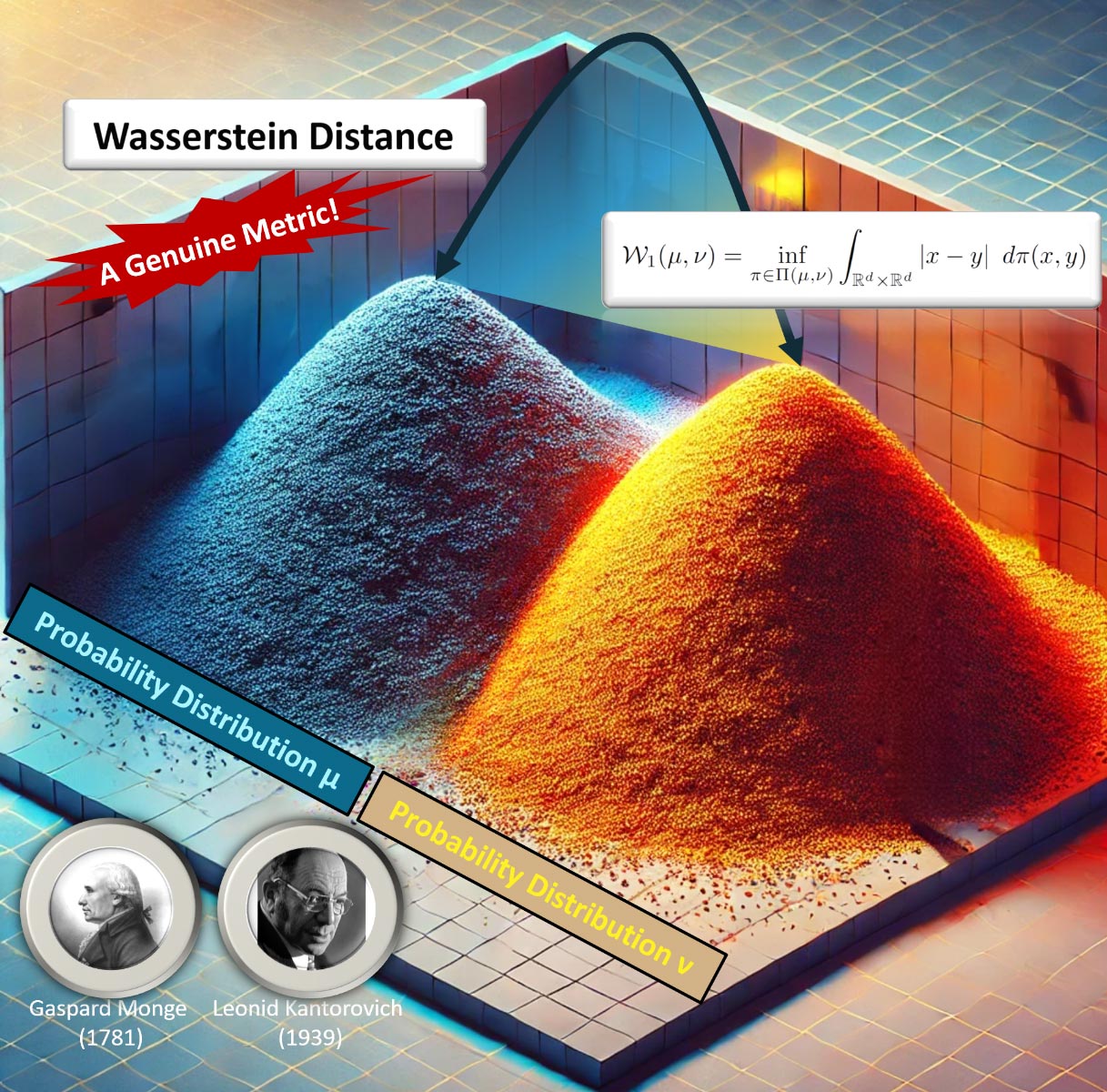
An exciting fusion of climate science, mathematics, and meteorology has birthed a new method, the Wasserstein Stability Analysis, transforming our understanding of climate extremes and subtle shifts beyond average trends.
What happens when experts in vastly different disciplines — climate science, mathematics, and meteorology — come together to address a pressing question? The result is an innovative method called Wasserstein Stability Analysis (WSA), which sheds new light on the subtle dynamics of climate change.
Zhiang Xie, a climate scientist from the Southern University of Science and Technology in China, joined forces with Dongwei Chen, a mathematician at Clemson University in the U.S., and Puxi Li, a meteorologist from the Chinese Academy of Meteorological Sciences. Their interdisciplinary approach has transformed how we study climate change, offering a fresh perspective on extreme events and shifts in probability distributions.
Their groundbreaking research was recently published in Advances in Atmospheric Sciences.
Advancing Beyond Averages in Climate Study
“Most of the time, climate studies focus on average temperatures or trends,” explains Zhiang Xie. “But we wanted to go deeper—beyond the averages—and look at how extreme events and other subtle patterns are changing.”
This curiosity led the team to adopt Wasserstein distance, a mathematical tool originally designed to measure the distance between probability distributions. “It’s like using a magnifying glass on the data,” says Dongwei Chen. “We’re not just looking at what’s typical; we’re digging into the rare and the extreme.”
Uncovering Hidden Climate Patterns
By applying their new WSA method to the 21st-century climate warming slowdown, the researchers uncovered a La Niña-like temperature shift in the equatorial eastern Pacific—something traditional methods had overlooked.
“This was a huge moment for us,” notes Zhiang Xie. “It’s exciting to see how combining mathematics with meteorology can reveal things we didn’t even know we were missing. For example, we also discovered how melting sea ice in the Arctic is loosening its grip on extreme warm events.”
Driving Innovation Through Diversity
The researchers credit their findings to their diverse backgrounds. “We all brought something unique to the table,” says Chen. “For me, it was about applying mathematical theory to real-world problems. For Zhiang and Puxi, it was about translating those findings into meaningful climate science.”
Li adds, “When you have experts from different disciplines working together, the questions themselves change. It’s not just, ‘What is the mean temperature doing?’ but, ‘How are extreme events evolving, and why does it matter?’ That’s the kind of innovation you get from collaboration.”
Exploring New Frontiers in Climate Science
The team’s WSA method opens up new possibilities for understanding the dynamics of climate change, particularly extreme weather events and threshold-specific shifts. “This is just the beginning,” says Li. “We’re now looking at how physical processes drive these changes in probability distributions, which could help us address the bigger challenges posed by climate change.”
Interdisciplinary collaborations like this provide new ways of approaching complex challenges, offering valuable insights into how we study and respond to one of humanity’s most urgent issues — climate change.
Reference: “Discovering Climate Change during the Early 21st Century via Wasserstein Stability Analysis” by Zhiang Xie, Dongwei Chen and Puxi Li, 28 December 2024, Advances in Atmospheric Sciences.
DOI: 10.1007/s00376-024-3324-6
Never miss a breakthrough: Join the SciTechDaily newsletter.
Follow us on Google and Google News.
3 Comments
“It’s not just, ‘What is the mean temperature doing?’”
Actually, we don’t even know that because, as I remarked elsewhere recently, we average the medians (actually mid-range) of the daily extremes. While other analyses have demonstrated that the diurnal lows are typically increasing more than the diurnal high temperatures, that is rarely mentioned and it is impossible to extract that information from the NASA/NOAA press releases that just discuss the annual averages of the daily or monthly mid-range temperatures. It would be more informative if Tmax and Tmin were plotted separately and the other descriptive statistics were derived for those two measurements instead of the averages.
“Panel on Climate Change Sixth Assessment Report (IPCC AR6), which illuminates the persistent warming trend in global mean surface air temperature (SAT) since the 20th century, predominantly driven by human influence.”
The first part of that sentence from the introduction of the actual paper is inaccurate. One doesn’t obtain parametric, descriptive statistics from the mid-range value derived from from the daily high and low temperatures. One loses information about the standard deviation of the daily temperatures when there are only two samples. Under the best of circumstances, those two temperatures don’t occur at the same time every day. In the worst-case, with a cold front moving across the recording station, the times of day could be reversed, meaning that the pre-dawn could be warmer than the mid-day temperature. The historical temperature record really isn’t fit for climatological analyses.
The second claim, about anthropogenic CO2 being the causative factor for the apparent warming, is commonly accepted, but the support for it is tenuous, at best.
When you rely on others to tell you what to think, ya got a big chance of the big flop-ola.
It turns out every single one of us can do all thinking – if we just do it ourselves. ‘Cause if ya don’t, you don’t.
If you lift your own weight, you get strong, if you let some other source do the lifting, you atrophy. Unfortunately, this is RULE NUMBER ONE. There are no other rules.