
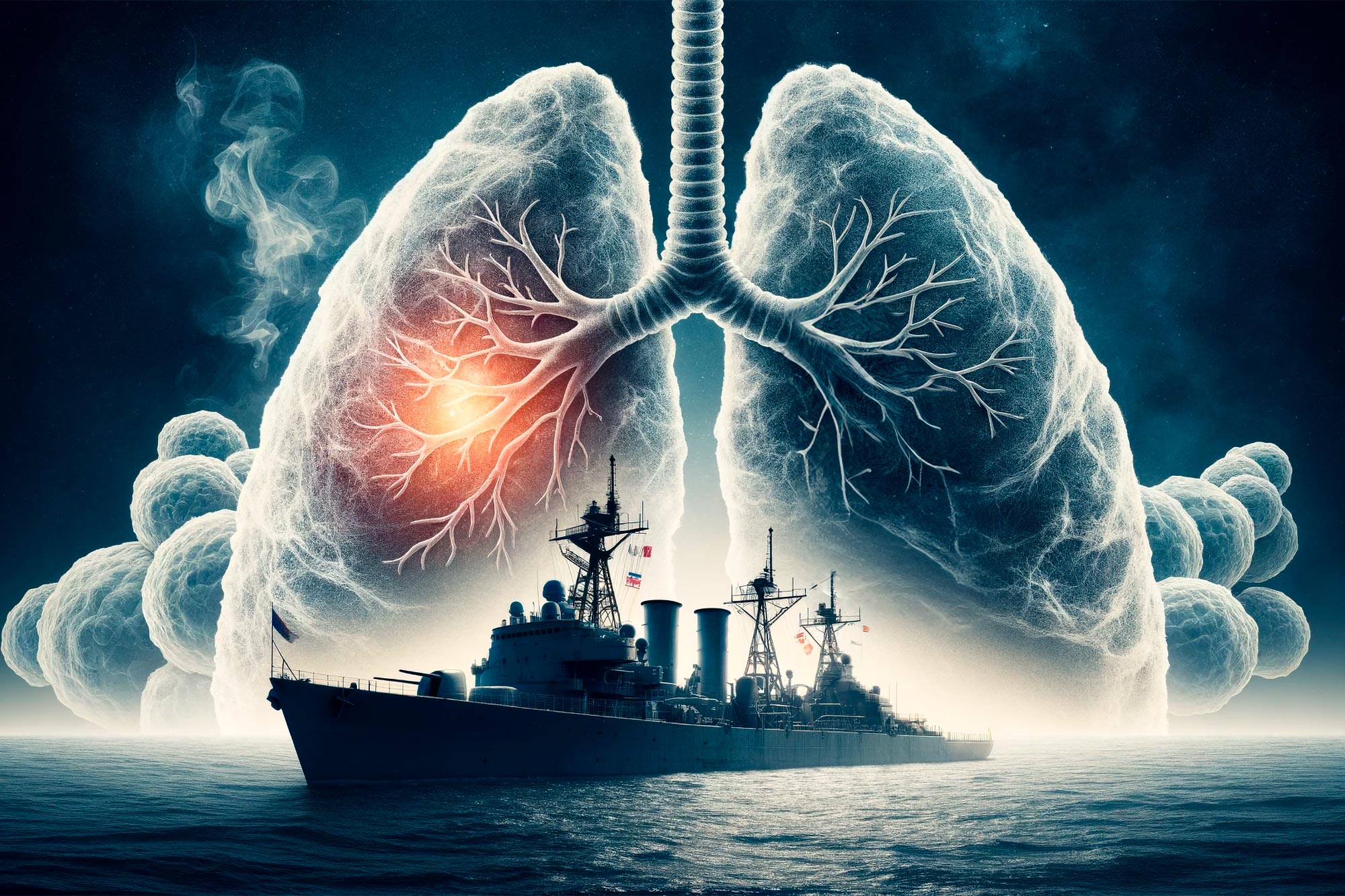
Research shows increased lung cancer rates in British and Australian naval personnel due to asbestos exposure, highlighting the ongoing risks of asbestos and the need for strict protective measures.
A University of Adelaide and Oxford University study has discovered asbestos exposure led to a higher incidence of asbestos-related lung cancers in British and Australian naval personnel than in other armed forces.
The data were collected from 30,085 United Kingdom and Australian personnel who served in the ’50s and ’60s, a time when asbestos-containing materials were present in British and Australian naval vessels.
Link Between Asbestos and Lung Cancer
Three of the four cohorts had previously been studied by the University of Adelaide and the UK Health Security Agency to identify the effects of radiation exposure from British nuclear testing; however, a raised incidence of mesothelioma, a cancer strongly linked to asbestos exposure, was seen in naval personnel in all cohorts.
The University of Adelaide’s Dr. Richie Gun and Oxford University’s Dr. Gerry Kendall were prompted by this finding to examine the dataset for the occurrence of lung cancers, which can also arise from asbestos exposure.

The fourth cohort was Australian veterans of the Korean War, which had been studied by the Australian Department of Veterans Affairs and the Australian Institute of Health and Welfare.
“We found the lung cancer rate was higher overall in naval personnel than in the other armed services, and, while smoking remains the dominant cause of lung cancer, it is unlikely the excess could be explained by a higher smoking rate in the navy,” Dr. Gun said.
Asbestos Exposure: A Major Concern
“Although actual measurements of airborne asbestos levels were not available, and estimates are difficult, we have concluded that the higher lung cancer rate in sailors was most probably caused by onboard asbestos exposure.
“This conclusion was strengthened by the occurrence of deaths in sailors from asbestosis, a condition which is non-cancerous but is nevertheless disabling and potentially fatal.”
The researchers have estimated that the proportion of lung cancers related to onboard asbestos exposure was of the order of 27 percent in Australian seamen and 12 percent in British seamen.
Continuing Risks of Asbestos
While there is a ban on imports and strict regulatory control of asbestos-containing materials in Australia, they still pose a risk to workers and some householders. There were 142 cases of asbestosis and 111 asbestosis deaths in 2021-2022 reported in the New South Wales Dust Diseases Register.
Dr. Gun said the effects of asbestos exposure are likely being underestimated unless lung cancer is considered alongside mesothelioma and asbestosis.
“Although it remains true that smoking causes most lung cancers, other agents such as asbestos can contribute to the incidence of cancer in an exposed population,” he said.
“Moreover, we know from other studies that the combination of smoking and asbestos exposure has an enhanced influence on lung cancer risk; this interactive effect would have contributed to the observed lung cancer excess.”
The discovery of a link between asbestos exposure and a higher incidence of lung cancer is a timely reminder of the need for protections against exposure to other harmful airborne dusts.
“Strict control measures are required to protect workers potentially exposed not only to asbestos but to other hazardous dusts, such as dust from engineered stone now installed in many kitchens,” said Dr. Gun.
Reference: “Asbestos-related cancer in naval personnel: findings from participants in the British nuclear tests 1952–1967” by Richard T. Gun, and Gerry M. Kendall, 14 November 2023, Scientific Reports.
DOI: 10.1038/s41598-023-44847-4
Never miss a breakthrough: Join the SciTechDaily newsletter.
Follow us on Google and Google News.