
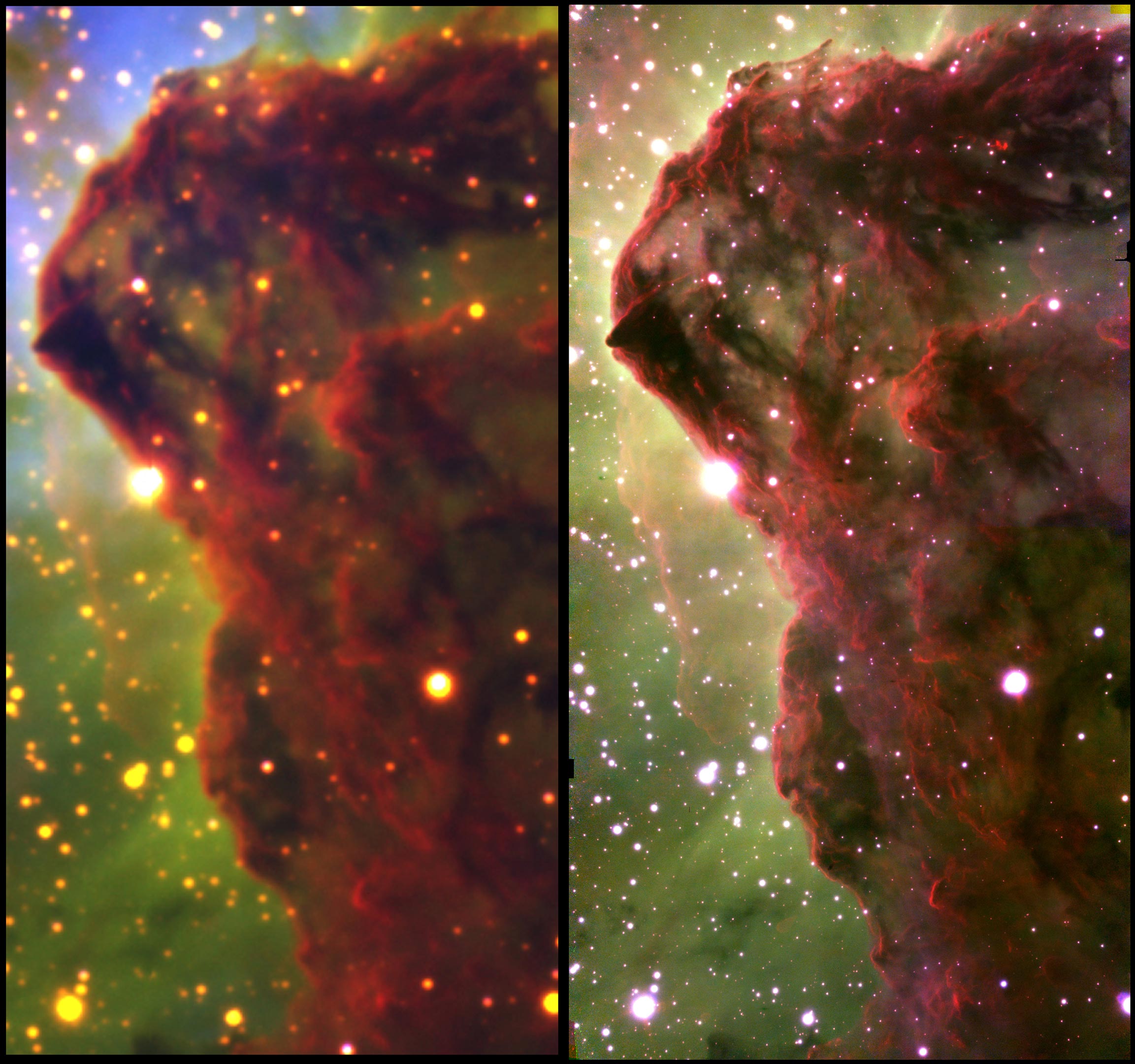
Sharpness of Gemini South’s star-forming image matches expected resolution of Webb Space Telescope.
NASA’s James Webb Space Telescope is still more than a year from launching, but the Gemini South telescope in Chile has provided astronomers a glimpse of what the orbiting observatory should deliver.
Using a wide-field adaptive optics camera that corrects for distortion from Earth’s atmosphere, Rice University’s Patrick Hartigan and Andrea Isella and Dublin City University’s Turlough Downes used the 8.1-meter (26.6-foot) telescope to capture near-infrared images of the Carina Nebula with the same resolution that’s expected of the Webb Telescope.
Hartigan, Isella, and Downes describe their work in a study published online this week in Astrophysical Journal Letters. Their images, gathered over 10 hours in January 2018 at the international Gemini Observatory, a program of the National Science Foundation’s NOIRLab, show part of a molecular cloud about 7,500 light-years from Earth. All stars, including Earth’s sun, are thought to form within molecular clouds.
“The results are stunning,” Hartigan said. “We see a wealth of detail never observed before along the edge of the cloud, including a long series of parallel ridges that may be produced by a magnetic field, a remarkable almost perfectly smooth sine wave, and fragments at the top that appear to be in the process of being sheared off the cloud by a strong wind.”
The images show a cloud of dust and gas in the Carina Nebula known as the Western Wall. The cloud’s surface is slowly evaporating in the intense glow of radiation from a nearby cluster of massive young stars. The radiation causes hydrogen to glow with near-infrared light, and specially designed filters allowed the astronomers to capture separate images of hydrogen at the cloud’s surface and hydrogen that was evaporating.

An additional filter captured starlight reflected from dust, and combining the images allowed Hartigan, Isella, and Downes to visualize how the cloud and cluster are interacting. Hartigan has previously observed the Western Wall with other NOIRLab telescopes and said it was a prime choice to follow up with Gemini’s adaptive optics system.
“This region is probably the best example in the sky of an irradiated interface,” he said. “The new images of it are so much sharper than anything we’ve previously seen. They provide the clearest view to date of how massive young stars affect their surroundings and influence star and planet formation.”
Images of star-forming regions taken from Earth are usually blurred by turbulence in the atmosphere. Placing telescopes in orbit eliminates that problem. And one of the Hubble Space Telescope’s most iconic photographs, 1995’s “Pillars of Creation,” captured the grandeur of dust columns in a star-forming region. But the beauty of the image belied Hubble’s weakness for studying molecular clouds.
“Hubble operates at optical and ultraviolet wavelengths that are blocked by dust in star-forming regions like these,” Hartigan said.
Because near-infrared light penetrates the outer layers of dust in molecular clouds, near-infrared cameras like the Gemini South Adaptive Optics Imager can see what lies beneath. Unlike traditional infrared cameras, Gemini South’s imager uses “a mirror that changes its shape to correct for shimmering in our atmosphere,” Hartigan said. The result: photos with roughly 10 times the resolution of images taken from ground-based telescopes that don’t use adaptive optics.
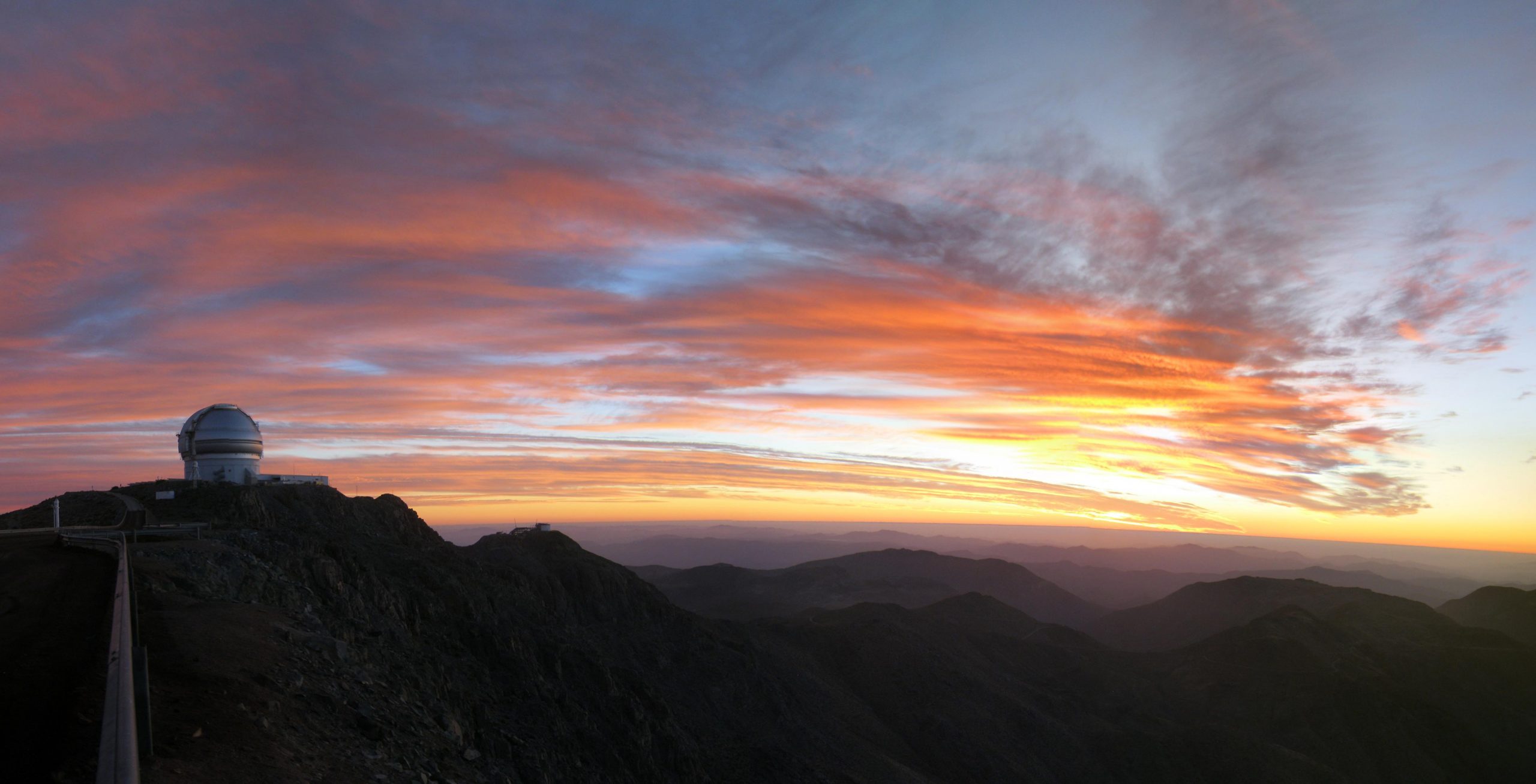
But the atmosphere causes more than blur. Water vapor, carbon dioxide, and other atmospheric gases absorb some parts of the near-infrared spectrum before it reaches the ground.
“Many near-infrared wavelengths will only be visible from a space telescope like the Webb,” Hartigan said. “But for near-infrared wavelengths that reach Earth’s surface, adaptive optics can produce images as sharp as those acquired from space.”
The advantages of each technique bode well for the study of star formation, he said.
“Structures like the Western Wall are going to be rich hunting grounds for both Webb and ground-based telescopes with adaptive optics like Gemini South,” Hartigan said. “Each will pierce the dust shrouds and reveal new information about the birth of stars.”
Reference: “A JWST Preview: Adaptive-optics Images of H2, Br-γ, and K-continuum in Carina’s Western Wall” by Patrick Hartigan, Turlough Downes and Andrea Isella, 5 October 2020, The Astrophysical Journal Letters.
DOI: 10.3847/2041-8213/abac08
Hartigan is a professor of physics and astronomy at Rice. Isella is an associate professor of physics and astronomy and of Earth, environmental and planetary sciences at Rice. Downes is a professor of mathematics and astrophysics at Dublin City University.
The research was supported by Rice University.
Never miss a breakthrough: Join the SciTechDaily newsletter.
Follow us on Google and Google News.
1 Comment
Thanks for your consideration in the shadow of covid 19, in the time of horrible death toll of humans.By looking at the universe vivid color pictures taken by your colleagues, we feel tranquility and peace, and for a while, we forget our real lifestyle at the moment. Yours truly, MOHSEN KOSARKHAH