
Close Menu
    Facebook X (Twitter) Instagram
    SciTechDaily
    • Biology
    • Chemistry
    • Earth
    • Health
    • Physics
    • Science
    • Space
    • Technology
    Facebook X (Twitter) Pinterest YouTube RSS
    SciTechDaily
    Home»Space»Hinode Satellite Views Solar Eclipse
    Space

    Hinode Satellite Views Solar Eclipse

    By Harvard-Smithsonian Center for AstrophysicsOctober 28, 20142 Comments3 Mins Read
    Facebook Twitter Pinterest Telegram LinkedIn WhatsApp Email Reddit
    Share
    Facebook Twitter LinkedIn Pinterest Telegram Email Reddit
    Hinode Satellite Captures Footage of Solar Eclipse
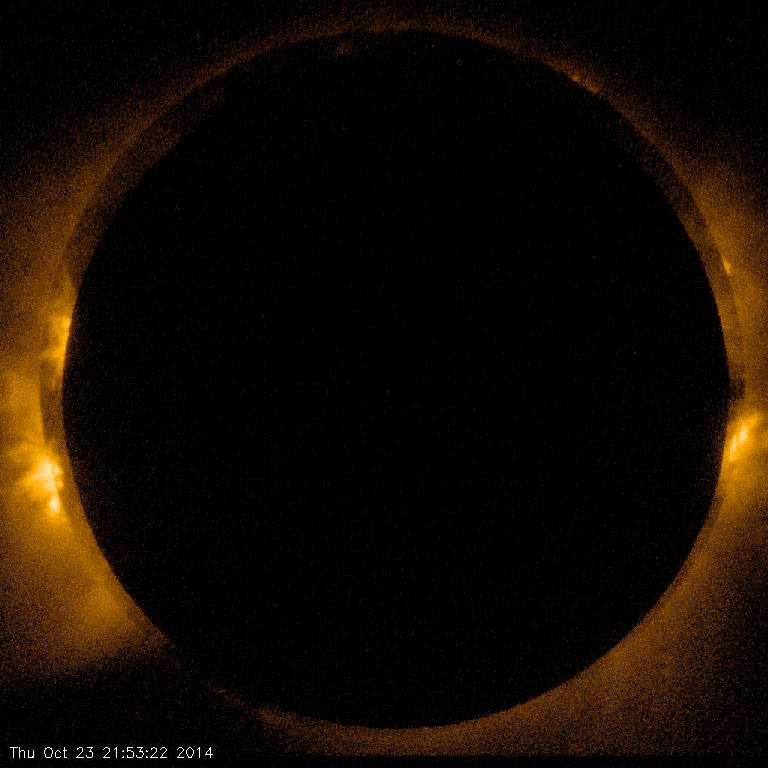
    On October 23rd, while North America was witnessing a partial eclipse of the sun, the Hinode spacecraft observed a “ring of fire” or annular eclipse from its location hundreds of miles above the North Pole. This image was taken by the X-ray Telescope. Credit: NASA/Hinode

    The Hinode satellite was able to capture x-ray footage of last week’s solar eclipse.

    Cambridge, Massachusetts – The moon passed between the Earth and the sun on Thursday, October 23. While avid stargazers in North America looked up to watch the spectacle, the best vantage point was several hundred miles above the North Pole.

    The Hinode spacecraft was in the right place at the right time to catch the solar eclipse. What’s more, because of its vantage point Hinode witnessed a “ring of fire” or annular eclipse.

    An annular eclipse occurs when the moon passes directly in front of the sun but doesn’t cover it completely because the moon appears too small. (The apparent size of the moon depends on its distance from Earth or, in this case, the spacecraft.) About one-third of all solar eclipses are annular.

    “This is only the second annular eclipse Hinode has witnessed since it launched in 2006,” says astrophysicist Patrick McCauley of the Harvard-Smithsonian Center for Astrophysics.

    The XRT was developed and built by the Smithsonian Astrophysical Observatory and the Japan Aerospace Exploration Agency. Hinode’s X-ray Telescope is the highest resolution solar X-ray telescope ever flown.

    The XRT collects X-rays emitted from the sun’s corona – the hot, tenuous outer layer that extends from the sun’s visible surface into the inner solar system. Gas in the solar corona reaches temperatures of millions of degrees. The energy source that heats the corona is a puzzle. The sun’s surface is only 10,000 degrees Fahrenheit (5,500 degrees Celsius), while the corona is more than 100 times hotter.

    “We are very interested in studying solar flares,” adds McCauley. “Flares are most dramatic in X-rays and we’re using the X-ray Telescope to better understand the physical mechanisms that drive flares so that they might someday be forecasted.”

    A question-and-answer with McCauley is available on the Smithsonian Science website.

    Headquartered in Cambridge, Massachusetts, the Harvard-Smithsonian Center for Astrophysics (CfA) is a joint collaboration between the Smithsonian Astrophysical Observatory and the Harvard College Observatory. CfA scientists, organized into six research divisions, study the origin, evolution, and ultimate fate of the universe.


    Never miss a breakthrough: Join the SciTechDaily newsletter.
    Follow us on Google and Google News.

    Astronomy Harvard-Smithsonian Center for Astrophysics Hinode Sun
    Share. Facebook Twitter Pinterest LinkedIn Email Reddit

    Related Articles

    In 1999 Mysterious Finger-Like Features Were Spotted on the Sun – Now Scientists Have an Explanation

    Spacecraft Enters the Sun’s Blistering Hot Corona for the First Time in History

    A “Living Catalog” of Solar Stream Interactions

    NASA’s IRIS Satellite Observes Large Solar Flare

    Sun’s Loops are Tapered, Wider at the Top and Narrower at the Ends

    New Observations Help Astronomers Learn How Young Stars Accrete Material and Grow

    TW Hydrae Provides Insight About the Birth of Our Sun

    New Model Advances the Understanding of How Solar Wind Works

    Earth in Motion and the Galaxies Around it

    2 Comments

    1. Steve Johnson on October 28, 2014 10:45 am

      magnetic field distortion viewed inside-alto-picture of moon-surface, due to change in vector-field-shift of poles

      Reply
    2. Steve Johnson on October 28, 2014 10:56 am

      viewed-from pure logic, within ape-primate-human-quantum, emergent-mind
      MISSING-LINK!!! the yeti has big-footed it bye-bye 4D OR NOT 4D….2B!!!

      Reply
    Leave A Reply Cancel Reply

    • Facebook
    • Twitter
    • Pinterest
    • YouTube

    Don't Miss a Discovery

    Subscribe for the Latest in Science & Tech!

    Trending News

    Bone-Strengthening Discovery Could Reverse Osteoporosis

    Scientists Uncover Hidden Trigger Behind Stem Cell Aging

    Scientists Find Way to Reverse Fatty Liver Disease Without Changing Diet

    Could Humans Regrow Limbs? New Study Reveals Promising Genetic Pathway

    Scientists Reveal Eating Fruits and Vegetables May Increase Your Risk of Lung Cancer

    Scientists Reverse Brain Aging With Simple Nasal Spray

    Scientists Uncover Potential Brain Risks of Popular Fish Oil Supplements

    Scientists Discover a Surprising Way To Make Bread Healthier and More Nutritious

    Follow SciTechDaily
    • Facebook
    • Twitter
    • YouTube
    • Pinterest
    • Newsletter
    • RSS
    SciTech News
    • Biology News
    • Chemistry News
    • Earth News
    • Health News
    • Physics News
    • Science News
    • Space News
    • Technology News
    Recent Posts
    • This Student Recreated the Universe in a Bottle. What She Discovered Could Help Reveal How Life Started on Earth
    • Alzheimer’s Symptoms May Start Outside the Brain, Study Finds
    • Cancer’s Secret Weapon? Scientists Reveal How Tumors “Learn” To Survive Treatment
    • Millions Take This Popular Supplement – Scientists Discover a Concerning Link to Heart Failure
    • What Makes Rubber So Strong? Scientists Finally Solve 100-Year-Old Mystery
    Copyright © 1998 - 2026 SciTechDaily. All Rights Reserved.
    • Science News
    • About
    • Contact
    • Editorial Board
    • Privacy Policy
    • Terms of Use

    Type above and press Enter to search. Press Esc to cancel.